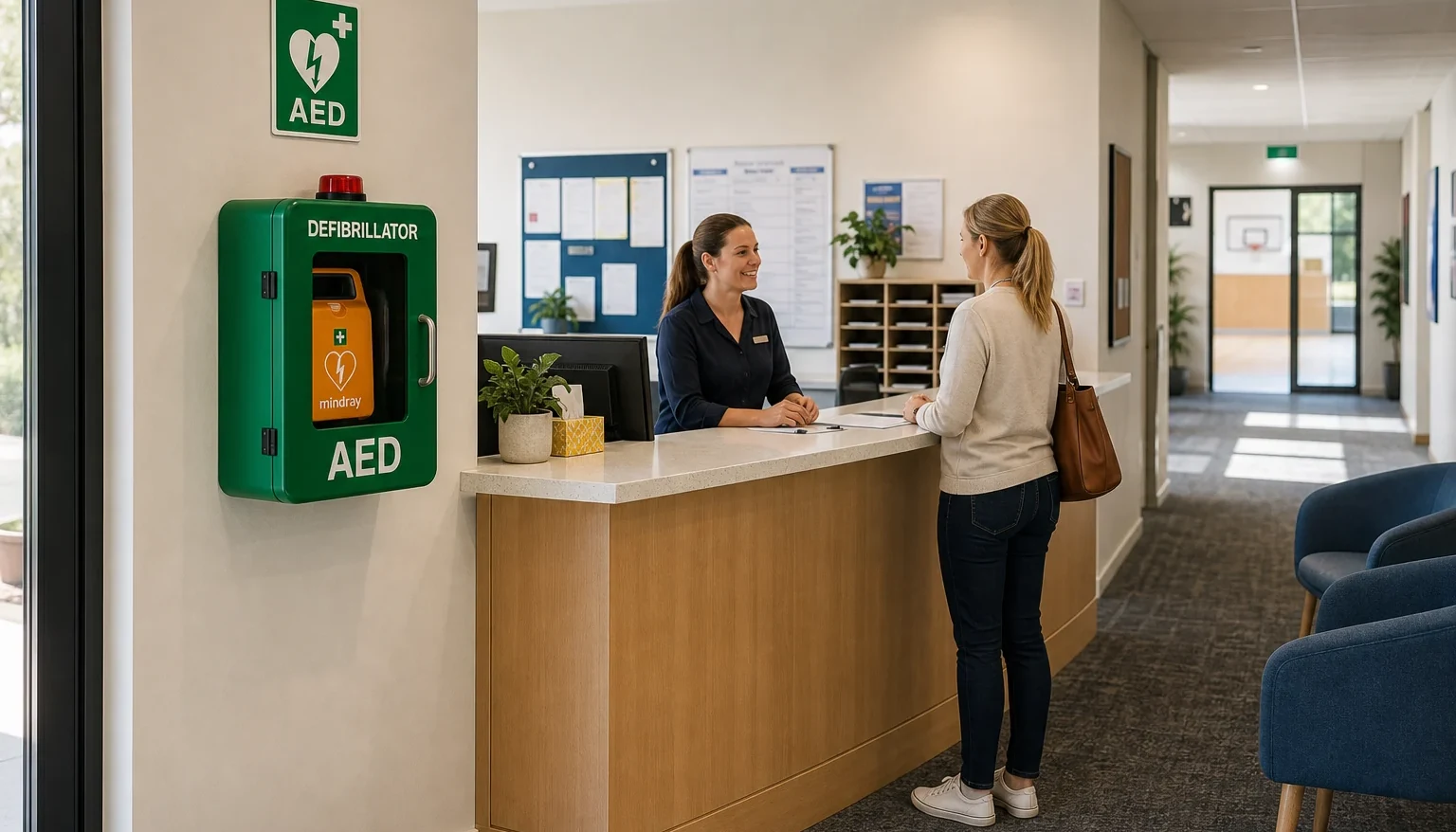
If you run a public school in the ACT, the question of whether you have a defibrillator has at least been on the territory government’s radar — about 38 of the ACT’s 89 public schools had one as of late 2020. If you run an independent or Catholic school, you’re outside that conversation entirely. There’s no program counting your devices, no directorate making the call for you. The decision is yours, school by school. This is the case for making it.
No mandate — in any ACT school
Let’s set the legal baseline first, because it’s easy to assume schools are a special case. They aren’t, not in the ACT.
The ACT has no AED-specific legislation. The closest it came was a 2022 Legislative Assembly motion from Shadow Health Minister Leanne Castley MLA, which sought to make AEDs mandatory in ACT government schools, workplaces and buses. The government amended the motion to remove the mandate, committing only to “support” greater availability. No Bill has followed. So there’s no law requiring an AED in any ACT school — public, independent or Catholic.
What applies instead is the general first aid duty under the Work Health and Safety Act 2011 (ACT), with practical detail in the territory’s First Aid in the Workplace Code of Practice (2020). The Code — the Safe Work Australia model, adopted in the ACT — treats AEDs as a discretionary, risk-assessed consideration, flagging three trigger factors: risk of electrocution, likely delay in ambulance response, and large numbers of people present.
For a school, the third factor does the heavy lifting. A school is a workplace with a large, fluctuating population on site every day.
Why independent and Catholic schools are on their own
Public schools sit under the Education Directorate, which can run a coordinated AED rollout if it chooses to (it has, partially). Independent and Catholic schools each govern themselves. There’s no central body tracking which of them have AEDs, no shared program, and no directorate decision to lean on.
That cuts both ways. It means nobody’s going to install one for you. It also means you’re free to make a sensible, fast decision without waiting for a system-wide policy — and that you carry the full WHS duty for your own site without a directorate standing behind you.
Where the real risk sits in a school
It’s worth being honest about the risk profile, because the instinctive objection is “our students are children — cardiac arrest is an adult problem.” Mostly true, and the case for school AEDs is stronger than that objection assumes for a few reasons.
The adults far outnumber the headline. A school isn’t just students. It’s teachers and support staff (an ageing workforce in many schools), parents at drop-off and pick-up, grandparents at assemblies and concerts, tradespeople, delivery drivers, and spectators at weekend sport. On a busy event day a school might have several hundred adults on the grounds. Sudden cardiac arrest in that population is exactly the foreseeable risk the WHS Code has in mind.
Community use extends the hours and the crowd. Many independent and Catholic schools hire out halls, gyms, ovals and pools to community groups outside school hours — sport, scouts, church services, fitness classes, events. Every one of those brings adults onto your site under your duty of care, often when fewer staff are around.
Young sudden cardiac arrest is rare but real. Undiagnosed heart conditions and commotio cordis (a blow to the chest at the wrong instant in the heartbeat, which can happen in contact and ball sports) do cause cardiac arrest in young, healthy people. It’s uncommon. But when it happens, an AED within reach is the difference, and a school running competitive sport is the setting where it’s most likely.
Put together, a school is a high-occupancy site, often with extended community hours, where the people most at risk — adults — are present in numbers every single day. The WHS trigger factor lands cleanly.
A sensible school AED program
For a typical independent or Catholic school campus:
- Start with the front office or main administration building. It’s staffed all day, central, and the natural place people head in an emergency. That’s your first device.
- Cover the sports facilities. A second AED at the gym, sports hall or oval pavilion covers the highest-exertion setting and the weekend community-sport crowd, who may be on site when the front office is closed. If your sport happens away from the main buildings, this device shouldn’t be a long run from the field.
- Think about reach on a spread-out campus. Schools sprawl. If getting from a far oval or a separate senior campus to the nearest AED takes several minutes, that’s several minutes the patient doesn’t have. Match the number and placement of devices to how far apart your buildings actually are.
- Mount them accessibly. 1.2–1.4 m from the floor, Australian Resuscitation Council AED symbol on the cabinet, clear signage. Don’t lock the device away — it needs to be grabbed in seconds. For an outdoor pavilion or oval cabinet in Canberra, an IP-rated weatherproof cabinet handles the cold and the elements.
- Train widely. AEDs guide any user through every step and need no certification, but staff confidence matters. Fold AED use into your regular first aid training, and make sure relief staff and community-hire groups know where the devices are.
Registering an AED in the ACT
This is where the ACT differs from most states. There’s no government or ambulance-run AED registry. ACT AED locations are held through the St John Ambulance Australia national register at aed.stjohn.org.au, which surfaces through the St John First Responder app, and through the volunteer StreetBeat outdoor-cabinet program.
For a school, register each device on the St John national register. It’s free, takes about ten minutes per device, and puts the AED on the de facto ACT map that responders use. Note that it isn’t confirmed ACT Triple Zero call-takers will automatically direct callers to your device the way SA’s register does — so registering is about the responder network and the public app, not a guaranteed 000 link. Register anyway; the visibility is the value.
What about funding?
Honestly, the ACT funding picture for schools is thin. There’s no dedicated ACT Government AED grant. The closest pathway is the Sport and Recreation Club Enhancement Program, which is aimed at sporting clubs rather than schools and doesn’t explicitly list AEDs as eligible — so it’s a long shot for a school, and you’d need to confirm eligibility with ACT Sport and Recreation directly. The practical expectation for an independent or Catholic school is to self-fund the program as part of your duty-of-care budget, the way you’d fund fire safety equipment.
Where SafePulse fits
We supply, install and maintain AEDs across the ACT, and we handle the St John register registration and the ongoing maintenance — pads and batteries replaced before expiry, six-monthly checks. For a multi-building campus we’ll work through placement so the devices actually cover your front office, your sports facilities and your far corners within the time that matters.
The voluntary position here follows from the territory-wide one in do ACT commercial buildings need an AED in 2026. If a school does install one, the absence of a government register affects how it gets found — see the ACT has no government AED registry. Our ACT AED page has more.
If your school is weighing up an AED program and you want a clear scope and a quote you can put to your board or finance committee, get in touch at safepulse.com.au/act/.