Body corporate-managed office buildings make up a meaningful share of Canberra’s commercial market. They sit in the town centres — Civic, Barton, Belconnen, Tuggeranong, Gungahlin — and across the smaller commercial precincts in between. If you’re on the executive committee of a body corporate or you manage one, this is the practical AED brief that’s been missing from the ACT conversation. No Act, no mandate, but a real WHS duty and a Canberra-specific layout problem worth solving.
The ACT legal floor
Australia’s Capital Territory has no AED-specific Act. A search of the ACT Legislation Register and the Summary of Bills (Eleventh Assembly, No 17, 27 March 2026) returns no Acts, regulations or pending Bills referring to defibrillators or AEDs.
The closest the ACT has come was a 2022 Legislative Assembly motion by Shadow Health Minister Leanne Castley MLA seeking to mandate AEDs in ACT government schools, workplaces and ACTION buses. The Labor–Greens government amended the motion to strip the mandate, leaving only a commitment to “support” greater AED availability. Per Hansard:
“the government … is not supportive of the legislation mandate for AEDs in all government facilities.”
That was the high-water mark for AED legislation in the ACT, and the government rejected it. Nothing has come back to the Assembly since.
What does apply to your body corporate office building is the Work Health and Safety Act 2011 (ACT) and the Work Health and Safety (First Aid in the Workplace Code of Practice) Approval 2020 — the ACT-adopted Safe Work Australia model code. As a Person Conducting a Business or Undertaking, the body corporate has a general first aid duty for the common areas it controls.
The Code treats AEDs as a discretionary, risk-assessed consideration. The trigger factors it names are familiar:
- Risk of electrocution to workers
- Likely delay in ambulance response
- Large numbers of workers or members of the public present
Factor 3 is the dominant one for a commercial office building. Factor 2 is relevant on weekends and after hours when the ACT Ambulance Service response can stretch. Factor 1 applies to maintenance and electrical contractors but isn’t the headline.
Who is the PCBU in a body corporate building
This question gets asked more often in the ACT than elsewhere because Canberra’s office stock is heavy with strata-titled and body corporate-managed buildings.
For an AED program, the practical division is the same as it is in commercial multi-tenancy buildings elsewhere:
- The body corporate (the owners corporation) is the PCBU for the common areas — main lobby, lifts, lift lobbies on each floor, plant rooms, end-of-trip facilities, basement carpark, shared corridors outside the demised tenancies. Body corporate staff (caretaker, building manager, cleaners) and visitors to the building experience these common areas
- Each tenant is the PCBU for their own demised premises. The tenant has its own first aid duty inside its tenancy
So the body corporate’s responsibility for an AED program runs to the common areas. The device that the building installs serves the body corporate’s duty for its own staff and contractors, the duty toward visitors moving through the building, and — as a practical matter — provides a building-wide resource available to tenants who experience an event inside their tenancy and run out into the corridor.
This is worth being explicit about in body corporate communications. The committee isn’t deciding whether to provide an AED for each tenant — tenants run their own programs inside their tenancies. The committee is deciding whether to provide one in the common areas. That’s a smaller, cleaner question.
The Canberra-specific layout problem
Canberra body corporate buildings are typically lower-rise than CBD towers — six to twelve storeys is common across Civic, Barton, Belconnen, Tuggeranong and Gungahlin — with central lift cores and a mix of tenancies per floor. A few things that shape AED placement:
Town-centre commercial buildings vary in foot traffic
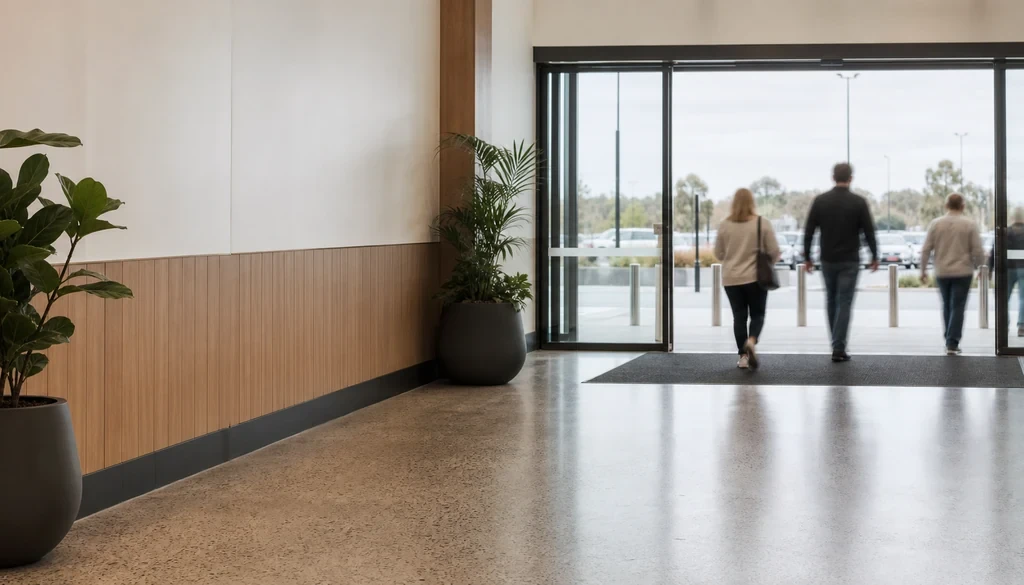
Civic and Barton skew toward Commonwealth tenants and professional services (legal, accounting, consulting). Belconnen, Tuggeranong and Gungahlin are mixed — government, professional services, retail-adjacent, sometimes medical or allied health on the ground floor. The first AED location should be the highest-traffic public area, which is almost always the main ground-floor lobby.
Multi-entry buildings
Many Canberra office buildings have a primary street-facing entrance and a secondary entrance from the carpark or rear laneway. The AED location should serve the main entrance; if the carpark entrance is a major after-hours route, a second device near it is worth considering for larger buildings.
After-hours access
Canberra building hours vary substantially between Commonwealth-tenanted (often 24/7 secured access) and standard commercial (business hours). The AED needs to be retrievable during the hours the building is occupied. For a building with significant Commonwealth tenancy, that may mean a device location accessible via the after-hours secure entry route, not just the main lobby
Cool climate and indoor mounting
Canberra’s seasonal range is wide but the building interiors are climate-controlled. Indoor mounting in a lift lobby or main reception area is the typical spec. Outdoor cabinet specs (IP55+, thermostatic control for direct sun) aren’t a primary concern in indoor Canberra installs
What ACT AED registry to use
This is where the ACT differs from NSW, Victoria, SA and Tasmania. The ACT does not operate a government-run or ambulance-service-run AED registry. The ACT Emergency Services Agency’s public AED page provides instructions on AED use but does not reference a registry and does not link to GoodSAM.
In practice, ACT AED locations are held through two channels:
- The St John Ambulance Australia national AED register at aed.stjohn.org.au, surfaced through the St John First Responder app
- StreetBeat (streetbeat.life) — St John Ambulance ACT’s public 24/7 outdoor AED program for Canberra suburbs, currently 32+ deployed cabinets
For a body corporate building installing an indoor AED in the common areas, registration with the St John national AED register is the route. That gets the device into the First Responder app and onto the de facto ACT AED locator map. The registration is free and takes about 10 minutes online.
Worth flagging: it isn’t currently confirmed that ACT Triple Zero call-takers will direct callers to your registered AED automatically the way SA’s SAAS register does. The St John register is the de facto ACT registry but the integration with 000 dispatch isn’t documented the way it is in other states. Register anyway — the public-facing app and the responder network is the value, even if the 000 integration is uncertain.
A sensible body corporate AED program
For a typical Canberra body corporate office building, 6–12 storeys, mixed commercial tenancy, single main lobby:
Where to put it
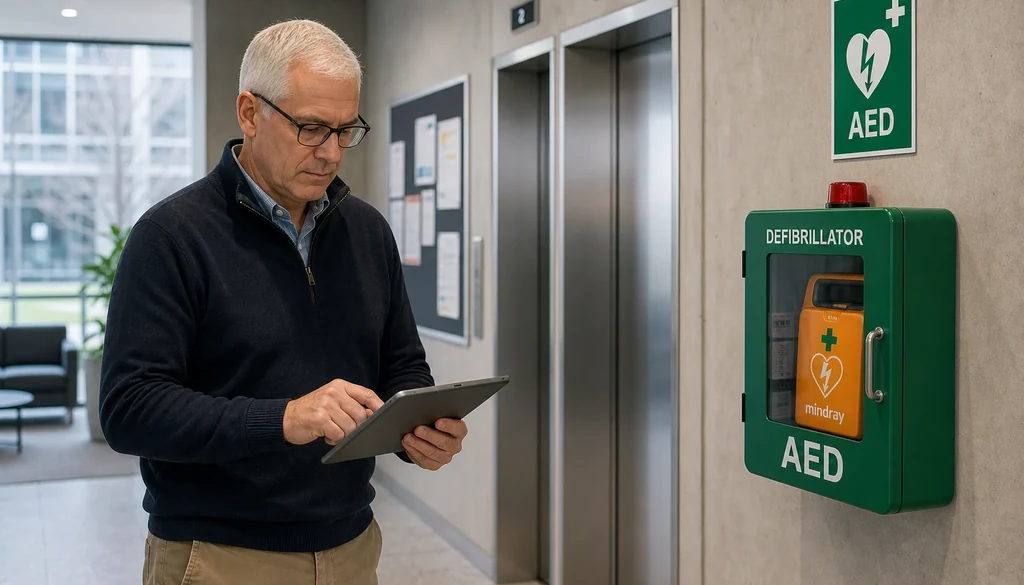
- Ground floor lobby, on the wall adjacent to the lifts at chest height (1.2–1.4 m from the floor), inside a publicly accessible cabinet
- Visible from the main entrance — someone walking in from the street should see the AED-symbol sign without searching
- For larger buildings (12 levels+) or buildings with very high foot traffic, a second device on a mid-level lift lobby
How to mount it
- Wall cabinet, 1.2–1.4 m from the floor
- Australian Resuscitation Council green-and-white AED symbol on the cabinet face
- Sign at eye level above the cabinet
- Second sign at the main entrance pointing to the AED’s location
Who’s responsible
- Building manager or caretaker as the named responsible person on the device
- Add to the building’s maintenance schedule — pads expire every 2–4 years, batteries every 4–5 years
- Train at least the building manager, the caretaker and any 24/7 security staff in CPR and AED use
Register it
- Via the St John AED register — also surfaces through the St John First Responder app
Reflect it in the body corporate documentation
- House rules / emergency response procedures should reference the AED and explain how it’s retrieved and used
- The AED is part of the building’s life safety equipment — list it alongside fire extinguishers, evacuation diagrams and emergency lighting in your building documentation
The funding question
Canberra body corporate budgets are tighter than commercial office tower budgets, and AEDs need to be justified at the AGM. A few points that come up:
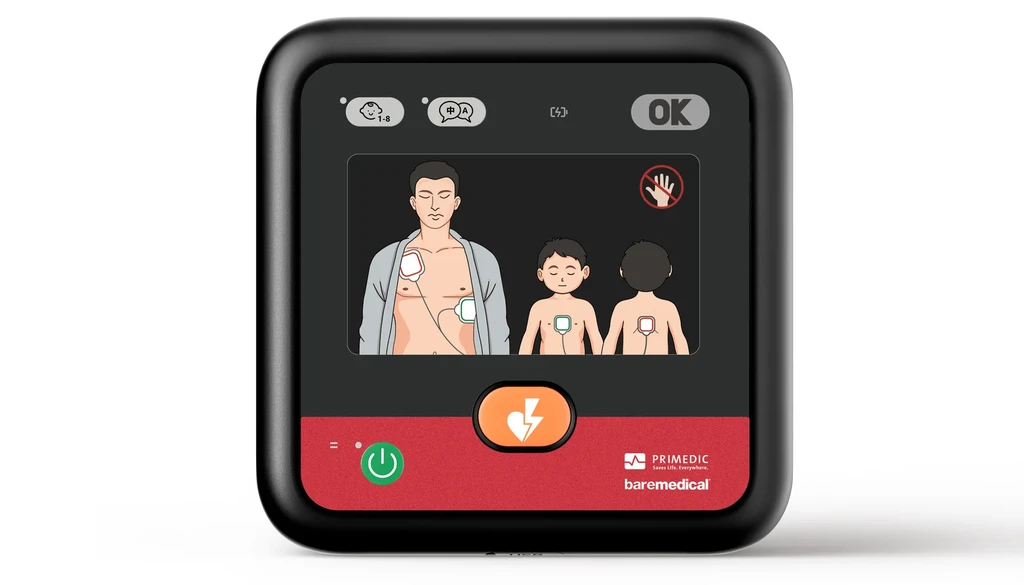
- The total program cost is small in body corporate budget terms — a Basic Install through SafePulse is $2,490 GST free, with maintenance at $40/month. Spread across the strata levy of a typical mid-size body corporate, the device adds a few dollars per lot per year
- Common-area life safety equipment is a standard body corporate expense category. AEDs fit naturally alongside fire extinguishers and evacuation diagrams
- The ACT Government does not run an AED grant program for body corporates. The Club Enhancement Program (Sport and Recreation) is sporting-club-focused, not body corporate-applicable. Plan to self-fund
What the body corporate shouldn’t claim
A few honest framings worth maintaining in body corporate communications:
- The AED isn’t “ACT compliance equipment” — there’s no ACT mandate to comply with
- The AED is best-practice common-area life safety equipment under the WHS duty, like fire extinguishers and emergency lighting
- The AED is for visitors, contractors and building staff. Tenants run their own programs inside their tenancies
- The AED doesn’t guarantee a save — it improves the odds substantially. Survival also depends on bystander CPR and time to first shock
Where SafePulse fits
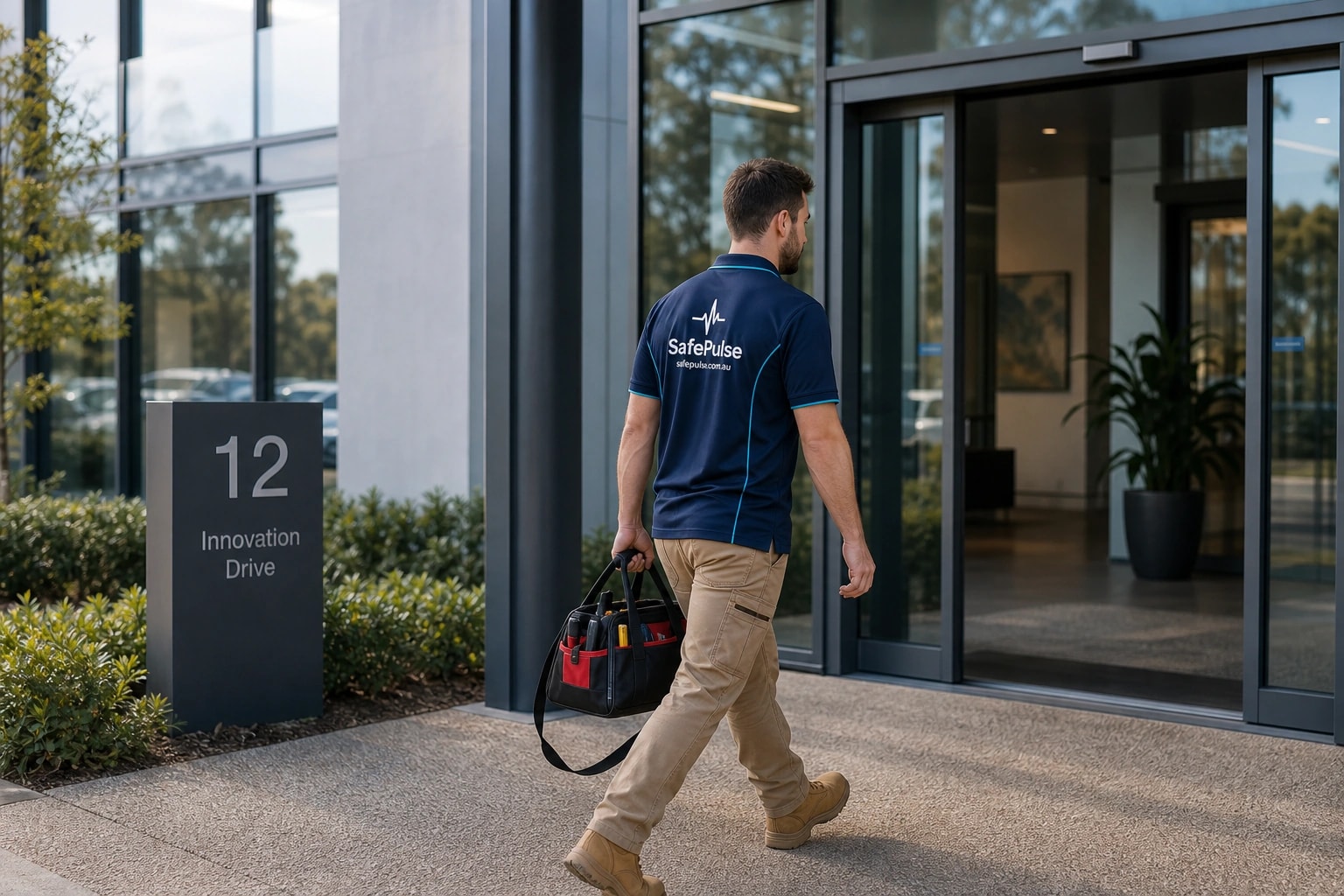
We supply, install and maintain AEDs across the ACT. We’ve worked with body corporates in Civic, Barton, Belconnen and the outer town centres. We handle the St John AED register registration as part of the install and run the six-monthly maintenance schedule.
Buildings leased to Commonwealth tenants add another layer worth understanding — AEDs in Commonwealth-government-tenanted buildings. And because the ACT has no government register, getting a device found in an emergency takes a bit more thought: the ACT has no government AED registry. More at our ACT AED page.
If you’re at the stage of putting an AED proposal in front of your body corporate committee or AGM, we can supply a one-page quote you can include in the meeting paper. Get in touch via safepulse.com.au/act/.