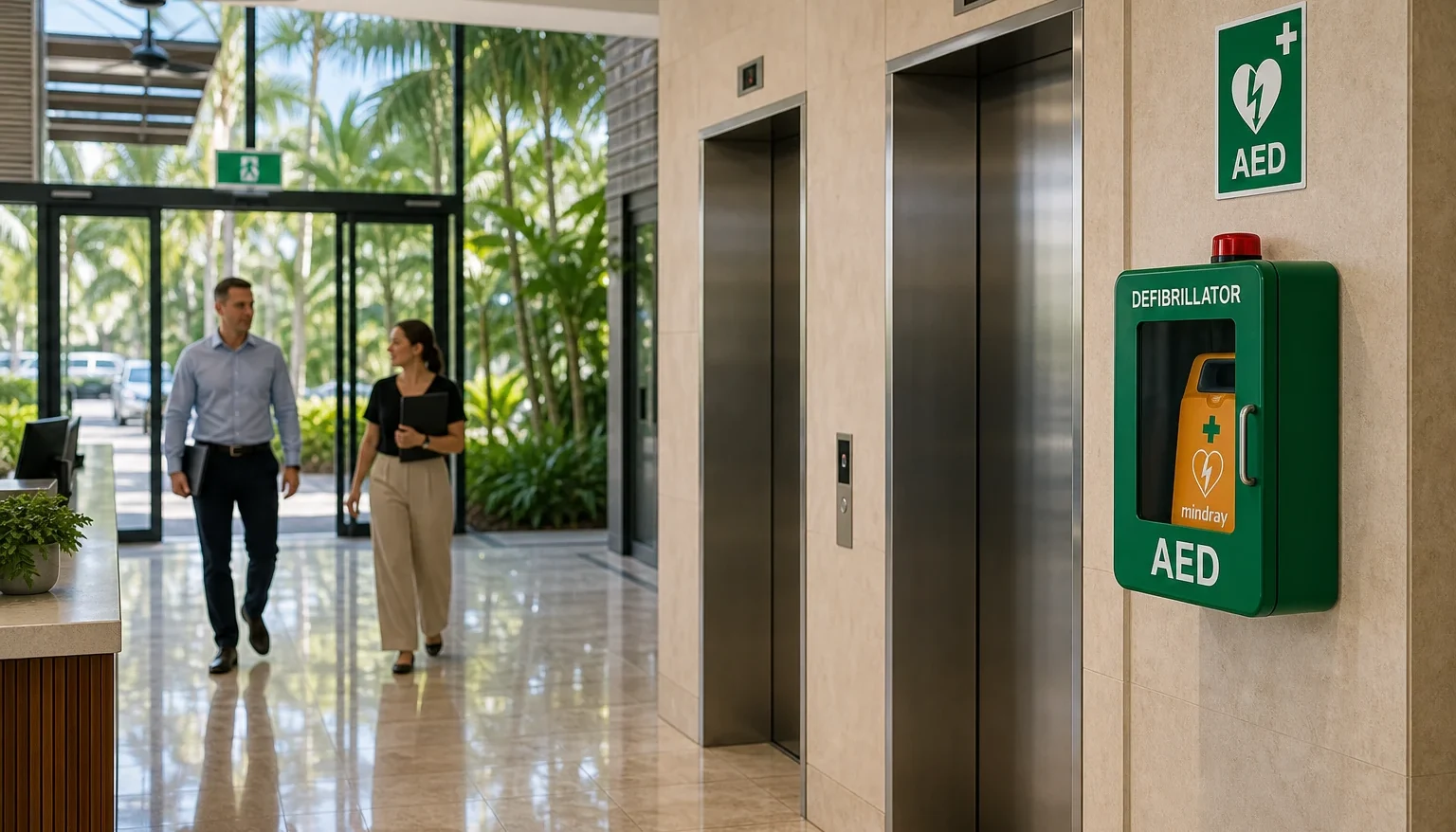
If you manage commercial buildings in Darwin or Palmerston, an AED program is one of those things that’s easy to keep putting off — there’s no law forcing it, no deadline on the calendar. But the case for one is solid, and the Top End throws in a couple of wrinkles that property managers in cooler capitals never have to think about. Here’s the practical version: what your duty actually is, where the device goes, how the heat changes things, and how registration works up here.
No NT mandate — but a real WHS duty
Start with the legal floor, because it’s where Top End AED content most often goes wrong. The Northern Territory has no AED-specific legislation, and no AED Bill has been tabled in the Legislative Assembly. There’s no requirement to install a defibrillator in an NT commercial building, and no penalty for not having one.
What you do have, as a property manager, is a general first aid duty under the Work Health and Safety (National Uniform Legislation) Act 2011 (NT). The territory’s First Aid in the Workplace Code of Practice (March 2020) gives that duty practical content. On AEDs the Code says you “should consider providing an AED if there is a risk to workers at your workplace from electrocution, if there would be a delay in ambulance services arriving at the workplace, or where there are large numbers of members of the public.”
For a Darwin or Palmerston commercial building, the “large numbers of members of the public” trigger is the one that fires. A multi-tenant office tower or a building with ground-floor retail has a steady population of workers, tenants and visitors moving through the common areas you control.
Who carries the duty in a multi-tenant building
The split is the same as it is anywhere, and worth being explicit about:
- You — the building owner or manager — are the PCBU for the common areas. Main lobby, lifts, lift lobbies, shared corridors, carpark, plant rooms, end-of-trip facilities. Your staff, contractors and every visitor to the building experience these spaces.
- Each tenant is the PCBU for their own demised premises and runs their own first aid arrangements inside their tenancy.
So your AED program runs to the common areas. The device the building installs serves your duty toward your own staff and contractors and toward the visitors moving through the building — and, as a practical matter, gives tenants a building-wide resource if someone collapses inside a tenancy and a colleague runs out for help. You’re not deciding whether to provide a device for each tenant. You’re deciding whether to provide one in the common areas. That’s a cleaner, smaller question.
The heat problem — the NT-specific wrinkle
This is the part property managers in Adelaide or Melbourne never deal with. The NT Code of Practice is explicit that an AED “should be located in an area … not exposed to extreme temperatures.” That’s not boilerplate up here — it’s a real constraint.
Most consumer-grade AEDs have an operating temperature ceiling around 50°C, and the electrode pad gel can degrade in sustained heat. In a Darwin or Palmerston build-up, an unconditioned space can sit well above what the device is rated for. So the placement rules change:
- Indoors, in the air-conditioned common areas, you’re fine. A lobby, a lift lobby, a conditioned corridor — standard indoor mounting works, and that’s where your primary device should go anyway because that’s where the foot traffic is.
- Watch the unconditioned spaces. A carpark, a loading dock, an external walkway, a plant room, a building services corridor — these can get genuinely hot, and a bare wall-mount in one of them risks cooking the device. If you need coverage there, use a proper outdoor-rated cabinet (lean toward IP56 or higher for the wet-season humidity), ideally with thermostatic control if it’s exposed to direct sun.
- Never a bare mount in direct sun or an unconditioned shed. It’s the one placement mistake the NT Code is specifically warning against.
The wet-season humidity matters too. An outdoor or semi-exposed cabinet in the Top End needs a higher IP rating than the same cabinet would in a temperate city, simply to keep moisture out across the monsoon.
A sensible program for a Darwin or Palmerston building
For a typical multi-tenant CBD office building:
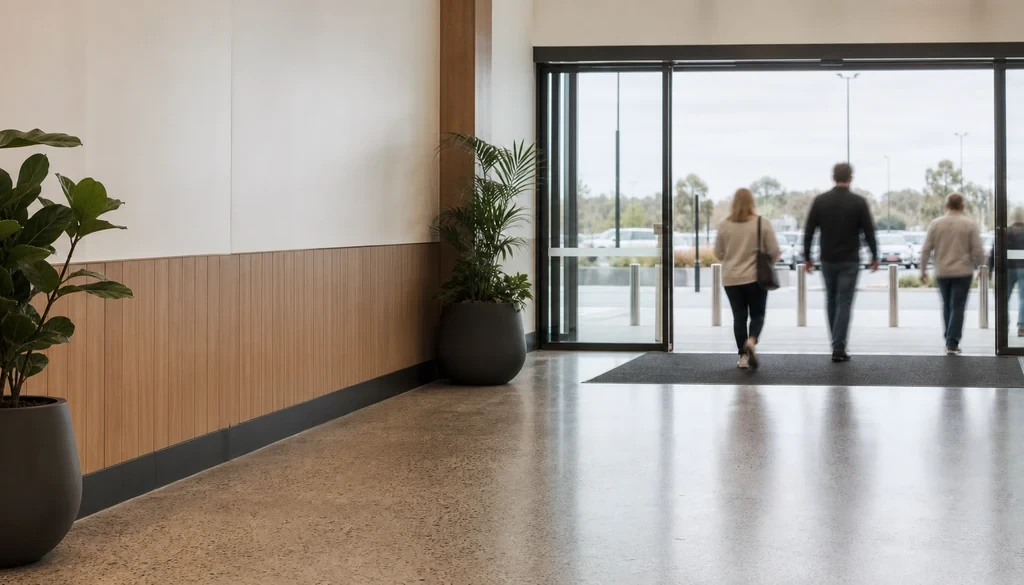
- Primary device in the ground-floor lobby, on the wall near the lifts at chest height (1.2–1.4 m), in a publicly accessible cabinet, visible from the main entrance. Air-conditioned, high-traffic, easy to find — the natural first location.
- A second device for larger or taller buildings, on a mid-level lift lobby, so reaching one from any floor doesn’t cost minutes.
- Cabinet and signage: Australian Resuscitation Council AED symbol on the cabinet, a sign above it, and a second sign at the main entrance pointing to the device’s location.
- Named responsible person: building manager or caretaker on the device, with the AED added to the building maintenance schedule — pads every 2–4 years, battery every 4–5 years.
- Train your building staff — manager, caretaker, any security — in CPR and AED use. The device guides any user, but confidence helps.
Registration in the NT — not GoodSAM
Here’s the other thing that catches people out. The NT does not use the GoodSAM platform that NSW, Victoria, SA and Tasmania use. In the Territory, St John Ambulance is the contracted ambulance provider — it is the ambulance service, and it runs the Triple Zero communications centres in Darwin and Alice Springs. AED registration goes through the St John NT First Responder app (free, iOS and Android).
Register each device through the First Responder app. When a member of the public uses the app to call 000, it sends GPS coordinates to the operator and gives the dispatcher visibility of registered nearby public-access defibrillators. There are a few hundred public-access AEDs registered across the NT this way — your building’s devices should be on that map. Registration is voluntary and free, but it’s what makes the device findable when it counts.
What you shouldn’t claim
A few honest framings worth keeping in your building communications and AGM papers:
- The AED isn’t “NT compliance equipment” — there’s no NT mandate to comply with.
- It’s best-practice common-area life safety equipment under your WHS duty, alongside fire extinguishers and emergency lighting.
- It serves visitors, contractors and building staff. Tenants run their own programs inside their tenancies.
- It doesn’t guarantee a save — it improves the odds substantially. Survival also depends on bystander CPR and time to first shock.
Where SafePulse fits
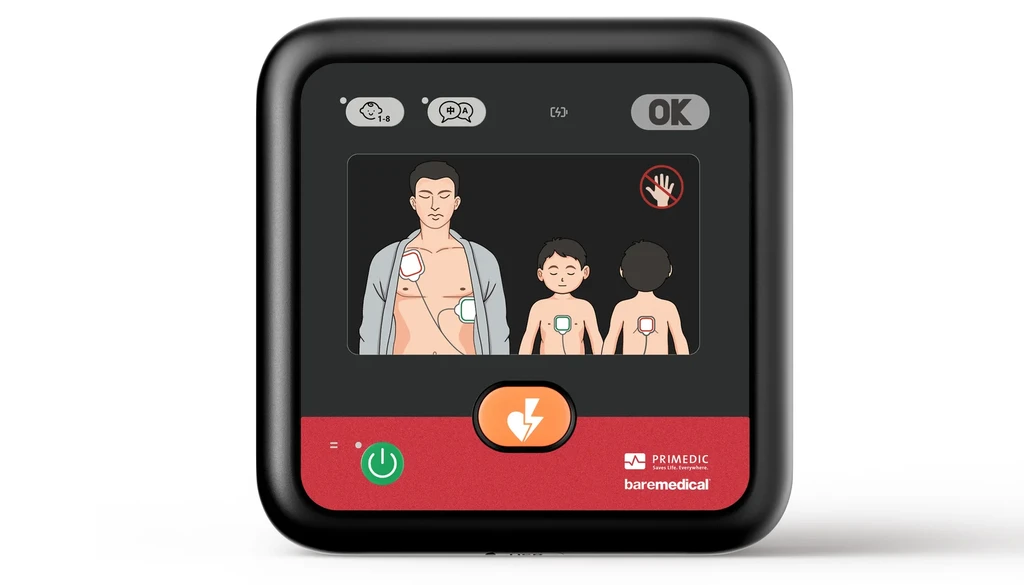
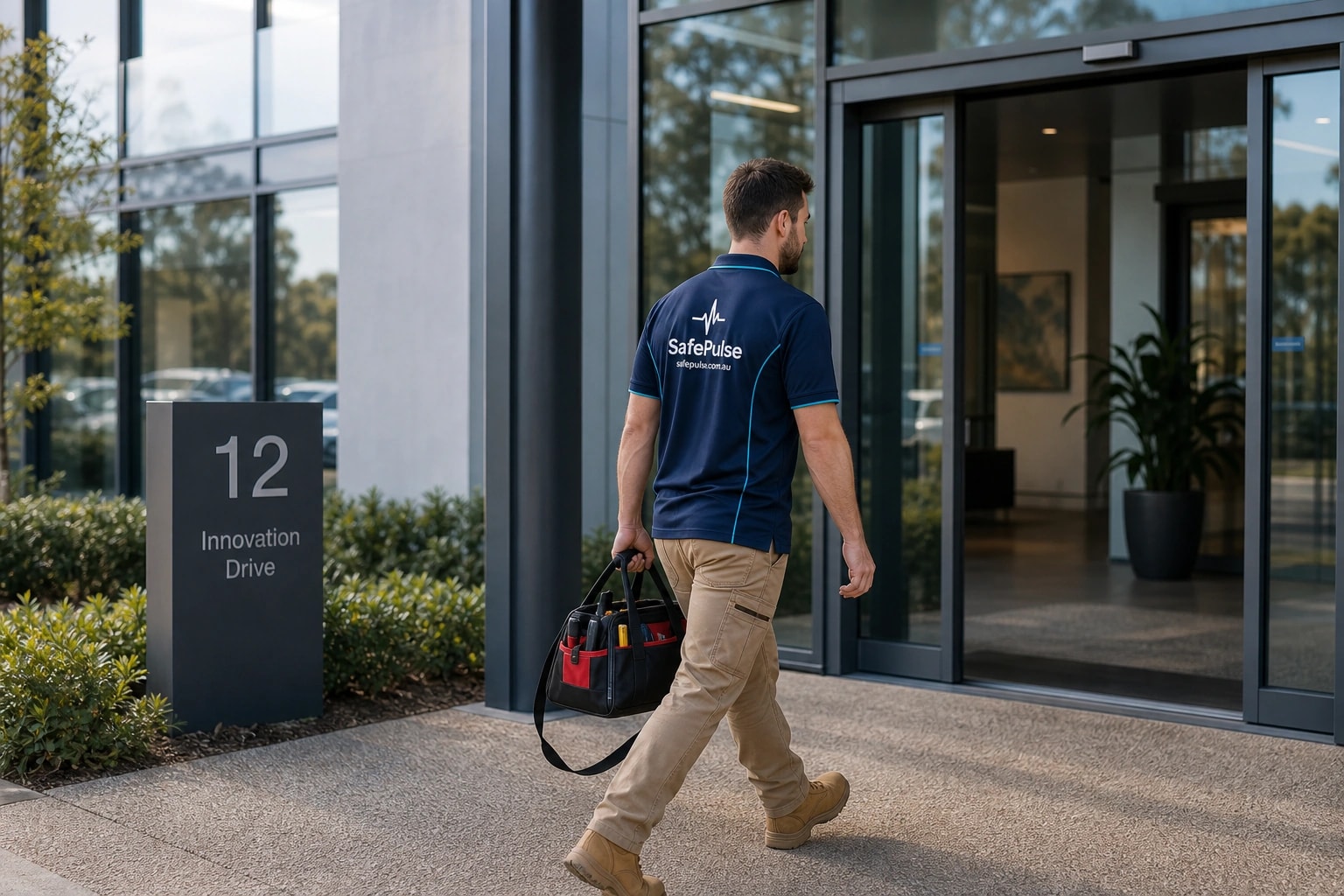
We supply, install and maintain AEDs across the Northern Territory, and we handle the St John NT First Responder app registration and the ongoing maintenance — pads and batteries replaced before expiry, six-monthly checks. We’ll spec the right cabinet for each location, which in the Top End means getting the indoor-versus-outdoor and the IP-rating call right so the device survives the build-up and the wet.
Cabinet choice deserves more attention in the Top End than almost anywhere else — see AEDs in the heat. For the Centre, there’s a practical AED guide for Alice Springs, and for the legal position, do Northern Territory commercial buildings need an AED in 2026. More at our Northern Territory AED page.
If you’re putting an AED program to a building owner or a body corporate committee, we can supply a one-page quote you can drop into the meeting paper. Get in touch at safepulse.com.au/nt/.