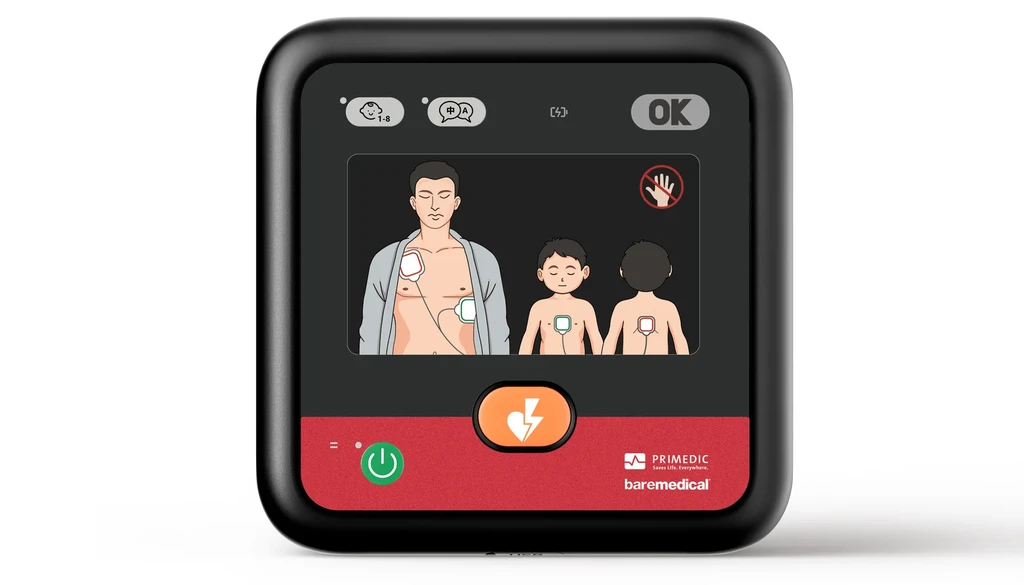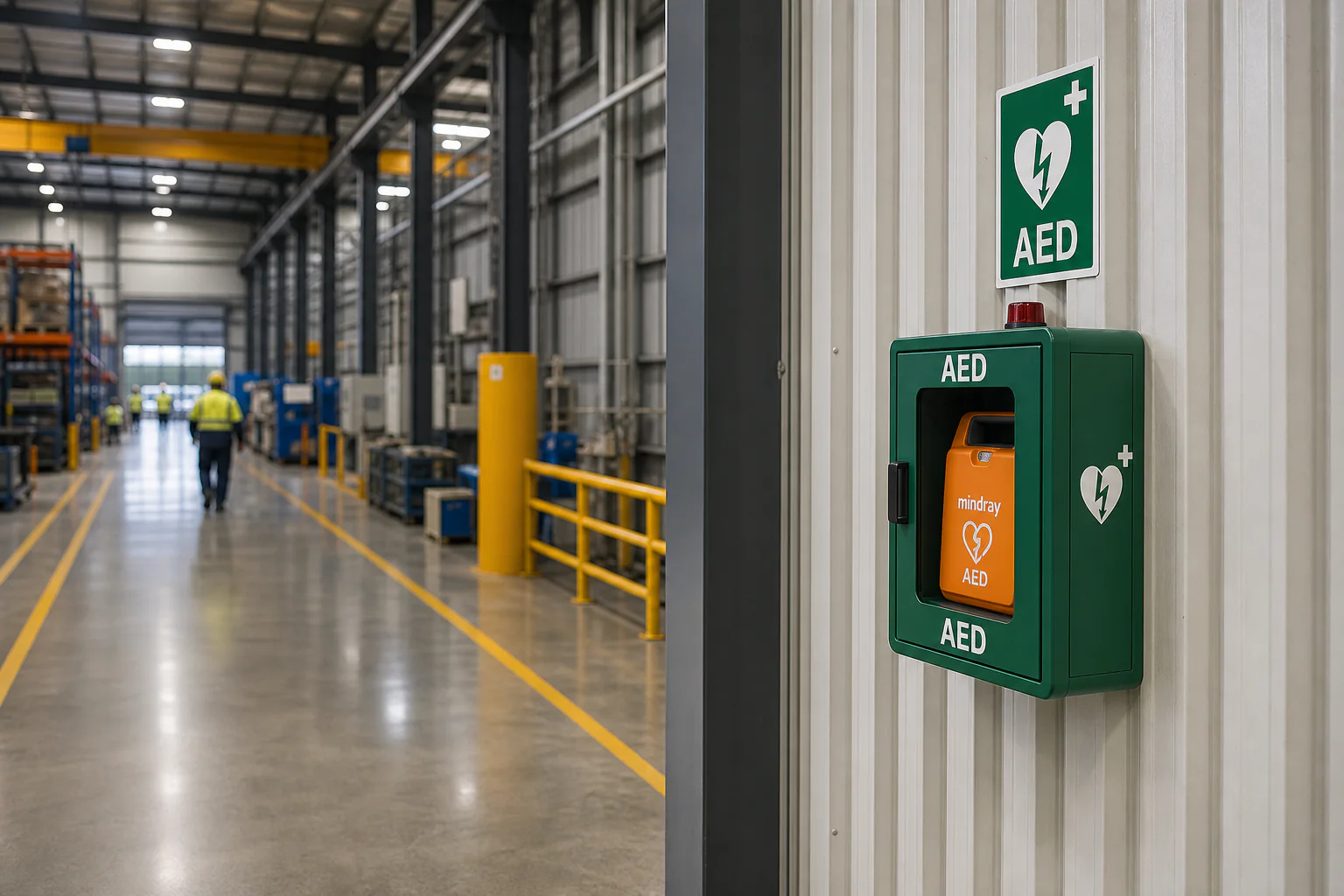
The Northern Territory is the smallest commercial AED market in Australia and arguably the highest-stakes one. Population dispersed across 1.4 million square kilometres, ambulance response measured in hours rather than minutes outside Darwin and Alice Springs, extreme heat, and an ambulance service contracted out to St John NT — not a government department.
For property managers in Darwin, Palmerston, Alice Springs, Katherine and the regional centres, the AED question runs through a different regulatory and operational landscape than the eastern states. This piece walks through what NT law actually requires, why the practical case is stronger here than the legal one suggests, and the path forward in 2026.
Is an AED legally required in NT commercial buildings?
No. The Northern Territory has no AED-specific legislation in force as of May 2026.
There is no NT equivalent to South Australia’s Automated External Defibrillators (Public Access) Act 2022. A search of legislation.nt.gov.au returns no Act, Regulation or Bill specifically governing public-access AEDs. The NT Legislative Assembly has had no AED-specific Bill tabled.
That means an NT commercial building in 2026 is not breaking any AED-specific law if it doesn’t have one. But the WHS duty applies, and the NT’s geography makes the practical case unusually strong.
What NT workplaces are required to do
The governing Act is the Work Health and Safety (National Uniform Legislation) Act 2011 (NT), supported by the Work Health and Safety (National Uniform Legislation) Regulations 2011. Under the Act, a person conducting a business or undertaking (PCBU) must ensure the health and safety of workers and others, so far as is reasonably practicable.
For first aid, the practical detail is set out in NT WorkSafe’s First Aid in the Workplace Code of Practice, approved by the Attorney-General and Minister for Justice on 29 January 2020 and published in the Northern Territory Government Gazette on 4 March 2020. It’s based on the Safe Work Australia model code and is the document a WorkSafe inspector or court would refer to in working out whether you’ve discharged your duty.
What the NT Code says about AEDs (verbatim)
The NT Code is unusually explicit about AEDs — and includes a passage worth quoting verbatim:
“Providing an automated external defibrillator (AED) can reduce the risk of fatality from cardiac arrest. While cardiopulmonary resuscitation (CPR) can prolong life, defibrillation is the only way to restore a heart with a fatal heart rhythm back to a normal heart rhythm.”
“You should consider providing an AED if there is a risk to workers at your workplace from electrocution, if there would be a delay in ambulance services arriving at the workplace, or where there are large numbers of members of the public.”
“They should be located in an area clearly visible, accessible and not exposed to extreme temperatures. They should be clearly signed and maintained according to the manufacturer’s specifications.”
That last sentence matters more in the NT than anywhere else in Australia. Most consumer-grade AEDs have an operating temperature ceiling around 50°C. Pad gel can degrade in sustained high heat. The NT’s climate makes outdoor cabinet specs and placement far from a nice-to-have.
The Code’s language is discretionary — “should consider” — informed by a risk assessment. Three trigger factors:
- Electrocution risk. Workplaces with switchboards, electrical work, mining and resources sites, manufacturing, oil and gas operations.
- Ambulance delay. This is the strongest WHS trigger in the NT — ambulance response in remote and regional areas can be measured in hours, sometimes longer.
- Large numbers of members of the public. Shopping centres, hospitality, hotels, tourism venues.
Failure to install an AED isn’t, in itself, an offence under WHS law in NT. Failure to discharge the broader duty of care could be — but that’s a fact-based argument, not a specific AED rule.
Why the NT is genuinely different
Three things set the NT apart from any other state’s AED conversation.
1. St John Ambulance NT is the ambulance service
Unlike most states (where ambulance services sit inside the state health department), the NT Government contracts St John Ambulance (NT) to provide all 24/7 emergency road ambulance and patient transport services across the Territory. St John NT also operates the two Territory Emergency Communications Centres (Darwin and Alice Springs) that handle Triple Zero (000) calls in the NT.
That has consequences for the AED registration pathway. NT does not use the GoodSAM platform that NSW, Victoria and SA use. The platform is the St John NT First Responder app — a free iOS and Android app where AED owners register devices and the public can locate nearby units. Per St John NT:
“Register your defibrillator with the St John NT First Responder App and Triple Zero (000) to ensure that it can be easily accessed in the event of an emergency.”
When a 000 call goes through the First Responder app, it sends GPS coordinates to the operator and the dispatcher gets visibility of registered nearby publicly accessible AEDs. Registration is voluntary and free.
Approximately 477 public access AEDs are registered via the First Responder app (per 2025 Heart Grant communications). The 2025 Heart Grant round added another 50.
2. Extreme heat is a Code-level placement constraint
The NT Code is explicit: AEDs “should be located in an area clearly visible, accessible and not exposed to extreme temperatures.” That maps directly onto the design of cabinets, the choice of location, and the maintenance regime in NT workplaces. For outdoor or vehicle-mounted installations in NT — common in mining, tourism, pastoral and remote-area work — specifying the right outdoor cabinet (high IP rating, ideally with thermostatic control) isn’t optional.
3. Delayed ambulance response in remote NT
The Code specifically addresses remote and isolated work:
“Extra first aid considerations may be necessary for workers in remote or isolated areas. For example, where access is difficult due to travel time, poor roads or weather conditions, arrangements should include aerial evacuation.”
For remote pastoral stations, mining operations, tourism operators and remote communities, the ambulance-delay trigger is the strongest WHS argument for an AED. The duty-of-care case under WHS law is materially stronger in remote NT than in metropolitan Darwin.
The St John NT Heart Grant
The Heart Grant is a competitive grant program run by St John Ambulance NT, funded by the Northern Territory Government Community Benefit Fund. It places AED kits — including training — with community facilities, sporting clubs, not-for-profits and similar community organisations.
The 2025 round allocated 50 AED kits and was fully allocated. St John NT has indicated future rounds will be announced; worth checking stjohnnt.org.au/heartgrant before relying on it.
For NT community groups, the Heart Grant is the most relevant subsidy pathway. SafePulse content for NT community/sporting audiences should mention the Heart Grant first, then position commercial supply for organisations that:
- Missed out on a Heart Grant round
- Need maintenance or monitoring (the Heart Grant supplies the device, not ongoing service)
- Are commercial entities (likely ineligible for community-targeted grants)
- Need multiple units across multiple sites
Comparison: NT vs SA vs NSW
| Factor | Northern Territory | South Australia | New South Wales |
|---|---|---|---|
| AED-specific Act in force | No | Yes (Act 2022, regs 2024) | No (three Bills lapsed) |
| AED-specific Bill before parliament | None identified | N/A — already law | Yes (Ward MP, lapsed three times) |
| Mandatory installation in commercial buildings | No | Yes (>600 m²) | No |
| Compliance deadline | None | 1 January 2026 | None |
| Mandatory registration | No (voluntary) | Yes (SAAS register, 2 weeks) | No (voluntary, GoodSAM) |
| Registry platform | St John NT First Responder app | SAAS register | GoodSAM via NSW Ambulance |
| GoodSAM integration | No | No | Yes |
| Ambulance provider | Non-government (St John NT) | Government (SA Ambulance Service) | Government (NSW Ambulance) |
| Mandatory signage | No (Code recommends) | Yes | No |
| Mandatory maintenance | No (recommended) | Yes (per manufacturer) | No |
| Penalties tied to AED | None (general WHS) | Yes (under the Act) | None |
| Sport/community AED grant | St John NT Heart Grant (NT Community Benefit Fund-backed) | No (Act compels installation) | Yes (Office of Sport) |
| Code-level temperature placement rule | Yes (extreme temperature exclusion) | No | No |
The NT sits in the same legal position as the other non-SA jurisdictions — but the practical case is shaped by climate, geography and the St John NT ecosystem in ways the other states’ content doesn’t need to grapple with.
Where AEDs make most sense in the NT
Even without legal compulsion, the workplaces and properties where the WHS case is strongest:
- Remote pastoral stations and stations offering tourism stays
- Mining and resources sites (electrocution risk + remoteness — McArthur River, Gove, Beetaloo gas operations)
- Tourism operators (Kakadu, Litchfield, Uluru-Kata Tjuta, Katherine Gorge, Tiwi Islands, Top End fishing)
- Sporting clubs and community centres — Heart Grant first, SafePulse for the rest
- Aged care, retirement villages and disability services
- Schools — especially remote and regional, where ambulance response is slowest
- Construction sites
- Large commercial premises in Darwin, Palmerston and Alice Springs CBDs
- Industrial and manufacturing workplaces with electrical hazards
Public access defibrillation in remote Indigenous communities is a real public health issue but a sensitive market. There’s no NT-specific Indigenous AED program; the Heart Grant is the closest funded pathway. Content addressing this market should be careful not to position commercial sales into communities — community/health-service-led pathways are more appropriate.
Practical approach for NT property managers and employers
- Run a documented WHS risk assessment. Apply the three trigger factors. In remote NT, the ambulance-delay trigger almost always applies — document it.
- Pick a TGA-approved unit. Required basis. IP56 or higher for outdoor or harsh-environment placement in NT. Check the manufacturer’s stated operating temperature range — most cap at 50°C.
- Place it well. Visible, accessible, unlocked, not exposed to extreme temperatures. This is the Code-level rule that bites in NT specifically. Foyer or staffed reception is the default for offices; outdoor cabinets need thermostatic control where exposed to direct sun.
- Register with St John NT. Free, via the First Responder app. Surfaces your AED to 000 and to nearby first responders.
- Train responders. Optional but materially improves the chance the AED gets used confidently — particularly important on remote sites where the responder is likely a colleague rather than a paramedic.
- Maintain per manufacturer instructions. Heat accelerates pad and battery degradation — be conservative with replacement schedules.
- For remote sites: include the AED in the emergency response plan with explicit reference to expected ambulance response time, including aerial evacuation arrangements where relevant.
Where SafePulse fits
We install AEDs for commercial buildings, sporting clubs, hospitality venues, tourism operators and industrial sites across the Northern Territory. SA-based, but the install package travels — TGA-approved Mindray units, 8-year warranty, climate-appropriate cabinets, signage, registration with St John NT, and an ongoing maintenance plan included.
If you’re scoping this for an NT site, see our Northern Territory AED solutions or send us the site details and we’ll come back with a scope.
Where to from here
The NT’s regulatory position is settled for now. No Bill, no public political push, and the St John NT ecosystem does most of the work an SA-style register would do, just on a voluntary basis.
Two Territory specifics matter more than the legal position on its own: heat will degrade a device if the cabinet is wrong, covered in AEDs in the heat, and the strongest risk case is remoteness — see AEDs in NT mining and resources. More at our Northern Territory AED page.
For NT property managers and employers, the question isn’t whether the law requires it — it’s whether the WHS duty has been discharged, the AED is on the wall, and the climate-appropriate cabinet, training and maintenance are in place. In remote NT, the ambulance-delay reality makes the case for an AED unusually strong — even without a single line of NT-specific legislation backing it up.