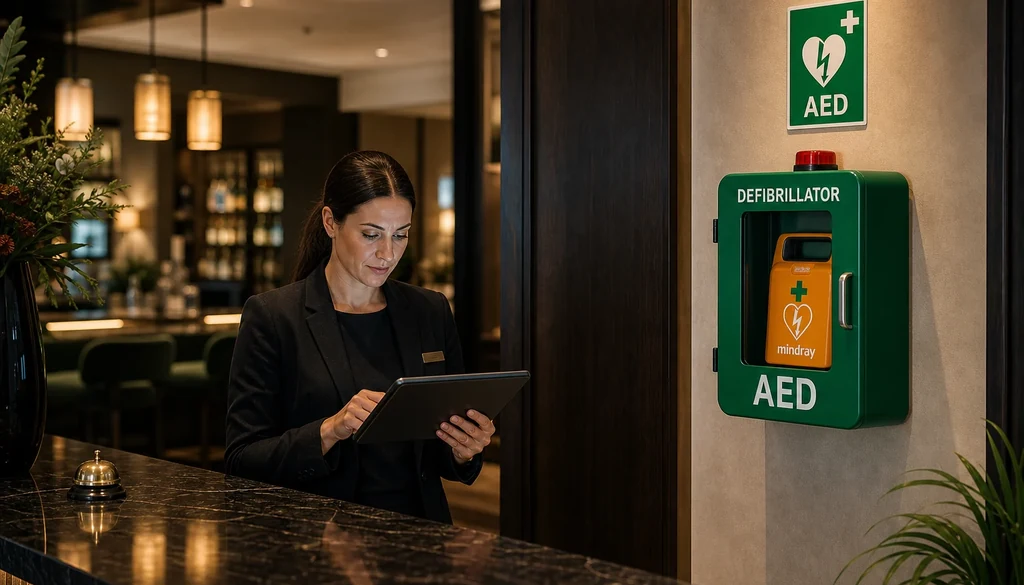
Hotel managers in Melbourne ask me variations of the same question every few weeks. “Are we required to have an AED?” The short answer is no — Victoria has no AED-specific legislation. The longer answer is that hotels and hospitality venues sit squarely inside the trigger factors that WorkSafe Victoria’s Compliance Code names as reasons to install one. If you operate a CBD hotel, a function venue, a large pub or a hospitality group, this piece is about how to think about it.
Where Victorian hospitality sits in the law
Victoria has no Act or Bill mandating AEDs in commercial buildings. The legal framework that applies to a Melbourne hotel or restaurant is the Occupational Health and Safety Act 2004 (Vic) — administered by WorkSafe Victoria, the state’s workplace safety regulator.
Section 21 of the OHS Act puts a general duty on employers: provide and maintain, so far as reasonably practicable, a workplace that is safe and without risks to health. Section 21(2)(d) specifically requires “adequate facilities for the welfare of employees.”
The detail of what that means for first aid lives in WorkSafe Victoria’s Compliance Code: First Aid in the Workplace (November 2021). The Code is the document a WorkSafe inspector would point to if asked what an “adequate” first aid response looks like in a Victorian workplace.
What the Code says about AEDs (paragraphs 149–152) is consistent across the model code Australian states have adopted: employers should “consider whether it is reasonably practicable to have an automated external defibrillator in the workplace as these are not difficult to use and save lives.” The Code names three trigger factors that push the “consider” toward “yes”:
- Risk of electrocution to workers
- Likely delay in ambulance arrival
- Large numbers of members of the public present
That third factor is exactly where hotels and hospitality live.
Why hospitality is the textbook case
Hotels, restaurants, pubs, clubs and function venues tick more of the Code’s factors than almost any other commercial setting. Here’s how the case stacks up.
Large numbers of members of the public
A 200-room Melbourne CBD hotel will see anywhere from 400 to 1,000 different guests through its lobby on any given day, plus restaurant covers, function attendees and walk-in traffic. Statistically, cardiac arrest in adults runs at roughly 1 in 1,000 people per year, concentrated in the 50–70 age bracket. The arithmetic on public exposure in Melbourne hospitality is unambiguous.
Older guest demographic
Hotels and function venues skew the public population older than the city average. Conference attendees, business travellers, leisure guests on the upper-decade trips that drive hotel revenue — the median guest is in the cardiac risk window. The Code’s “members of the public” factor is dialled up when those public members are over 55.
Alcohol and high-arousal events
Pubs, clubs and function venues add behavioural and physiological factors that raise cardiac risk on the night. Late nights, raised heart rate, drinking, dancing, occasional confrontation. Cardiac events on a Friday or Saturday night in licensed venues are not rare.
Ambulance response time in the CBD
Melbourne CBD ambulance response is faster than regional Victoria, but the survival math still bites. Cardiac arrest survival drops by about 10% per minute without defibrillation. Even a six-minute CBD response — which is fast — drops survival into the 30–40% range. An AED on-site, used in the first two or three minutes, lifts that materially.
Staff exposure
Beyond guests, hotel and hospitality workforces include kitchen staff, function staff and maintenance crews working long shifts, often through the night when on-site supervision is lighter and external response is slower.
For a careful Victorian compliance manager working through the Code’s “reasonably practicable” test, hospitality is the case that’s hardest to argue against.
What “reasonably practicable” actually means here
This phrase carries a lot of weight in Victorian OHS, so it’s worth unpacking. WorkSafe Victoria defines “reasonably practicable” with reference to:
- The likelihood of the hazard or risk occurring
- The degree of harm if it does occur
- What the duty holder knows, or ought reasonably to know, about the hazard and how to control it
- The availability and suitability of ways to eliminate or minimise the risk
- The cost — but only after considering the other factors
For an AED in a Melbourne hotel:
- The hazard is sudden cardiac arrest. It happens. Across a 12-month operating year in a 200-room CBD hotel, the probability of at least one cardiac event in a guest, staff member or attendee is meaningful
- The harm is fatal in the overwhelming majority of cases without rapid defibrillation
- An AED is a well-known, easily available, low-cost control measure
- The cost of a Basic Install through SafePulse is $2,490 GST free, plus $40/month for maintenance — the entire annual program runs at less than the daily room rate of a single guest stay
When the Code asks an employer to consider “reasonably practicable”, and the cost side is small while the harm side is fatal, the case for action is straightforward. No AED-specific law means no automatic offence for not having one. It does not mean the duty disappears.
Where to put the AEDs
For a typical CBD hotel:
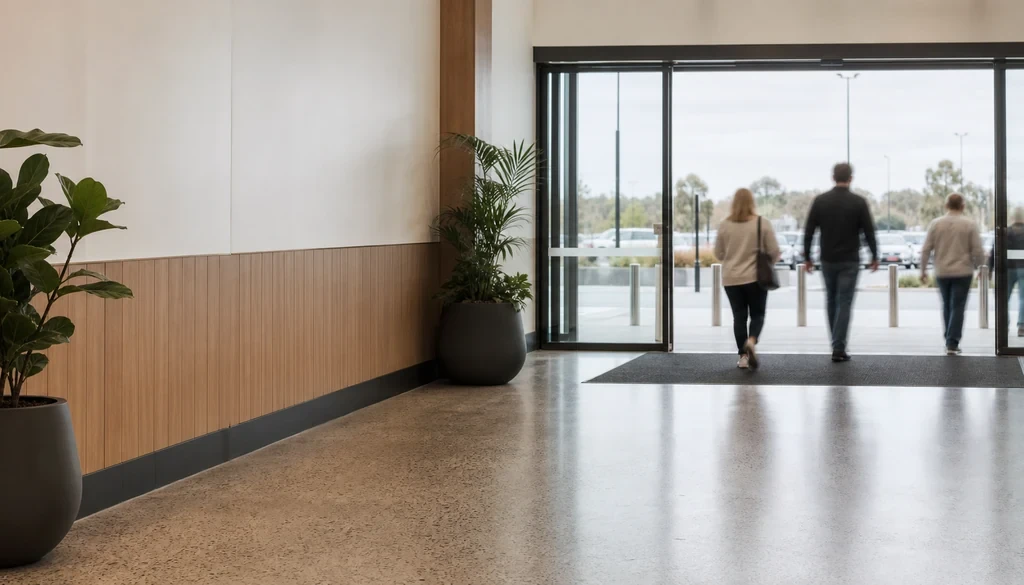
- Main lobby — the highest-traffic public area, staffed 24/7, the most likely first response point if a guest collapses. The first AED goes here, behind the front desk in a publicly accessible cabinet or on a wall in clear sight
- Restaurant or function area — for hotels with significant on-site food and beverage, a second device in the function zone reduces response time on the floor where alcohol-related and exertion-related events most often happen
- Back of house — for very large hotels, a kitchen-area or staff-corridor device serves the workforce, particularly the kitchen and maintenance staff working away from front-of-house
For a free-standing restaurant or function venue: one device in a publicly accessible cabinet near the main service area, mounted at chest height (1.2–1.4 m from the floor), is the typical spec.
For a pub or licensed club: one device behind the main bar or in the gaming room area, where most patrons concentrate. Larger multi-floor venues should plan for one device per floor.
What to spec
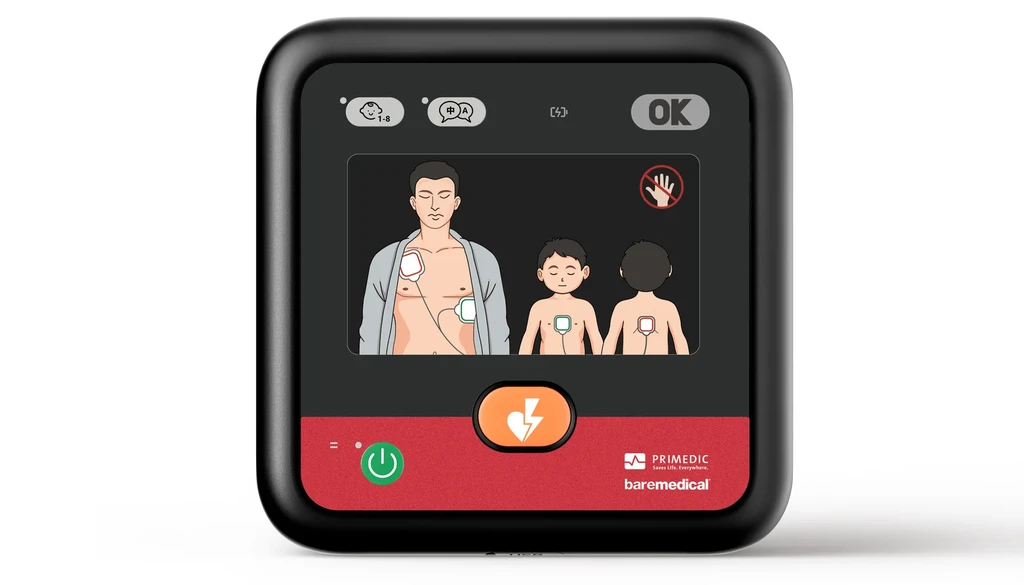
- TGA-approved — all AEDs sold by reputable Australian suppliers are TGA-listed. Confirm before purchase
- IP55 or above for any outdoor or partially exposed mounting — the WorkSafe guidance defaults to indoor mounting, but lobby installs can occasionally see weather depending on entrance design
- Two sets of pads and the standard ancillaries (shears, razor, gloves)
- Adult and paediatric pad compatibility where the demographic warrants it — most modern AEDs handle this with a switch or paediatric attenuator
Register the device with Ambulance Victoria
Registration in Victoria is voluntary, but worth doing. Ambulance Victoria runs the Register My AED service, integrated with the GoodSAM platform. Registered AED locations are shared with Triple Zero call-takers and with nearby GoodSAM Trusted Responders.
For a hotel, this matters because cardiac arrests do not exclusively happen on-property. A registered AED on the lobby wall becomes part of the surrounding GoodSAM responder pool, available to be used at the venue next door if a responder is alerted to a nearby arrest.
Registration takes about 10 minutes online. Information required: brand, model, serial number, pad and battery expiry dates, site address, hours of public access.
The wrong reasons to not install
A few patterns I see in Victorian hospitality that don’t hold up under scrutiny:
- “Our staff aren’t trained” — AEDs are designed for untrained users. The device walks the user through the entire process with voice prompts. CPR and AED training for nominated staff is best practice, not a barrier to installation
- “Our PI insurer hasn’t asked” — many haven’t, yet. Some have. Insurers are increasingly favourable toward AED-equipped venues. None will penalise you for installing one
- “It’s expensive” — at $2,490 GST free for a Basic Install with maintenance bundled, it’s less than the carpet replacement budget for a single room renovation
- “WorkSafe hasn’t issued a notice” — WorkSafe doesn’t proactively audit hospitality for AEDs. The point of the Code is to inform your risk assessment, not to wait for an inspector
A worked example — a 150-room Melbourne CBD hotel
A typical configuration for a Melbourne hotel of that size:
- One AED behind the front desk in the lobby
- One AED in the function/restaurant precinct
- Two staff per shift trained in CPR and AED use (typically front desk + duty manager)
- Registration with Ambulance Victoria, plus a sign at the main entrance indicating an AED is on-site
- Maintenance included in the monthly service plan — pads and battery replaced before expiry, six-monthly inspection visit
Total annual cost for a two-device program through SafePulse: under $5,000 setup and around $80/month ongoing. For context, that’s roughly the cost of a single function shift’s staff overtime.
Where SafePulse fits
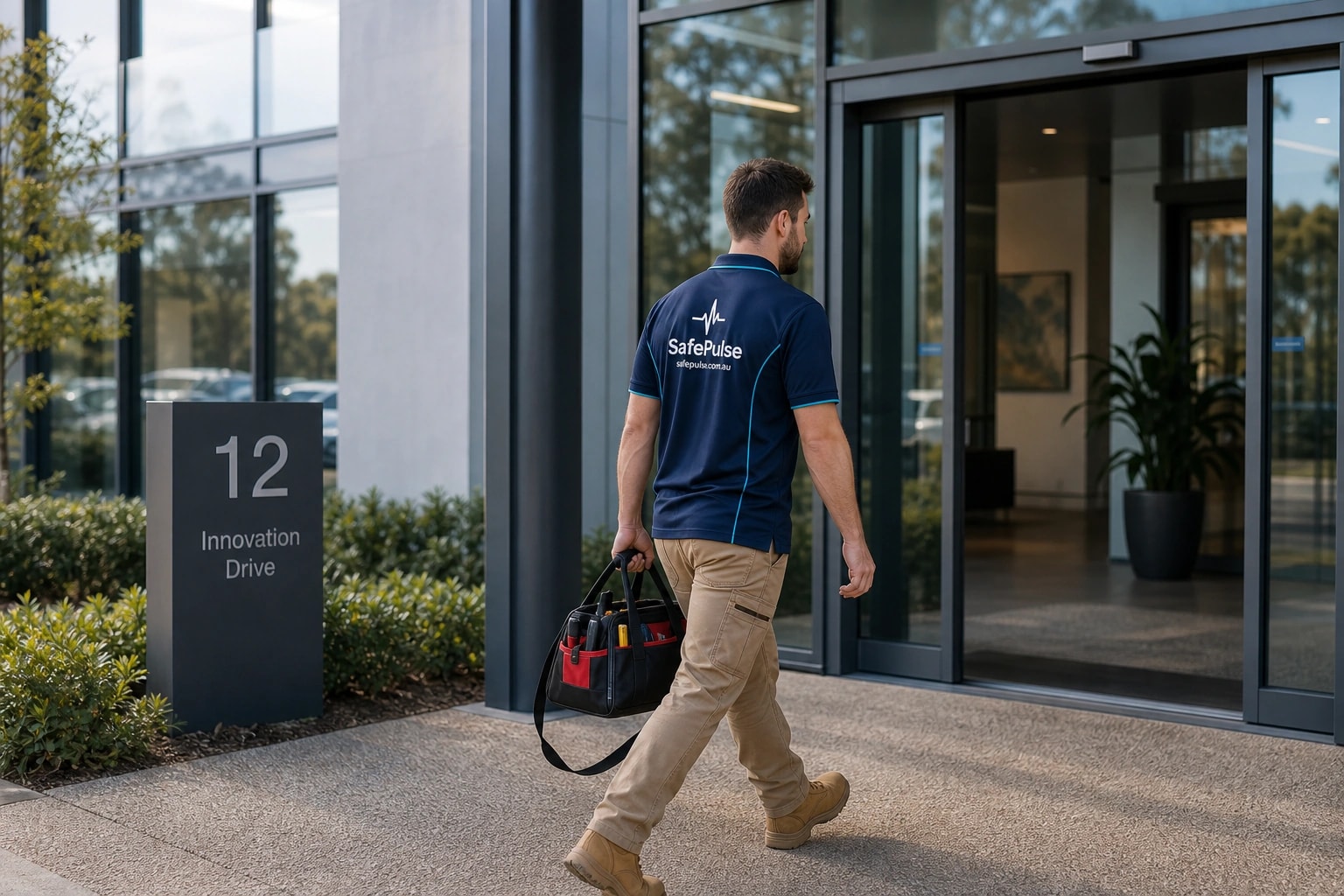
We install and maintain AEDs in Melbourne hotels, restaurants and function venues. The install is non-disruptive — about an hour per device, including signage and registration. We handle the Ambulance Victoria registration on your behalf, build the maintenance schedule, and replace consumables before they expire.
Public footfall is one of the factors the Code asks you to weigh — the detail is in what the WorkSafe Victoria Compliance Code says about AEDs, and the duty behind it in Victorian OHS duty of care. Our Victorian AED page sets out where Victoria stands.
If you’re at the stage of working out where the devices would go in your venue, get in touch via safepulse.com.au and we’ll walk it through.