Victoria has no law requiring a defibrillator in a shopping centre. No Act, and no Bill has ever been tabled in the Victorian Parliament on the subject.
What Victoria has instead is a test. And large retail is about the hardest place in the state to argue your way out of it.
What the test actually is
Section 21 of the Occupational Health and Safety Act 2004 requires employers to provide and maintain a working environment that’s safe and without risks to health, so far as is reasonably practicable. Subsection (2)(d) adds adequate facilities for the welfare of employees.
The OHS Regulations 2017 don’t name defibrillators anywhere. The detail lives in WorkSafe Victoria’s Compliance Code: First Aid in the Workplace, which came into effect on 4 November 2021 and replaced the 2008 version. We re-checked this month that it’s still the current code, and it is.
Paragraphs 149 to 152 are the AED section. The language is that employers should consider whether it’s reasonably practicable to have a defibrillator in the workplace, “as these are not difficult to use and save lives.”
Note the verb. Consider. Not install, not provide. That’s the outer edge of what Victorian law asks for, and anyone telling you otherwise is selling something.
We’ve gone through what the Compliance Code says line by line elsewhere. The point here is what “reasonably practicable” does when you apply it to a centre with thirty thousand people a week walking through it.
Two ways to comply, and retail sits awkwardly in both
The Code gives employers two routes. There’s a prescribed approach, which tells you what to provide based on the size and risk level of your organisation, including first aid officer numbers and kit contents. And there’s a risk assessment approach, where you assess your own workplace and provide what that assessment justifies.
Large retail doesn’t sit neatly in the prescribed route, because the prescribed route is built around your workforce. A centre with forty direct employees looks small on paper. The thing that makes it high-consequence isn’t the forty people on the payroll. It’s the ten thousand who came in on Saturday.
So retail almost always ends up in the risk assessment route, and once you’re there the reasonably practicable balance is the whole argument.
Why the balance lands where it does
“Reasonably practicable” weighs the likelihood of the harm and how serious it would be against what it costs to do something about it. Both sides of that scale are unusual in a large centre.
On the likelihood side: the profile of a weekday shopping crowd skews older than almost any other commercial environment. That’s not a statistic, it’s an observation any centre manager will confirm from their own foot count. Cardiac arrest risk rises with age. You’re not creating the risk, but you’re concentrating a lot of it under one roof for hours at a time.
On the seriousness side: cardiac arrest is survivable for a short window and then it isn’t. WorkSafe’s own guidance puts it bluntly — very few people survive a cardiac arrest without immediate assistance, and a defibrillator improves the chances dramatically.
On the cost side: this is where the argument usually collapses for a large operator. A defibrillator is a four-figure item with a maintenance schedule. Set that against the turnover of a regional shopping centre and the “we considered it and it wasn’t reasonably practicable” conclusion becomes very hard to write down with a straight face.
That’s not a legal threat. There’s no AED-specific penalty in Victoria and nobody is getting fined for an empty wall. It’s just that the test is a balancing exercise, and in this setting the balance is lopsided.
Distance is the part people underestimate
Here’s the thing that separates a centre from an office tower: a defibrillator at one end of a concourse is not covering the other end.
Someone has to hear the call, find the device, and get back. In a building with two hundred metres of internal concourse, plus a food court, plus back-of-house corridors, that round trip can be several minutes on its own before anything useful happens.
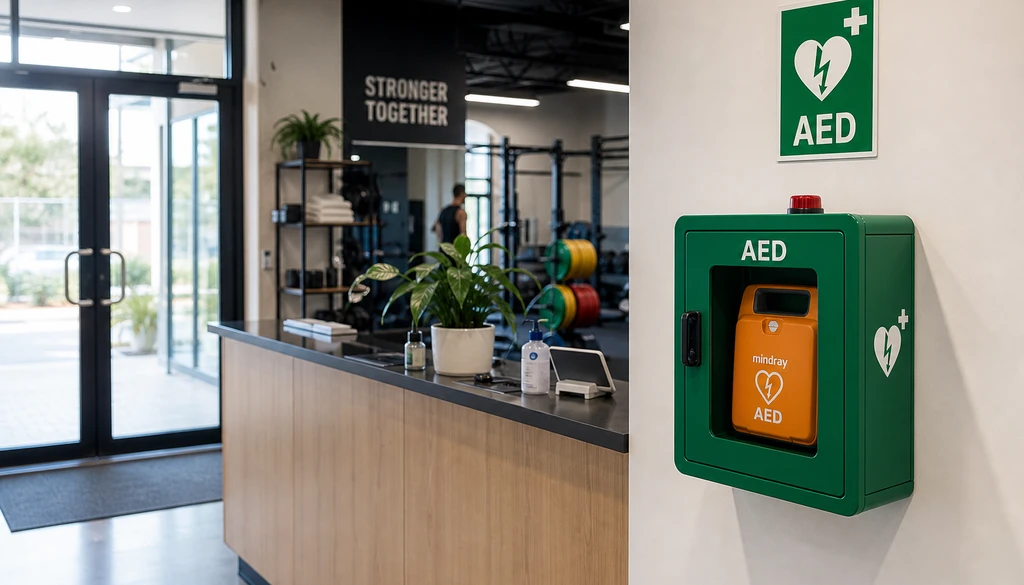
The honest way to size this is to walk it. Pick the point in your centre furthest from where you’d put a device, and time someone walking there and back at an urgent pace. If the number makes you uncomfortable, that’s your answer on how many you need, and the Code’s placement language backs it up. Devices should be in well-known, visible and accessible locations, and they should not be locked.
That last point catches people. A cabinet behind the management desk that’s staffed until 5pm isn’t accessible at 7pm. Whatever you install has to work at the times the centre is actually open.
Who owns the duty in a centre
Victoria’s OHS Act is framed around employers and their employees, which makes a multi-tenant centre genuinely more tangled than a single-occupier building.
The workable answer, and the one we see hold up in practice, is to allocate it in writing rather than assume it:
- Centre management takes the common areas, because that’s where its own staff work and where it has control.
- Individual retailers make their own assessment for their own floor, particularly the large anchors with their own workforces and their own OHS programs.
- Maintenance ownership is named, in writing, for every device. Not “someone at the centre”. A named role.
The failure mode isn’t two parties fighting over responsibility. It’s both assuming the other one has it.
Registering with Ambulance Victoria
This is voluntary in Victoria. There’s no legislative requirement to register, and nothing about it is tied to a compliance obligation.
It’s still worth doing, and in a centre it’s worth doing properly. Ambulance Victoria runs a free registry at registermyaed.ambulance.vic.gov.au, integrated with the GoodSAM platform. Registered locations are shared with Triple Zero call takers, who can direct a caller to the nearest device, and with GoodSAM responders who get alerted to nearby devices when a cardiac arrest is reported close by.
Register each device separately with its actual access hours. A centre with three devices registered as one address, or registered as 24-hour when the doors lock at six, is worse than useless to a dispatcher trying to direct a panicked caller.
The part most people don’t know about is what happens afterwards. If your device gets used in a public emergency, Ambulance Victoria arranges recommissioning, downloads the patient data and passes it to the treating hospital, returns the device within 72 hours, and supplies free replacement pads. That’s a genuinely good service and it’s a reason to register beyond the dispatch benefit.
Registration enquiries go to aed.register@ambulance.vic.gov.au.
Keeping it ready
A device that fails its self-test in March and gets noticed in September is a prop.
Ambulance Victoria’s guidance is to assign one or two named people to check monthly that the unit is working and the pads haven’t expired. In a centre, fold that into the existing building services round rather than inventing a new process, and log it. Pads and batteries have finite lives and both will expire quietly.
Two things worth saying plainly, because they come up in every centre conversation:
Nobody needs training to use one. WorkSafe Victoria says it directly — anyone can use a defibrillator on someone suspected of being in cardiac arrest, and you don’t need specialised training. The unit talks the user through it and won’t shock a heart that doesn’t need it. Training helps with confidence, not with permission.
Don’t let the outdoor question stall the indoor decision. If you’re covering an external forecourt or a car park link, higher IP-rated enclosures are sensible industry practice, but that’s a specification conversation and not a Victorian regulatory requirement. It shouldn’t hold up putting devices inside where the people are.
Where to start
If you manage a centre and you haven’t run this assessment, run it and write it down. That’s what the Code is asking for. The document that says “we considered it, here’s what we found, here’s what we did” is the thing that matters, and it’s useful whether or not anyone ever asks to see it.
If the answer comes back as “we should have devices and we don’t know how many”, walking the distances is the fastest way to a number.
We install and maintain defibrillators for commercial sites across Victoria, including Ambulance Victoria registration and ongoing servicing. Start at our Victoria page, and if you’re weighing the same question in a hospitality setting, Melbourne hotels and venues covers that ground. The common mistakes Victorian operators make is a short read worth doing before you buy anything.