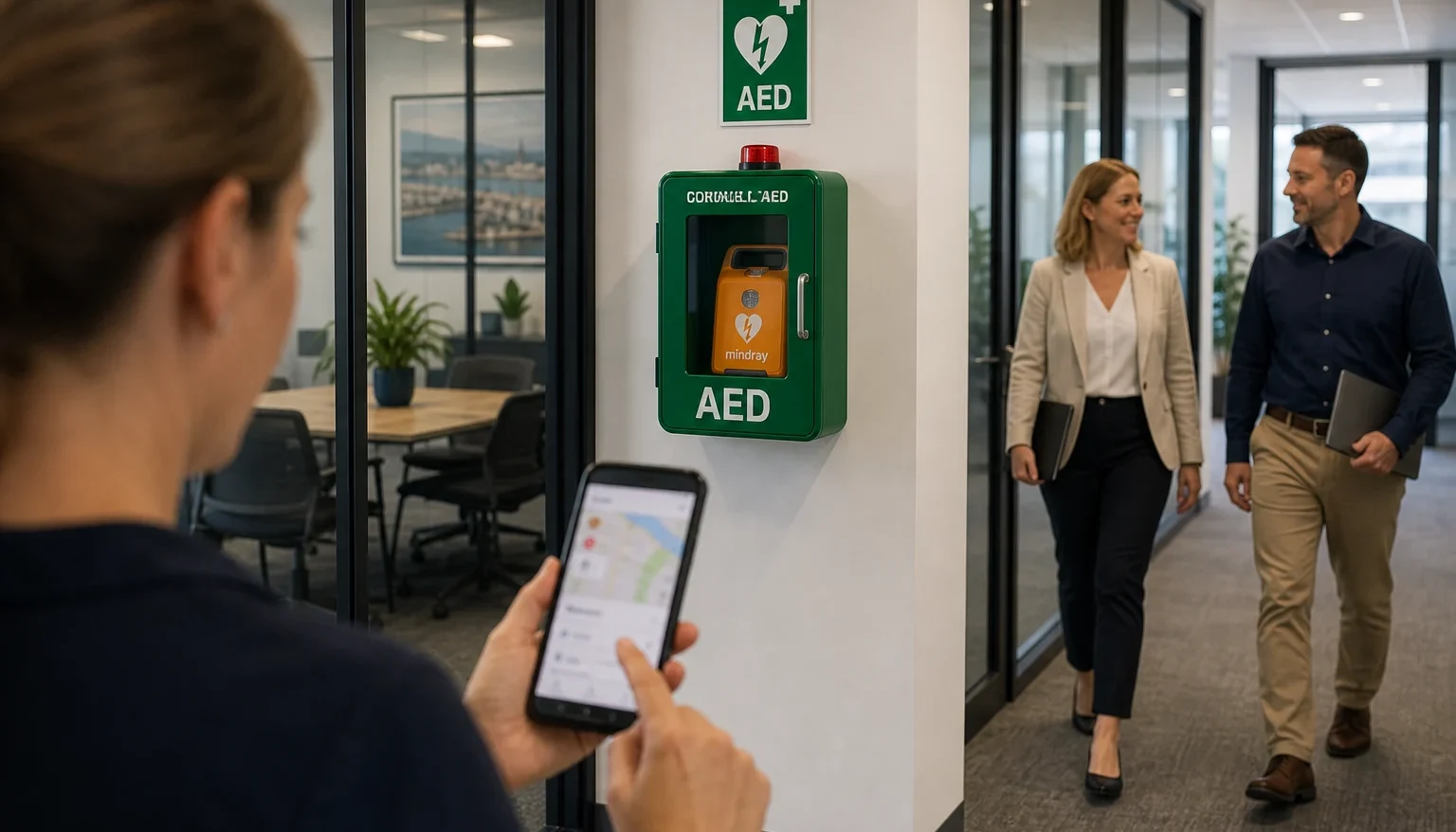
You’ve put an AED in your workplace. Good call — in New South Wales that’s a decision you’ve made on your own initiative, because there’s no law forcing your hand. There’s one more thing worth doing, and it costs nothing: registering the device with NSW Ambulance through GoodSAM. Here’s why it matters and exactly how to do it.
What GoodSAM is
NSW Ambulance maintains a public register of AEDs across the state, and that register is built into the GoodSAM Responder app. The idea is simple. When someone goes into cardiac arrest, two things happen: a Triple Zero call goes out, and nearby trained responders registered with GoodSAM get an alert. Both the call-taker and those responders can see where the closest registered AED is.
A defibrillator that nobody can find doesn’t help anyone. Registration is what turns your device from a box on your wall into a resource that a stranger having a cardiac arrest two doors down can actually be sent to.
Is registration mandatory in NSW? No.
Let’s be straight about this, because it’s where a lot of NSW content gets it wrong. There is no law in NSW requiring you to register an AED. There’s no law requiring you to have one either.
NSW has no AED-specific legislation in force. A private member’s Bill — the Automated External Defibrillators (Public Access) Bill — was introduced three times by Gareth Ward MP, and all three lapsed without passing. The most recent lapsed in May 2025, and the government rejected the call for a mandate. So as of now, AEDs in NSW commercial buildings are a best-practice decision, not a compliance obligation.
What NSW workplaces do have is a general first aid duty under work health and safety law. The SafeWork NSW First Aid in the Workplace Code of Practice says an AED may be provided where there’s a risk of electrocution, a likely delay in ambulance arrival, or large numbers of the public present. That’s discretionary language — “may”, informed by a risk assessment — not a rule that says you must install or register.
So registration is voluntary. But it’s the right thing to do, and it’s free, and it takes a few minutes. Here’s how.
Registering a single AED
For one device, the GoodSAM app is the fastest route.
-
Download the GoodSAM app (iOS or Android) or go to the NSW Ambulance AED registration page at ambulance.nsw.gov.au/get-involved/goodsam/register-an-aed.
-
Create an account if you don’t already have one.
-
Add the AED and enter its details: - The exact location — building, floor, and where in the space (“ground floor reception, wall-mounted left of the entry doors”) - The hours the AED is accessible - Brand, model, and serial number - Pad and battery expiry dates - A site contact
-
Submit. Once it’s registered, the device becomes visible to GoodSAM responders and to NSW Ambulance during emergencies.
That’s it. The whole thing is a five-minute job if you’ve got the device details in front of you.
Registering multiple AEDs
If you’re a property manager, a facilities team, or a business with devices across several sites, registering them one at a time through the app is slow going. NSW Ambulance handles bulk registration through a dedicated channel.
Email AMBULANCE-AEDRegistry@health.nsw.gov.au with your list of devices. For each one, supply the same details you’d enter in the app — location, accessibility hours, make and model, serial number, pad and battery expiry, and a site contact. The registry team can load them together rather than making you do it device by device.
This is the route to use for an office portfolio, a multi-site retailer, a school network, or anyone managing more than a couple of units.
What to have ready before you start
Whichever route you take, gather these first so you’re not chasing details halfway through:
- Precise location for each device, down to where in the building it’s mounted
- Accessibility hours — be honest about it. A device behind a reception desk that’s staffed 9 to 5 isn’t accessible at midnight, and the register should say so
- Make, model and serial number
- Pad and battery expiry dates
- A responsible-person contact for each site
Keeping your registration accurate
A register entry is only useful if it’s right. Two things are worth a standing habit:
- Update the entry when something changes. If you move the device, change the accessible hours, or replace it with a new unit, update the registration so a responder isn’t sent to a device that’s no longer where the app says it is.
- Re-check when you service the device. Every time you replace pads or the battery, glance at the register entry. Expiry dates on the register should match the device on the wall.
What happens after you register
It’s worth understanding what your registration actually switches on, because GoodSAM works on two fronts.
The first is the Triple Zero side. When a 000 call comes in for a suspected cardiac arrest, the call-taker can see registered AEDs near the patient and direct the caller — or a bystander — to go and fetch the closest one while the ambulance is on its way.
The second is the responder side. GoodSAM is also a volunteer responder network. People with relevant training — off-duty paramedics, nurses, first aiders — register as responders, and when a cardiac arrest is reported nearby, the app alerts them and shows them both the patient location and the nearest registered AED. Your device becomes a waypoint someone can grab on the way to help.
So registering doesn’t just put a pin on a map. It plugs your AED into the dispatch and the responder systems that get a defibrillator onto a patient in the minutes that decide the outcome. That’s the whole value, and it’s why a device that’s installed but unregistered is doing only half its job.
Why it’s worth the few minutes
Survival from a cardiac arrest drops fast with every minute that passes before defibrillation. Bystander CPR buys time; a shock from an AED is what restores a normal rhythm. The faster someone gets a defibrillator onto the patient, the better the odds — and “faster” depends entirely on someone knowing where the nearest device is.
Registration is the cheapest, simplest thing you can do to make your AED count for someone beyond your own four walls. It plugs your device into the system that finds it. There’s no downside and no cost, so once the AED’s on the wall, get it on the register.
Where SafePulse fits
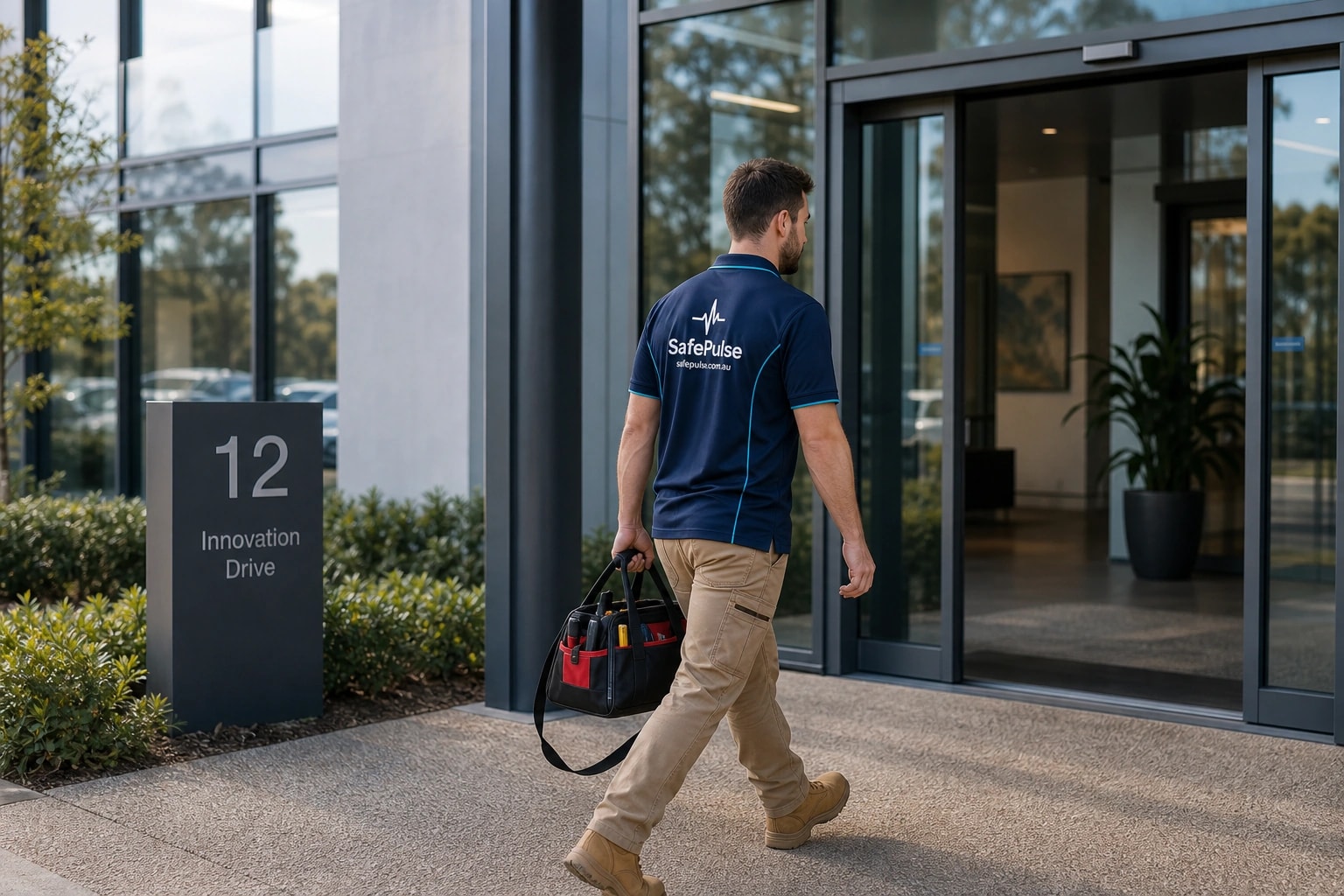
We install and maintain AEDs across NSW, and we handle GoodSAM registration as part of the install — including bulk registration for clients with devices across multiple sites. When we service a device, we keep the register entry current so the expiry dates and location always match reality.
Registration is voluntary in New South Wales, which is worth reading against what the state does require — the WHS first aid and AED duty. If you’re choosing a device before you register it, there’s why we install Mindray AEDs in NSW workplaces. Our New South Wales AED page covers the state position.
If you’ve got AEDs in service and you’re not certain they’re registered, or you’ve got a portfolio you’d rather not register one app entry at a time, get in touch at safepulse.com.au and we’ll sort it.