NSW construction sites tick more first-aid risk boxes than almost any other workplace category. Electrical work, height work, isolated tasks, plant and mobile equipment, ageing workforces, ambulance access constrained by traffic management — the SafeWork NSW Code of Practice’s three AED trigger factors apply more or less continuously across the working day.
NSW doesn’t have an AED-specific law. What it has is a WHS framework that treats AEDs as a risk-assessed first-aid item, and a Code of Practice that names the exact triggers a construction site routinely hits. This piece walks through what compliance looks like on a NSW construction site in 2026 — without overclaiming what the law actually requires.
Is an AED legally required on a NSW construction site?
No. NSW doesn’t have AED-specific legislation in force. There’s no equivalent to South Australia’s Automated External Defibrillators (Public Access) Act 2022, and no current Bill mandating AEDs on construction sites.
Three private member’s Bills have been introduced in NSW Parliament by Gareth Ward MP since 2024. All three lapsed. Status of any subsequent Bill should be re-verified against the NSW Parliament Bills register before relying on it.
What’s actually in force is the Work Health and Safety Act 2011 (NSW) and the Work Health and Safety Regulation 2017 (NSW), supported by the First Aid in the Workplace Code of Practice. That’s the framework a SafeWork NSW inspector will use to assess whether your site has discharged its first-aid duty.
What WHS law does require on a NSW construction site
The Act requires a person conducting a business or undertaking (PCBU) — the principal contractor, in most construction contexts — to ensure, so far as is reasonably practicable, the health and safety of workers and others at the workplace. That’s the umbrella duty.
Under the WHS Regulation, the practical first-aid requirements are:
- Provide first aid equipment and ensure each worker has access to it
- Provide first aid facilities where appropriate
- Ensure workers have access to trained first aiders or first aid information
The Code of Practice gives operational content to those duties. On AEDs, it states:
“An AED may be provided to reduce the risk of fatality from cardiac arrest where there is a risk to your workers from electrocution, a delay in the arrival of ambulance services or where there are large numbers of members of the public at your workplace.”
That’s the operative passage. Three trigger factors:
- Electrocution risk
- Delayed ambulance response
- Large numbers of members of the public
The language is “may be provided” — discretionary, risk-assessed, not mandatory. Failure to install an AED isn’t, in itself, an offence under WHS law in NSW. Failure to discharge the broader duty of care can be — and that’s where the construction sector sits in an unusually exposed position.
Why the Code’s triggers map almost completely onto construction
Most workplaces hit one of the three triggers. Construction sites routinely hit all three at once.
Electrocution risk. Energised plant. Underground services. Temporary power on site. Hand tools, generators, switchboards, lighting circuits. Any electrical trade working live, working near service mains, or working at height with metal frames near overhead lines. The risk isn’t theoretical — it’s daily, and it’s the single most cited reason a Code-trained PCBU adds an AED to the site’s first-aid kit.
Delayed ambulance response. Three factors compress an ambulance’s likely arrival time on a construction site: site access is often controlled by perimeter fencing or one-way traffic management; the site itself may be set back from the road, on a slab one or three storeys above grade, or behind a maze of formwork; and ambulance access through congested metro traffic in Sydney CBD, Western Sydney, the Hunter, or any active development corridor can mean meaningful response delays even when the ambulance is dispatched quickly. In regional NSW, the delay is structural, not situational.
Workforce and public exposure. Large commercial sites have hundreds of workers on the deck. Civic and infrastructure projects sit immediately adjacent to public footpaths and roadways, with public exposure across the perimeter. The third trigger applies most directly to civic-adjacent projects but the workforce size alone is often enough to put the question on the table.
A site that ticks all three of those Code triggers is in a position where a reasonably practicable WHS response will, in most cases, include an AED. SafeWork NSW won’t write you up specifically for not having one — but if a foreseeable cardiac arrest occurs, a coronial inquiry or prosecution under the umbrella duty will ask why a Code-recognised risk control wasn’t in place.
How to think about reasonable practicability for AEDs
The “reasonably practicable” test under s.18 of the WHS Act asks five questions:
- The likelihood of the hazard or risk occurring
- The degree of harm that might result
- What the PCBU knows, or ought reasonably to know, about the hazard and ways of eliminating or minimising it
- The availability and suitability of ways to eliminate or minimise the risk
- After assessing the above, the cost associated with available ways of eliminating or minimising the risk
On a construction site:
- Likelihood — cardiac events are not rare in working-age populations; electrocution is a low-frequency, high-consequence event; the population on a major site is large.
- Degree of harm — fatal without rapid defibrillation.
- Knowledge — the Code names the trigger factors explicitly; a Code-aware PCBU knows.
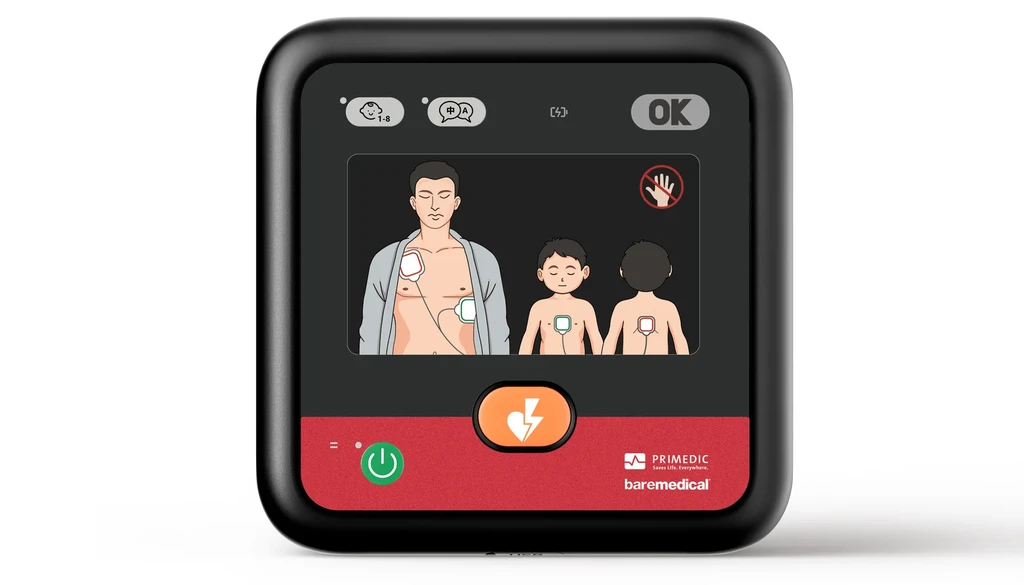
- Availability of controls — a TGA-approved AED is widely available, easy to deploy, requires no training to operate, and integrates into existing first-aid procedures.
- Cost — a SafePulse Basic Install is $2,490 per unit, GST free, with maintenance from $40/month. Negligible relative to project budgets, even at small-builder scale.
When a control is widely available, low-cost, easy to deploy and addresses a Code-recognised risk on a high-population site, “reasonably practicable” stops being a discretionary call and starts looking like a defensible compliance decision.
Placement and operational standards for site AEDs
NSW Health’s guidance for organisations sets out the basics, which translate directly to construction:
- TGA approved. All AEDs sold by reputable Australian suppliers are TGA-approved.
- IP rating. IP55 or above for outdoor or partially enclosed use — site offices, gantries, perimeter cabinets. Dust and rain are the primary environmental factors. Coastal and harbour-edge projects can push the spec higher.
- Two sets of pads, shears, razor. Standard.
- Adult and paediatric pad compatibility where reasonably available.
Placement on a construction site is more constrained than in an office:
- Site office or crib room — the default location. Always staffed, weatherproof, ambulance-accessible.
- Mounted publicly visible — not in a locked cupboard, not in a project manager’s locked office. The Code’s “well-known, visible and accessible” framing applies.
- Mount height — 1.2 to 1.4 m from the floor for cabinet placement.
- Signage — directional signage to the AED from the site entry and from the high-population areas of the deck. Construction sites change daily; signage needs to be reviewed at the same cadence as the site’s first-aid plan.
- Large or staged sites — consider multiple AEDs. A site with workers on level 12 doesn’t benefit from an AED in the ground-floor crib room when the response window is single digits of minutes.
For multi-storey or long-corridor sites, the cardiac response window — under five minutes from collapse to first shock for materially improved survival — is the design constraint. One AED at a site’s central first-aid point may not cover a 200-metre deck.
Training, monitoring, and the maintenance question
AEDs don’t require trained users in NSW — the Code and NSW Health both confirm that anyone can use one with the device’s voice prompts. But on a construction site, the first responder is much more likely to be a colleague than a paramedic, and training builds the confidence to actually deploy the unit when the moment arrives.
Maintenance is where most workplace AEDs fail. Flat batteries. Expired pads. A unit that’s been moved twice and never put back. The Code is explicit: maintain per the manufacturer’s specifications. WorkSafe regulators across all states flag under-maintained AEDs as a Code compliance issue — it’s the kind of thing that turns up in incident reviews.
For a construction site, where the principal contractor changes, subcontractor rotation is constant and the site itself reconfigures monthly, a monitored unit removes the dependency on someone physically checking the AED every two weeks. SafePulse’s Smart Install package includes AED Alert 2.0 — daily status reports, live tamper alerts, GPS theft tracking, automatic activation notifications. The maintenance differential ($25/month Smart vs $40/month Basic) effectively pays back through reduced manual inspection time, and the device’s status is verifiable without leaving the site office.
Registration with NSW Ambulance
NSW Ambulance maintains the NSW AED public registry, integrated with the GoodSAM Responder app. Registration is voluntary — not a legal requirement — but recommended. Registered AEDs become visible to GoodSAM volunteer responders and to Triple Zero (000) call-takers, which materially shortens the time from collapse to first shock if a public bystander is involved.
For multi-AED registration across a site or project, NSW Ambulance accepts bulk submissions at AMBULANCE-AEDRegistry@health.nsw.gov.au. Individual unit registration is via the GoodSAM app.
Where construction-specific complications come up
A few items worth flagging for principal contractors and site WHS officers:
- Subcontractor scope. First-aid duty sits with the PCBU. On a managed contractor site, the principal contractor’s WHS Management Plan should specify who provides the AED, where it lives, and the maintenance arrangement. Don’t assume each subcontractor will bring their own — that’s how three AEDs end up in three site offices and zero on the deck.
- Staged handover and base-build vs fit-out. As the site transitions from civil works to base-build to fit-out, the AED placement should move with the active work zone. A unit mounted in a ground-floor crib room during civils works can stay there for level 1 base-build, but by level 12 fit-out it needs to be repositioned or supplemented.
- Public-facing perimeters. Civic projects, road and rail infrastructure, large CBD sites — the third Code trigger (large numbers of members of the public) bites here. The public exposure isn’t just to workforce risks; bystanders may collapse from medical causes near the site perimeter, and an AED accessible from the perimeter staffed gate covers both the workforce and the foot-traffic case.
- Remote and regional projects. Single-figure-minute ambulance response is not realistic outside the inner metro. For regional NSW projects, the delayed-ambulance trigger isn’t situational — it’s a structural feature of the geography.
Practical approach for NSW principal contractors
- Document the WHS risk assessment. Apply the three Code triggers to the site. Most major construction sites hit all three.
- Provision the AED through the WHS Management Plan. Specify the make, model (TGA-approved), location, signage, maintenance contractor and registration status.
- TGA approval and IP55+ as the spec floor. Adult and paediatric pad compatibility where the workforce composition warrants it.
- Crib room or site office as default placement. Visible, unlocked, mounted 1.2–1.4 m from the floor. Multiple units on large or staged sites.
- Signage from site entry and high-population areas. Reviewed at the same cadence as the first-aid plan.
- Register with NSW Ambulance via GoodSAM. Free, voluntary, recommended.
- Maintain per manufacturer instructions. A monitored package removes the under-maintenance failure mode that catches most workplace AEDs out.
- Reposition as the site changes. Active work zone, not where the AED started its life.
Where SafePulse fits
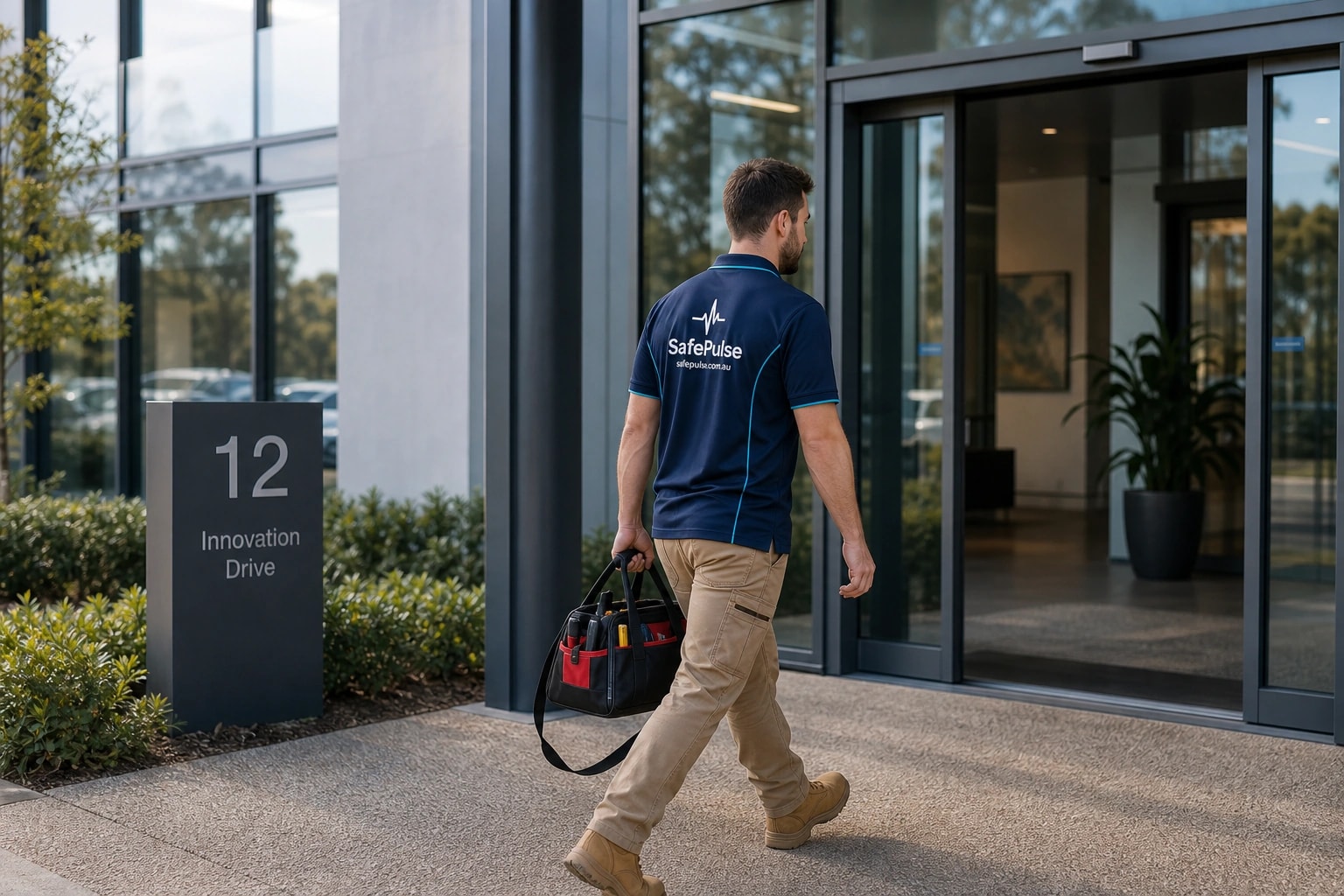
We install AEDs on construction sites, principal contractor offices and infrastructure projects across NSW. Each install is a TGA-approved Mindray unit, IP-rated cabinet, mandatory signage, 8-year warranty, and registration with NSW Ambulance via GoodSAM. The Smart Install adds AED Alert 2.0 monitoring — particularly useful on staged or long-running sites where manual inspection is hard to keep on the cadence the manufacturer’s instructions require.
If you’re scoping AED provision for a NSW construction site or principal contractor portfolio, see our NSW AED solutions or send us the project details and we’ll come back with a scope.
The bottom line
NSW doesn’t legally require an AED on a construction site. The Code of Practice names the three risk factors construction sites hit routinely, and the WHS umbrella duty asks whether reasonable controls have been put in place. For a Code-trained PCBU, that’s not a discretionary call — it’s a defensible compliance decision, captured in the WHS Management Plan, registered with NSW Ambulance, and maintained on schedule.
The electrocution trigger is one of three in the SafeWork NSW Code — the underlying obligation is unpacked in NSW WHS duty of care: first aid and AED obligations. Once a device is on site, registering it with NSW Ambulance via GoodSAM is free and worth doing. More on the state position at our New South Wales AED page.
The legal threshold in NSW is lower than in SA. The practical one — given a site routinely hits all three Code triggers at once — sits very close to it.