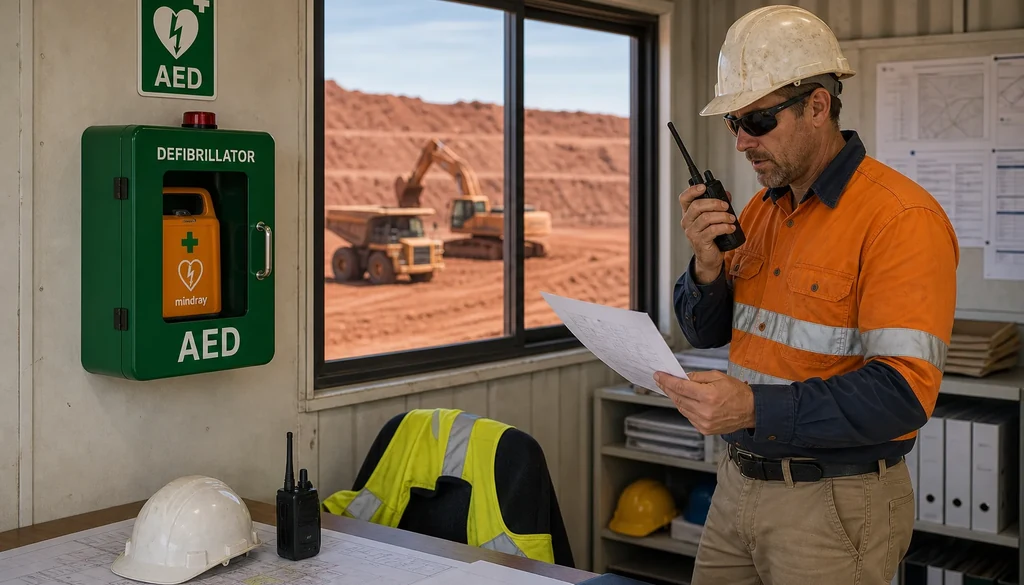
Mining and resources operations in the Northern Territory operate under one of the most demanding WHS environments in Australia. Remote sites, extreme heat, long ambulance response times, electrocution risk on processing plant and electrical infrastructure, large rotating workforces. If you’re a WHS officer at Glencore McArthur River, Rio Tinto Gove, Newmont’s NT operations or one of the Beetaloo gas projects, this piece is the practical framing for AED provision under the NT WHS Act. No mandate by name — but the triggers stack.
The NT legal floor
The Northern Territory has no AED-specific legislation in force. A search of legislation.nt.gov.au returns no Act, regulation or Bill governing public-access AEDs as of May 2026. The framework that applies to NT mining is:
- Work Health and Safety (National Uniform Legislation) Act 2011 (NT)
- Work Health and Safety (National Uniform Legislation) Regulations 2011
- First Aid in the Workplace Code of Practice (approved by the Attorney-General on 29 January 2020, gazetted 4 March 2020)
Mining sites in the NT sit under this general WHS framework — the NT does not have a separate mining safety Act of the kind Queensland has (the Mining and Quarrying Safety and Health Act 1999 (Qld)). The same WHS Act applies to a Top End office and a remote uranium mine; the duty just looks materially different on the ground because the risks are different.
The Code of Practice treats AEDs as discretionary. It names the three trigger factors:
- Risk of electrocution to workers
- Likely delay in ambulance arrival
- Large numbers of members of the public present
For an NT mining site, factors 1 and 2 carry the case. Factor 3 — public presence — usually doesn’t apply on a fly-in fly-out site, though it does apply to mine-adjacent infrastructure (port loading facilities, road train rest areas, regional offices).
Why the case stacks up for NT mining
The Code’s wording on AEDs (verbatim, from the NT First Aid in the Workplace Code of Practice):
“You should consider providing an AED if there is a risk to workers at your workplace from electrocution, if there would be a delay in ambulance services arriving at the workplace, or where there are large numbers of members of the public.”
“Extra first aid considerations may be necessary for workers in remote or isolated areas. For example, where access is difficult due to travel time, poor roads or weather conditions, arrangements should include aerial evacuation.”
For Glencore McArthur River (zinc-lead-silver, Gulf country), the closest formal ambulance station is in Borroloola, more than an hour by road in good conditions. Aerial evacuation via CareFlight or similar is the realistic external response, with response times running into hours.
For Rio Tinto Gove (bauxite, East Arnhem), Nhulunbuy has a hospital and a paramedic station, but the operational mine site is across a working footprint where on-site response is the only response that matters in the first crucial minutes.
For Beetaloo gas operations (Tamboran, Empire Energy and others), the sites sit hours from Katherine. Heliport infrastructure exists for evacuation but ground response from Katherine, Daly Waters or Mataranka is impossible in a useful timeframe.
For Tanami gold operations (Newmont and others), the geography is even more demanding — the Tanami is one of the most remote operating areas in Australia.
The Code’s first trigger — electrocution risk — applies to:
- Crushing and processing plant electrical infrastructure
- Substations and switchyards
- Mobile maintenance teams working on equipment around HV cabling
- Underground operations with extensive electrical wiring
The Code’s second trigger — ambulance delay — applies to the entire NT mining sector. There isn’t a mine site in the Territory where ambulance response time isn’t materially longer than urban Australia.
Heat — the NT-specific factor the Code names
The NT Code is the only Australian First Aid Code that explicitly addresses extreme temperature in its AED guidance. Verbatim:
“They should be located in an area clearly visible, accessible and not exposed to extreme temperatures.”
This matters more in the NT than anywhere else. Most consumer AEDs cap operational temperature around 50°C. The pad gel degrades faster in sustained high heat. An AED mounted on the exterior wall of a galvanised steel transportable in direct Tanami sun will reach internal temperatures well above the device’s rated range during summer.
Practical implications for an NT mining AED program:
- Indoor mounting wherever possible — crib rooms, control rooms, first aid rooms, accommodation common areas, maintenance workshops with air-conditioning
- Outdoor mounting only with appropriate cabinet — IP56+ rated, ideally with thermostatic control. Shaded location preferred. Not on a north or west-facing exterior wall in direct sun
- Check the manufacturer’s operating temperature range against your worst-case ambient — devices spec’d for milder climates may be inappropriate for NT outdoor placement
- Vehicle-mounted AEDs in light vehicles operating across the site need to live in an air-conditioned cabin compartment, not in a glovebox or the back tray
Where AEDs actually live on an NT mining site
The placement decisions for a mature NT mining operation usually shake out across these locations:
Operations centre / control room
Always staffed, always air-conditioned, the natural radio dispatch point for any emergency. One AED here is the central device.
First aid room / medical demountable
Where the site has dedicated medical infrastructure (most large operations do). One device here, paired with the site medic’s equipment.
Crib rooms (multiple)
Crib rooms are where workforce concentrates at break times. For a large mine, several crib rooms are distributed across the operation. One AED in each major crib room reduces the distance any worker needs to travel to retrieve a device.
Maintenance workshops
Where most electrical work happens, often physically separated from the operations centre. One AED here for the maintenance workforce — particularly relevant for the electrocution-risk trigger in the Code.
Process plant control room (separate from main control)
For large operations with a separate process plant control point, an AED at that location.
Accommodation village common areas
Workforce live on site for FIFO rosters. Cardiac events in the accommodation village outside working hours are a real category. One AED in the main mess hall or recreation building.
Site emergency response plan integration
The AED locations are listed in the site’s emergency response plan, with retrieval routes, trained responders by shift, and the device’s role in the overall response sequence (radio call → first responder retrieves AED → CPR + AED while waiting for medical / CareFlight / aerial evacuation).
For a typical large NT mining operation, the total AED count is six to twelve devices across the operating footprint, plus vehicle-mounted devices on light vehicles operating across the site.
Register with St John NT — not GoodSAM
A key difference between NT and the eastern states: NT does not use the GoodSAM platform. NT uses the St John NT First Responder app, operated by St John Ambulance NT, which is the contracted NT ambulance service provider for the entire Territory.
For an NT mining AED program, registration with St John NT achieves:
- Visibility to the Territory Emergency Communications Centre (Darwin or Alice Springs) handling 000 calls
- The site’s AED locations are listed in the central NT AED inventory
- Coordination with St John NT’s wider Community First Responder network, which matters for any responder activity at mine-adjacent locations
Register via St John NT’s defibrillator page and download the St John NT First Responder app. Voluntary, no cost.
The Heart Grant question for community-adjacent ops
The NT Heart Grant (funded by the NT Community Benefit Fund, delivered by St John NT) is the Territory’s main publicly subsidised AED pathway. It places AED kits with community facilities, sporting clubs and not-for-profits.
Heart Grant is not a funding pathway for commercial mining operations. The Fund is community/NFP-oriented. Mining operators should plan to self-fund their AED program through standard site safety capital.
That said, mining operators often have a community engagement function — supporting local sporting clubs, community halls and Aboriginal community organisations near operations. Where this happens, the Heart Grant is relevant context for what local community groups can access independently. Mining community engagement teams aren’t expected to fund community AEDs themselves, but they should know the Heart Grant exists for the community organisations they work with.
The 2025 Heart Grant round allocated 50 AED kits and is fully allocated. Future rounds are expected. Watch stjohnnt.org.au/heartgrant for round announcements.
Training — the standard worth holding to
For a mining site AED program to actually work in an emergency, the training piece matters more than the device piece.
- HLTAID013 — Provide first aid in remote or isolated site — this is the nationally recognised qualification for mine rescue, remote workforces and isolated site first responders. The full training unit, not the shorter HLTAID009 or HLTAID011 first aid certificates. HLTAID013 covers the longer response windows and limited equipment scenarios that NT mining operations actually face
- CPR refresher annually — required to keep the qualification current
- Site-specific AED familiarisation — every nominated first responder physically uses the AEDs on site during induction, not just in classroom training. Familiar with cabinet location, retrieval route, pad placement and the radio protocol for activation
This is the standard most NT mining operators already meet — the point is that the AED program lives or dies on the training, not the hardware.
What NT mining operators shouldn’t claim
A few honest framings:
- The mine site isn’t “compliant with NT AED law” — there’s no NT AED law to comply with. The mine site is meeting its WHS first aid duty under the NT WHS Act, with the Code of Practice as the operational benchmark
- The AED program isn’t a substitute for site medical staffing, emergency response procedures or aerial evacuation arrangements. It’s one component of the broader response chain
- The Mining and Quarrying Safety and Health framework that applies in Queensland does not apply in NT. NT mining sits under the general WHS Act 2011, like every other NT workplace, with the Code of Practice as the operational reference
- “GoodSAM” isn’t the registry in NT. St John NT First Responder is
A practical sequence for a WHS officer
If you’re a WHS officer at an NT mining operation reviewing the site’s AED program:
- Walk the site footprint and confirm the placement list — operations centre, first aid room, crib rooms, maintenance, accommodation, plus any high-risk-zone-specific devices
- Check the operational temperature rating of every device against the worst-case ambient at its location. Replace any device that’s outside spec, particularly outdoor-mounted ones
- Confirm cabinet IP rating for any outdoor or partially-exposed device — IP56+ minimum for NT outdoor
- Confirm the maintenance schedule — pads in date, batteries in date, six-monthly inspection
- Confirm the responder training schedule and refresher dates
- Confirm the device list and locations are correctly entered in the site emergency response plan, the radio protocol, and the St John NT First Responder app
- Brief the site management on the AED program at the next safety meeting — make sure the operations leadership knows where the devices are and how they’re used
Where SafePulse fits
We supply, install and maintain AEDs across the Top End — Darwin, Palmerston, the regional centres, the mining sector. For NT mining sites, we work with site procurement and HSE teams to scope the device count, the cabinet spec for outdoor placements, the integration with the site response plan, and the maintenance schedule.
Whatever the site, heat is the factor that quietly ruins devices up here — AEDs in the heat covers cabinet specification. For the legal position, there’s do Northern Territory commercial buildings need an AED in 2026, and our Northern Territory AED page.
If you’re at the stage of reviewing or expanding your site’s AED program, get in touch via safepulse.com.au/nt/ and we’ll work through the layout.