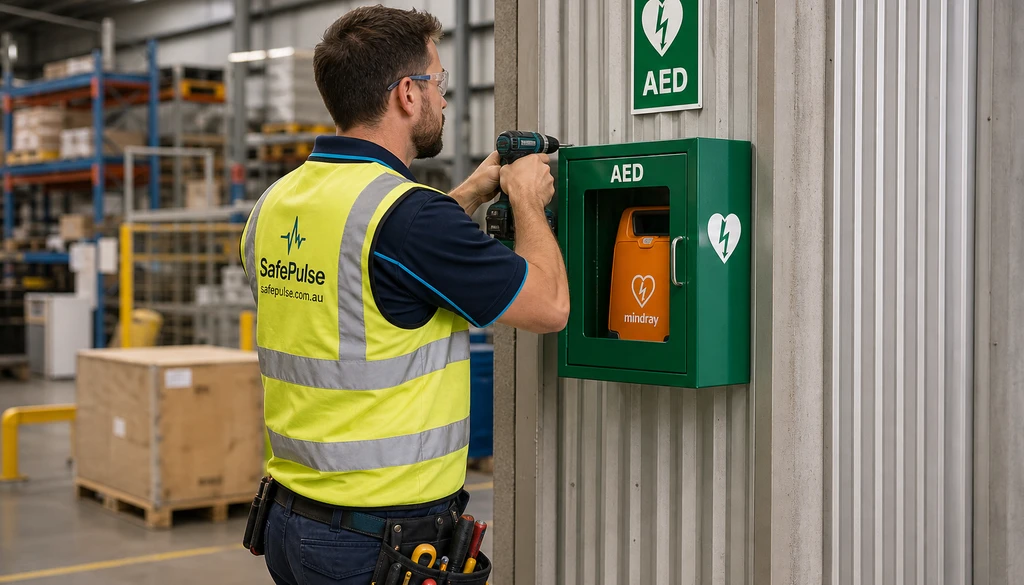
Queensland doesn’t have a law requiring an AED on a construction site or in an electrical trade. There’s no Queensland AED Act, and as of writing there’s no AED bill before the Queensland Parliament either. So this isn’t a compliance-deadline article. It’s about a risk that the state’s own workplace safety guidance singles out — and why construction and electrical work sit right in the middle of it.
The short version: electric shock can cause cardiac arrest, a defibrillator is what treats it, and Queensland’s first aid guidance names electrocution risk as one of the reasons to consider having an AED on site. If your work involves live electrical hazards, that’s not a coincidence you want to ignore.
What Queensland law actually requires
Start with what’s real. Under the Work Health and Safety Act 2011 (Qld), a person conducting a business or undertaking — a PCBU — has a primary duty to ensure, so far as is reasonably practicable, the health and safety of workers. The companion WHS Regulation 2011 backs that with a specific first aid duty at regulation 42: you have to provide first aid equipment, ensure workers can access it, and make sure enough people are trained to administer first aid.
The regulation doesn’t name AEDs. The practical detail lives in the First aid in the workplace Code of Practice 2021, and the Code treats a defibrillator as a risk-based consideration rather than a blanket requirement. It flags three situations where you should consider providing one: where there’s a risk of electrocution to workers, where ambulance arrival is likely to be delayed, and where large numbers of the public are present.
Notice the first of those three. Electrocution isn’t a footnote in the Queensland guidance — it’s the lead example. That’s the trigger construction and electrical work walk straight into.
Why construction and electrical trades fit the trigger
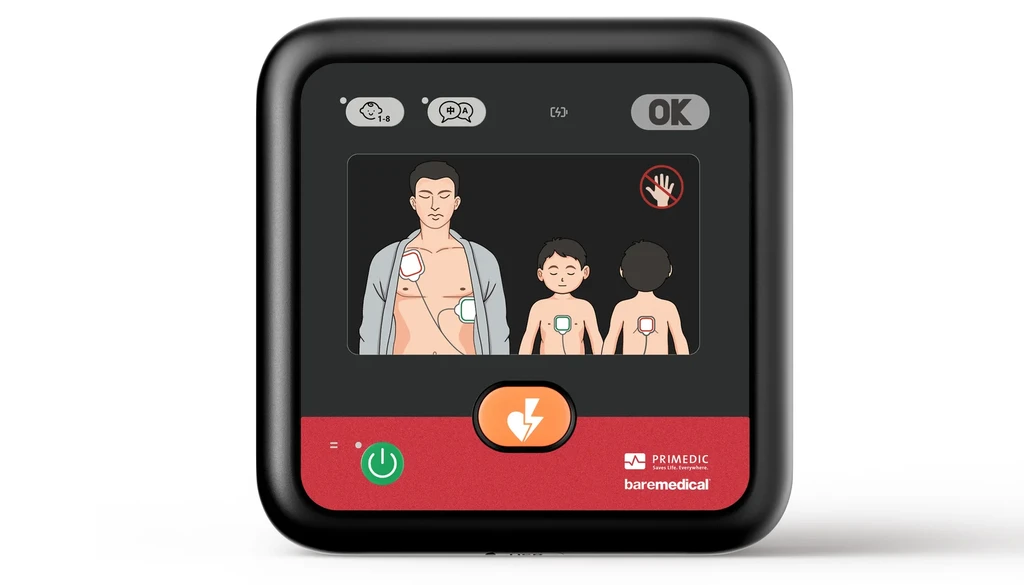
An electric shock across the chest can throw the heart into ventricular fibrillation — a chaotic rhythm that stops it pumping. That’s cardiac arrest, and the only thing that reverses it is a defibrillator delivering a shock, ideally within the first few minutes. CPR buys time; the AED is what restarts an organised rhythm.
So on a site where live electrical work happens — switchboard and distribution work, electrical contracting, plant and machinery, temporary site power, solar and battery installs — the work itself creates the exact emergency an AED is designed for. That’s a different risk profile to a quiet office where the only realistic cardiac arrest is a worker’s underlying heart condition. When the hazard on your site can cause the arrest, the “should we consider one” question has already half-answered itself.
Construction adds a few complications on top of the raw electrical risk:
- The site changes daily. Trades come and go, the layout shifts, and the “safe” areas move with the build. First aid provisions that made sense at slab stage may not at fit-out.
- People work alone or spread out. A sparky in a plant room or a worker at the far end of a large site may be minutes from the nearest colleague, let alone a first aider.
- Multiple crews, one site. On a busy job the head contractor’s duty covers a mix of subcontractors who each assume someone else has the safety gear sorted.
Each of those stretches the time between collapse and treatment — which is the thing that most determines whether the person survives.
Queensland’s ambulance-delay reality
The Code’s second trigger — likely delay in ambulance response — is worth taking seriously in Queensland specifically. The state is big and spread out, and a lot of construction and resources work happens well outside the metro ambulance footprint. Regional and remote sites in Central, Far North and Outback Queensland can be a long way from the nearest crew.
Every extra minute matters. Survival from a shockable cardiac arrest falls sharply for each minute that passes without defibrillation. On a regional site, “we’ll wait for the ambulance” can quietly mean “we’ll wait past the window where a shock would have worked.” An on-site AED is the control that closes that gap, and it’s exactly the scenario the Code’s ambulance-delay trigger describes.
The Queensland registration quirk worth knowing
If you do put an AED on site, register it with the Queensland Ambulance Service. It’s voluntary — there’s no Queensland law requiring registration — but it means that when someone calls Triple Zero from your registered site, the dispatcher can direct them to your device.
There’s an important limitation to understand, and it’s genuinely different to how the eastern states work. The QAS register only alerts the dispatcher when the cardiac arrest is at your property. It won’t flag your AED for an emergency at the business next door, and there’s no evidence QAS integrates with the GoodSAM responder app the way NSW and Victoria do. In plain terms: in Queensland, the AED on your own site is the one that helps your own people. You can’t lean on a neighbour’s device showing up in a wider alert network. That makes having your own on a hazardous site matter more, not less.
What good looks like on a Queensland site
If the risk assessment points to an AED — and on electrical and construction work it usually does — a few things make the difference between a device that’s present and one that actually works when it’s needed:
- A TGA-approved unit. Every AED sold in Australia has to be approved by the Therapeutic Goods Administration. Buy from a reputable supplier and that’s covered.
- A cabinet rated for the site. Queensland heat, humidity and dust are hard on equipment, and construction sites are rough. IP55 or above is the practical benchmark for exposed or outdoor positions. That’s industry best practice rather than a Queensland regulation, but it’s the sensible engineering call.
- Placement people know. Visible, accessible, not locked away in a site office nobody can reach after hours. On a large or shifting site, a known central point — or more than one — beats a single unit tucked in a corner.
- Maintenance. Pads and batteries expire. A responsible person needs to track that and replace on schedule, or the device is compliance theatre.
- Training helps, but isn’t a barrier. Anyone can use an AED — it talks the user through it. Get crews trained where you can, but don’t treat training as a reason to delay installing one.
The honest bottom line
There’s no Queensland mandate here, and this article isn’t pretending there is. What there is: a general WHS duty you already carry, a Code of Practice that names electrocution as a reason to consider an AED, work that creates that exact risk, and a state geography that can put the ambulance further away than you’d like. Weigh those honestly and the case for a defibrillator on a construction or electrical site is strong — not because a law says so, but because the risk does.
Electrocution is one of three triggers in the Queensland Code — the full legal position is in do Queensland commercial buildings need an AED in 2026. Worth knowing too that registering the device with QAS doesn’t reach past your own boundary, as QAS registry vs GoodSAM explains. Our Queensland AED page has more.
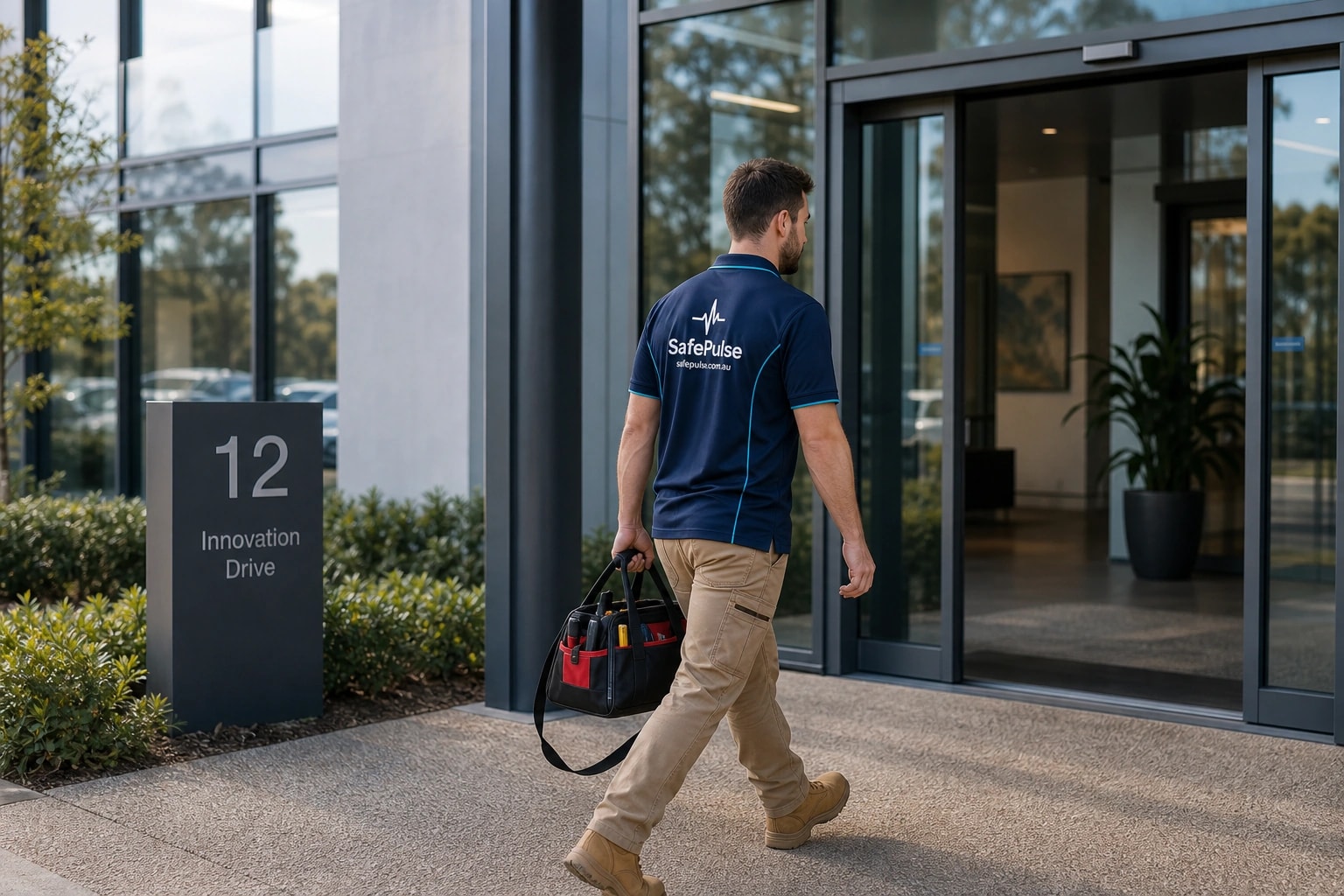
At SafePulse we install and maintain AEDs for commercial, industrial and construction sites, including the parts that matter on a rough or remote job — a cabinet that survives the environment, placement that works across a changing site, and consumables kept in date. If you’re weighing it up for a Queensland site, we’re happy to talk it through.