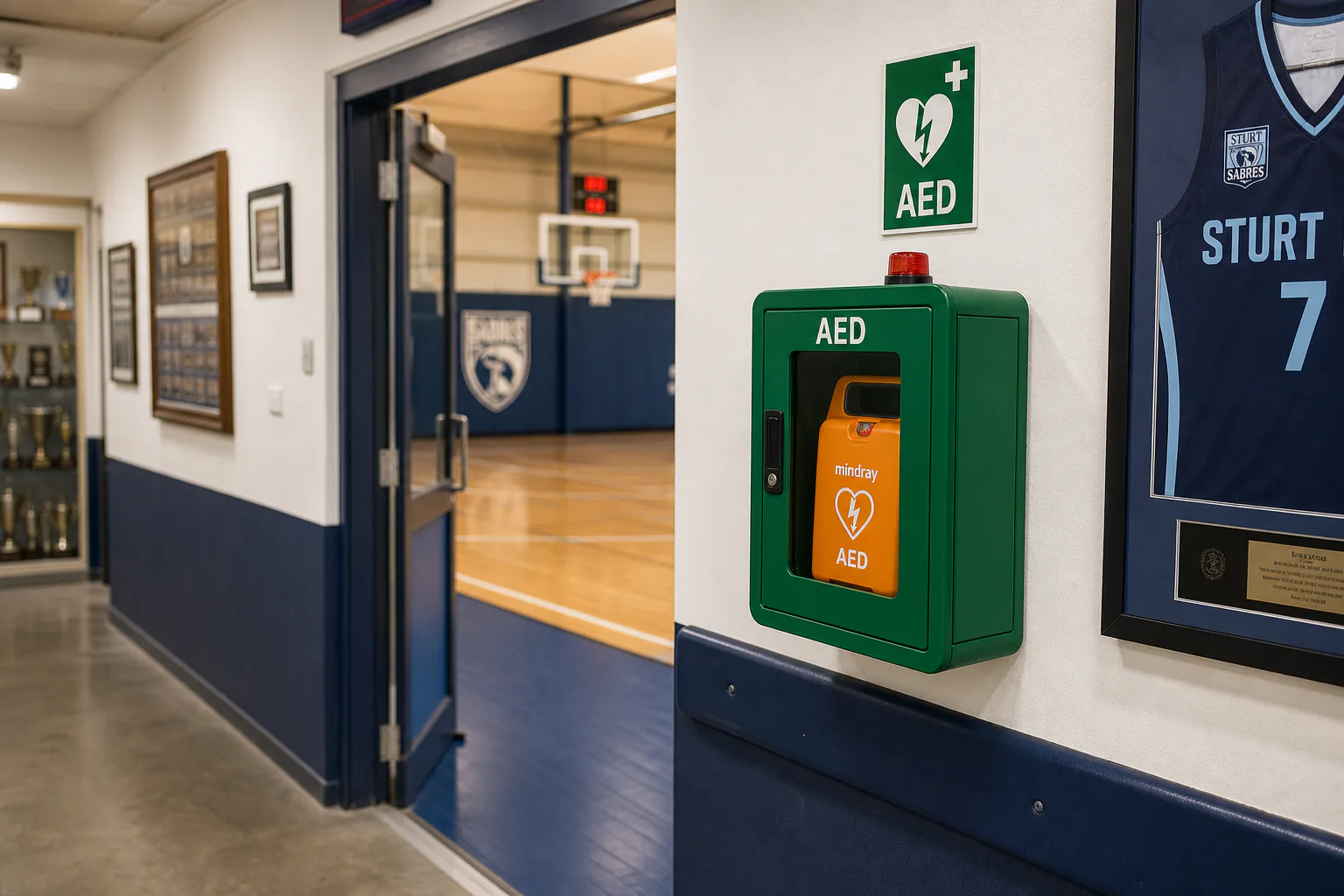
If you run a Queensland community sporting club and you’ve been pricing up an AED, you’ve probably noticed the funding picture is messier than the equivalent in NSW or Victoria. Queensland doesn’t have a dedicated state-government AED grant program for sport. There’s no equivalent to the NSW Office of Sport’s Local Sport Defibrillator Grant Program or Victoria’s Emergency Sporting Equipment Grant Program. That’s the honest starting point.
What Queensland does have is a patchwork: a general-purpose state grant that may or may not stretch to AEDs depending on how the round is administered, a partner grant through Queensland Rugby League and Alpha Sport that subsidises an AED package, and a national program (Project Defib) that’s open to QLD clubs alongside everyone else. None of them is the slam-dunk you’d want; together they’re enough to materially change the cost of getting an AED on the wall.
This is a practical guide to what’s actually available, how the rounds work, and how to think about the funding picture if you’re committed to the device but the cheque-book isn’t.
The state position — short version
There is no Queensland AED Act, no AED Bill before the Queensland Parliament (verified 2 May 2026 — re-verify before time-sensitive content), and no dedicated state-government AED grant program equivalent to the NSW or VIC schemes. We’ve checked both sport.qld.gov.au/sport/funding-programs and qld.gov.au/recreation/sports/funding; neither lists an AED-specific program.
What sporting clubs do operate under is the Work Health and Safety Act 2011 (Qld) and the First Aid in the Workplace Code of Practice 2021. The Code treats AEDs as a risk-based consideration — recommended where there’s risk of electrocution, delayed ambulance response, or large numbers of members of the public. A sporting club hits the third trigger by definition. The recommendation in the Code is the strongest “official” voice in QLD telling community clubs to install one — but it’s recommendation, not requirement, and it doesn’t come with a grant attached.
Active Clubs — the general-purpose state grant
What it is: The Active Clubs program (Department of Sport, Racing and Olympic and Paralympic Games) provides $2,500 (GST exclusive) grants to Queensland-based not-for-profit sport and active recreation organisations.
Eligibility: Incorporated under the Associations Incorporation Act 1981, Corporations Act 2001, Co-operatives National Law Act 2020 or related legislation. Must be Queensland-based with an ABN.
Eligible expenditure categories: Four categories — volunteer training and education, volunteer recognition, equipment (on-field and off-field), and flexible participation opportunities.
Where AEDs sit: The published guidelines list “equipment” as a broad category. They do not specifically name defibrillators or AEDs as eligible items. As of the most recent round check, the program was between rounds (Round 4 has closed). Whether a future round will explicitly fund AEDs depends on how the equipment category is interpreted by the Department in any given round.
Practical take: Don’t bank on Active Clubs for an AED until you’ve confirmed it in writing for the live round. Email or call the Department before submitting. If “off-field equipment” is interpreted broadly enough to include safety equipment, an AED can fit; if it’s interpreted narrowly to mean training equipment for the sport itself, it won’t. The Department will tell you which.
Round status: Re-verify against qld.gov.au/recreation/sports/funding/active-clubs before quoting current status to a client. Rounds open and close on the Department’s calendar.
Alpha Sport Heart Starter — the QRL-partnered grant
What it is: Alpha First Aid runs the Heart Starter grant in partnership with Queensland Rugby League. $500 toward an AED package for eligible community sporting clubs.
Eligibility: Community sporting clubs. The QRL partnership specifically opens the program to QRL-affiliated clubs across Queensland.
What you get: A subsidy applied to an Alpha First Aid AED package — not a free defibrillator, but $500 off the package price. The remainder is paid by the club.
Where to apply: alphafirstaid.com.au/aed-grant. Confirm program currency before relying on it.
Practical take: Useful as a top-up to a self-funded purchase. The amount won’t cover an entire AED program (device + cabinet + installation + maintenance + training), but $500 off the device price meaningfully reduces the upfront cost. If your club is QRL-affiliated, it’s worth checking. If not, you may still be eligible — Alpha runs the broader Heart Starter program for community clubs generally, not just QRL.
Project Defib — the national subsidy
What it is: A national charity program subsidising Defibtech Lifeline VIEW units to Australian sports clubs. $1,600 grant per club, with the club paying the balance.
Eligibility: Australian sports clubs nationally — QLD clubs are eligible alongside clubs in any other state. The program is set up to address community AED gaps rather than fund commercial premises.
Where to apply: projectdefib.com.au. Application process and round status managed by Project Defib.
Practical take: This is the largest dollar amount on the QLD-eligible list. A $1,600 subsidy on a device that retails for roughly $2,000–$3,000 makes the unit affordable for most clubs. The trade-off is that the funded device is a specific model (Defibtech Lifeline VIEW). If your club has a strong preference for a different brand for compatibility reasons (matching what local council or league clubs use), Project Defib won’t be the right fit. For most clubs starting from zero, it is.
Where Queensland Country Bank fits
What it is: Queensland Country Bank’s Good for Good community grants — general not-for-profit grants up to $30,000. Not AED-specific, but past recipients have included AED purchases.
Eligibility: Queensland-based not-for-profit organisations. Bank membership preferred.
Where to apply: queenslandcountry.bank. Rounds are advertised by the bank on their FAQ and grants page.
Practical take: Higher dollar amounts than Active Clubs but much broader competition (any community NFP, not just sport). A standalone AED purchase is unlikely to be a competitive application by itself; bundling AEDs into a broader facility-upgrade or community-safety initiative makes the application much stronger. Worth considering if you’re already preparing a Good for Good submission.
Local council grants
Several Queensland local councils run community grant rounds that have funded AEDs in past years. These vary by council, by round, and by year. Worth checking your local council’s grants page — search “[council name] community grants” — and asking whether AEDs are eligible under the current round’s equipment or safety categories.
Council-funded AEDs sometimes come with a public-access condition (mounted outdoors, 24/7 accessible). That’s worth considering up-front — it changes the cabinet specification (you need outdoor-rated, IP55+, often vandalism-resistant) and the maintenance schedule.
What’s missing — and why that matters
Queensland’s AED funding picture is materially thinner than NSW’s, Victoria’s, Tasmania’s or even South Australia’s. NSW has a dedicated state sport AED grant. VIC has two state grant streams that explicitly list AEDs. Tasmania funds a $500,000 Community AED Fund delivering 180 free units over two years. SA, of course, has legislation that puts the funding question into a different category entirely.
That gap is part of the operating reality for QLD community clubs. The funding pathways that exist are useful but partial, and most clubs end up part-funding an AED program from their own budget alongside whatever grant they can secure.
It’s not a reason to delay the device. The Queensland First Aid Code of Practice 2021 still applies. Cardiac arrest in a sporting setting is still foreseeable. Survival still depends on time-to-shock, which depends on whether there’s a defibrillator on the wall. The funding picture is the budget conversation, not the safety conversation.
How to think about the total cost
For a typical community sporting club, an AED program isn’t just the device. It’s:
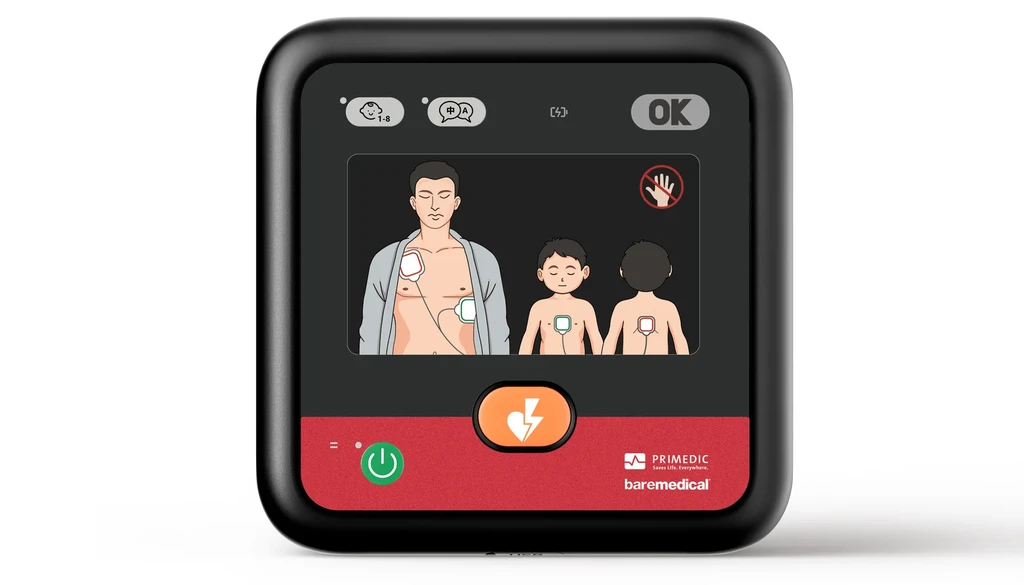
- The defibrillator itself (TGA-approved unit)
- A cabinet (indoor or outdoor-rated, IP55+ for any outdoor placement)
- Installation and signage
- Voluntary registration with the Queensland Ambulance Service (qld.gov.au/emergency/QAS/aed-registration-form)
- Ongoing maintenance — pads replaced typically every 2–4 years, battery every 4–5 years, plus monthly visual checks
- CPR/AED training for nominated first aiders
Project Defib or Alpha Sport’s Heart Starter covers part of the device cost. Active Clubs (if interpreted to include AEDs) covers a chunk more. Council or Queensland Country Bank grants can plug remaining gaps. Most clubs end up with a 30–70% subsidised total cost, with the balance carried by the club’s own funds.
What to do about it
If your QLD community sporting club is working through this:
- Check Active Clubs first. Email the Department of Sport to confirm AED eligibility under the current round’s equipment category, in writing. Apply if confirmed.
- Check Project Defib eligibility. If you’re open to the Defibtech Lifeline VIEW unit, it’s the largest subsidy on the list.
- Check Alpha Sport’s Heart Starter. $500 toward an Alpha-supplied package.
- Approach your local council. Many councils run safety-related community grants; AEDs often qualify.
- Look at Queensland Country Bank if you’re already eligible — particularly if you can bundle the AED into a broader facility-upgrade request.
- Budget the balance. Whatever you raise through grants, plan to part-fund the program from club funds. An AED program is a 5–7 year asset; spread across that life, the per-year cost is small relative to a season’s other expenses.
- Don’t delay the device while you chase the perfect funding. If grants are months away and a season is starting, fund the device, then offset the cost when the grant comes through.
Funding routes change round to round, but the underlying position doesn’t — it’s the WHS duty explained in do Queensland commercial buildings need an AED in 2026. Once a device is in place, registering it with QAS is free, with the one limitation that piece explains. More at our Queensland AED page.
SafePulse installs and maintains AEDs for community sporting clubs across Queensland. We work with clubs on whichever funding pathway you’ve secured — grant-funded, club-funded, council-funded or a mix — and the install package includes cabinet, signage, QAS registration, and a maintenance plan that documents itself. If you’d like a walk-through of what an AED program would look like for your club, get in touch.