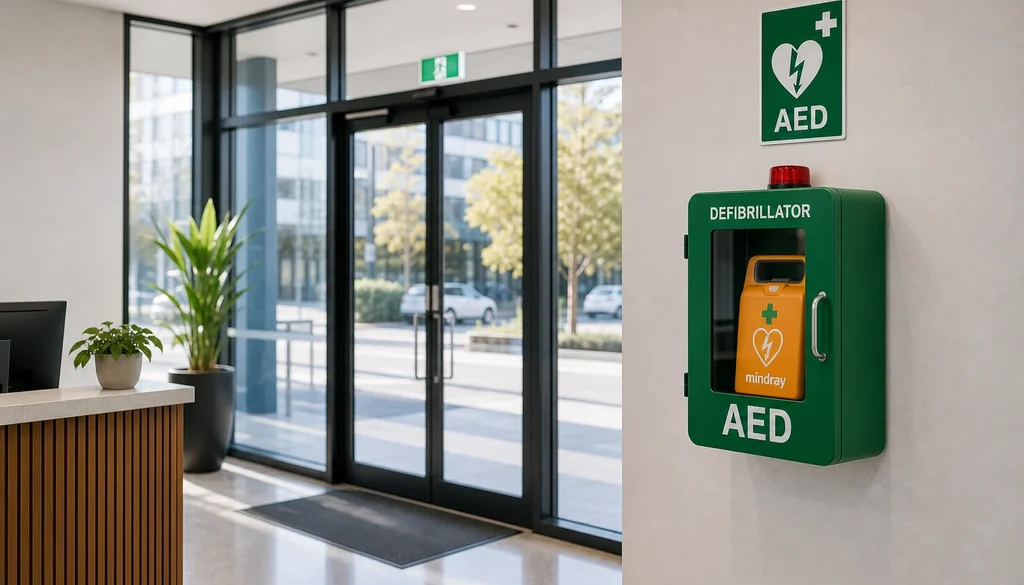
If you’ve just installed an AED in a South Australian commercial building, the device itself is only one part of the job. The Automated External Defibrillators (Public Access) Act 2022 also requires signage — and most owners I talk to either skip it or overdo it. Here’s what’s actually required, what’s recommended, and what a compliant signage layout looks like in practice.
The two signs the Act actually requires
SA Health’s Best Practice Guide (v3.0, Feb 2026) sets out the signage requirements that flow from the Act and Regulations. There are two compulsory signs for a typical building install:
- A sign near the AED itself — so anyone close to the device can see it
- A sign outside and near the entrance of the building or facility — so someone arriving in a hurry, or a paramedic talking to a bystander over the phone, can confirm an AED is nearby before stepping inside
For AEDs mounted outside a building, you need a sign near the AED indicating one is present. For AEDs carried in vehicles (trains, trams, public buses, emergency service vehicles), the sign goes on the outside of the vehicle so it’s visible without opening doors.
That’s the legal floor. Two signs in a typical office or retail install — entrance and AED — and you’re meeting the Act’s signage rule.
What goes on the signs
The Act doesn’t dictate the artwork. SA Health publishes templates and you’re welcome to use them, but as long as the signs are unmistakeable and use the standard symbol, you’re inside the rules.
In practice, that means:
- The Australian Resuscitation Council (ARC) approved AED symbol — the green and white running figure with the heart-and-lightning-bolt. Don’t invent your own icon
- Clear directional cue if the sign isn’t right next to the device (“AED located inside reception”)
- A note to call 000 in case of cardiac arrest is recommended but not strictly required
SA Health hosts template artwork on its AED page. We download fresh copies for each install so the signage is consistent across our SA fleet — and so we know it’s the version SA Health currently endorses, rather than an older PNG that’s been doing the rounds.
Recommended additions for larger buildings
SA Health’s Best Practice Guide adds a layer of recommendations on top of the mandatory minimum. They’re not enforceable in the same way, but they’re the difference between “technically compliant” and “actually findable in an emergency”.
The big ones:
- Floor-by-floor signage in multi-storey buildings — ideally near each lift bank — indicating which floor the AED lives on
- Cabinet markings — the AED symbol applied to the cabinet itself or the wall bracket, so the device reads as an AED from across a foyer
- A CPR/AED instruction chart placed next to the device, so a bystander has a clear visual prompt while the AED voice-prompts walk them through the rest
If you’ve got a four-storey commercial building and the AED lives in the ground floor reception, a single sign at the reception desk isn’t doing the job. Someone on level 3 watching a colleague collapse needs to know, immediately, where to run. Lift-area signage on each floor solves that.
Where signs typically sit on the wall
There’s no statutory mounting height for AED signage in the Act, but a few practical rules emerge from how we lay these out across SA installs:
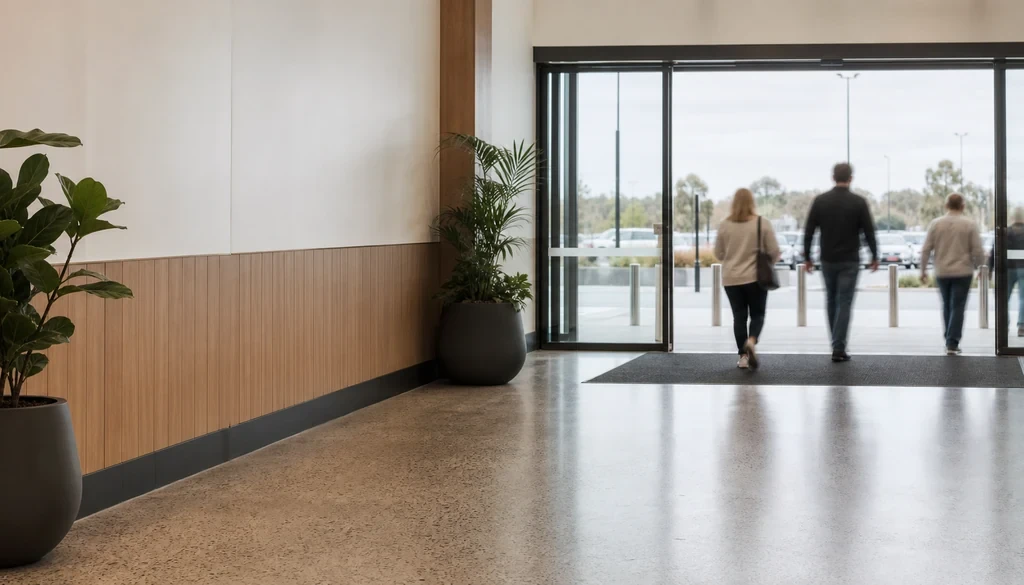
- Entrance signs — at eye level on the wall beside or above the main entry, visible from outside the door before someone walks in
- AED-location sign — directly above the cabinet, at the top of the green AED-symbol envelope, so the eye is drawn first to the sign and then to the device below
- Floor signs — at eye level on the wall opposite the lifts, or directly beside the lift call buttons, where people stand and wait
The Act requires that the AED itself is mounted so it’s publicly accessible without a key or code, and best practice puts the cabinet itself at 1.2–1.4 m from the floor. Signage sits a little above that — typically at 1.8–2.0 m so it clears the cabinet and isn’t blocked by heads in a crowded foyer.
What you can’t do with signage
Two things to watch:
- Don’t hide the device behind a locked or keyed cabinet — the Act and the Regulations are explicit. A member of the public must be able to access the AED without a key, code, or special clearance. A locked AED defeats the point and breaches the Act. Standard transparent or alarmed cabinets are fine; key-only cabinets are not
- Don’t rely on a sign alone where the AED isn’t actually accessible — if the device is behind reception, you still need a sign at the reception desk indicating it’s available on request. “There’s an AED in the back office somewhere” is not a compliant arrangement
A worked example — a 4,000 m² SA office tower
For a typical mid-sized commercial office on land used for commercial purposes, with about 4,000 m² of publicly accessible floor area across three levels, the AED count is three units (per the Regulations’ scaling table). Signage for a building like that looks like:
- Outside entrance — one sign at the main public entrance indicating AEDs are inside
- At each AED — a sign directly above each of the three cabinets, with the ARC symbol and a CPR chart card alongside
- At each lift bank on each floor — a sign indicating the nearest AED location (“AED — Ground floor, reception”)
That’s six to eight signs total for a building of that size, depending on entrances and lift arrangements. The cost is small. The clarity it adds in an actual emergency is enormous.
Registration is a separate job — don’t skip it
Signage and registration are different requirements. Both flow from the Act. Once your AED is installed and signposted, it also needs to be registered on the SA Ambulance Service (SAAS) AED Register within two weeks of installation. The register tells Triple Zero (000) call-takers where your device is and what hours it’s accessible.
Registration enquiries go through SAAS at health.saasaedregister@sa.gov.au. We register every SafePulse install on our clients’ behalf as part of the install — it’s a five-minute job that closes the compliance loop.
A practical checklist
Before signing off an SA install, the signage walk-through is:
- Sign at the building entrance — visible from outside
- Sign at every AED location — directly above the cabinet
- Cabinet markings — ARC symbol on the front
- Floor signage — at every lift bank in multi-storey buildings
- CPR instruction chart next to the device
- Registration submitted to SAAS within 14 days
That’s the whole job. Two compulsory signs to meet the Act’s minimum, and three or four optional additions that turn a compliant install into one that actually works under pressure.
Where SafePulse fits
We supply, install, sign and register every AED we deploy. The signage layouts above are what we walk through with every SA client before the cabinet goes on the wall, because once it’s mounted, moving it is a pain. If you’ve inherited an existing install and the signage is patchy, we’ll audit it as part of a maintenance visit — happy to look at what you’ve got and tell you what you’d need to bring it up to the Act’s standard.
Signage is one piece of a larger set — the device count, the SA Ambulance registration deadline and the maintenance duty all sit alongside it. If you’re working through the whole picture, start with our South Australian AED compliance overview, then the SA Ambulance register walkthrough and what maintenance the Act actually requires.
For SA buildings still working through their first install, our Basic and Smart packages include signage, registration and the cabinet at 1.2 m as part of the standard scope. Nothing additional to specify.