A construction site combines three things that don’t show up together anywhere else: live electricity, heavy plant, and a workforce that often outnumbers the nearest ambulance response time by an order of magnitude. None of those individually mandates an AED in Victoria. Stacked together, they make a strong case under the Occupational Health and Safety Act 2004 — even though the Act itself doesn’t name AEDs as required equipment.
Victoria sits in an honest middle position on AEDs. There’s no AED-specific legislation, no Bill before the Parliament, and no mandate. What there is, is an OHS duty of care plus a Compliance Code (November 2021) that explicitly tells employers to “consider” whether an AED is reasonably practicable on site. For construction, the answer to that question is almost always yes — and this piece walks through why, what the OHS framework actually requires, and how to set up an AED program that fits the way a construction site actually operates.
The Victorian legal position — short version
There is no Victorian Act or Regulation that requires an AED on a construction site. Search the consolidated legislation and you’ll find one narrow exception (the Non-Emergency Patient Transport Regulations 2016, which require AEDs in NEPT vehicles — irrelevant to building work) and nothing else.
What does apply:
Section 21 of the OHS Act 2004. An employer must provide and maintain, so far as is reasonably practicable, a workplace that is safe and without risks to health. Section 21(2)(d) adds the requirement to provide “adequate facilities for the welfare of employees.”
The OHS Regulations 2017. Give practical content to the s.21 duty for first aid, without naming AEDs as required equipment.
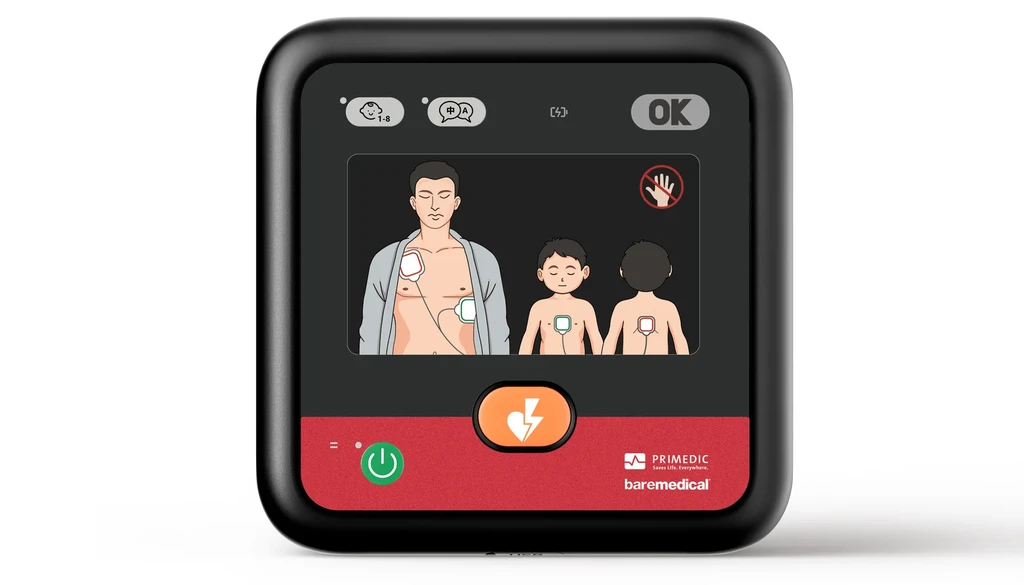
The Compliance Code: First Aid in the Workplace (November 2021). WorkSafe Victoria’s published Code, paragraphs 149–152, says employers should “consider whether it is reasonably practicable to have an automated external defibrillator in the workplace as these are not difficult to use and save lives.” The Code also addresses placement: AEDs should be in well-known, visible and accessible locations, and should not be locked.
The Code’s language is discretionary — “should consider”, not “must install”. But the Code is the document a WorkSafe inspector or a court will look at when working out whether an employer has discharged the broader s.21 duty. On a construction site, the question isn’t really whether the Code applies — it does — it’s whether the answer to “is it reasonably practicable” lands at yes.
Why construction sites usually end up on the “yes” side
The Compliance Code (mirroring the model national code) names three risk factors that make AED provision more clearly reasonably practicable:
- Risk of electrocution to workers
- Likely delay in ambulance arrival
- Large numbers of members of the public
Construction trips at least the first two on most sites.
Electrocution risk. Live electrical work, temporary site power, exposed cables, wet conditions on concrete pours, scaffold contact with overhead lines, switchboard work, lift shaft work, lighting and HVAC commissioning — every one of these is a foreseeable cardiac arrest pathway. Electrocution doesn’t just stop the heart; it stops it in a rhythm that’s often shockable. That’s exactly the scenario AEDs are designed for. The Code names electrocution risk first for a reason.
Ambulance delay. Construction sites aren’t always close to a hospital. CBD sites usually are; outer-suburban developments, regional builds, infrastructure projects on highways or in rural Victoria are not. Even on CBD sites, traffic, building access (lifts, scaffolding, secured entry) and the time it takes for paramedics to reach an injured worker on the 27th floor extend the practical response time well beyond the dispatch-to-arrival number. A defibrillator on the wall in the site shed shaves minutes off the time-to-shock — and time-to-shock is the variable that drives survival.
Workforce concentration. A medium-to-large construction site can have 100+ workers on site at peak. That’s a population concentration most office buildings don’t match. While the Code phrases this as “members of the public”, the principle applies to any concentration of people — the higher the population on site, the higher the absolute rate of foreseeable cardiac events.
Add isolated work — sole-trader contractors on site at unusual hours, weekend security, after-hours commissioning — and the conservative answer to “is an AED reasonably practicable here?” is yes on almost any construction project of any scale.
What about the federation health and safety system on building sites?
Victorian construction sits inside two overlapping frameworks: state OHS law (administered by WorkSafe Victoria) and, for projects that meet the threshold, the federal Work Health and Safety Act 2011 (Cth) through the Office of the Federal Safety Commissioner (FSC) accreditation scheme. Federal Government-funded projects of $4 million+ require the head contractor to be FSC accredited.
Neither system specifically mandates an AED. The FSC scheme builds on the model WHS framework, which is itself the source of the same “should consider” language used in the Victorian Compliance Code. An FSC audit isn’t looking for an AED on a tick-box; it’s looking for a credible safety management system. Construction firms with mature safety systems generally have an AED program because the risk register points to one, not because a federal auditor asked for it.
What “good” looks like on a construction site AED program
A construction AED program has to fit how a site actually operates: mobile workforce, multiple entry points, a site office or shed that’s the natural emergency assembly point, and a calendar that moves from “groundworks” to “fit-out” to “commissioning” — each phase with different risk profiles.
Practical elements:
1. Site office / shed as the primary location. The first AED sits where the site induction happens, where first aid kits are, where the site supervisor is based, and where any responder is most likely to come from. Sign-posted clearly, mounted at 1.2–1.4 m from the floor, not locked.
2. Additional units for vertical and large sites. On a multi-storey build, an AED per floor (or per couple of floors at peak) is the default once the structure is occupied. The same logic applies to large horizontal sites — civil infrastructure, large industrial fit-outs — where the time to walk to the site shed is longer than the time-to-shock window.
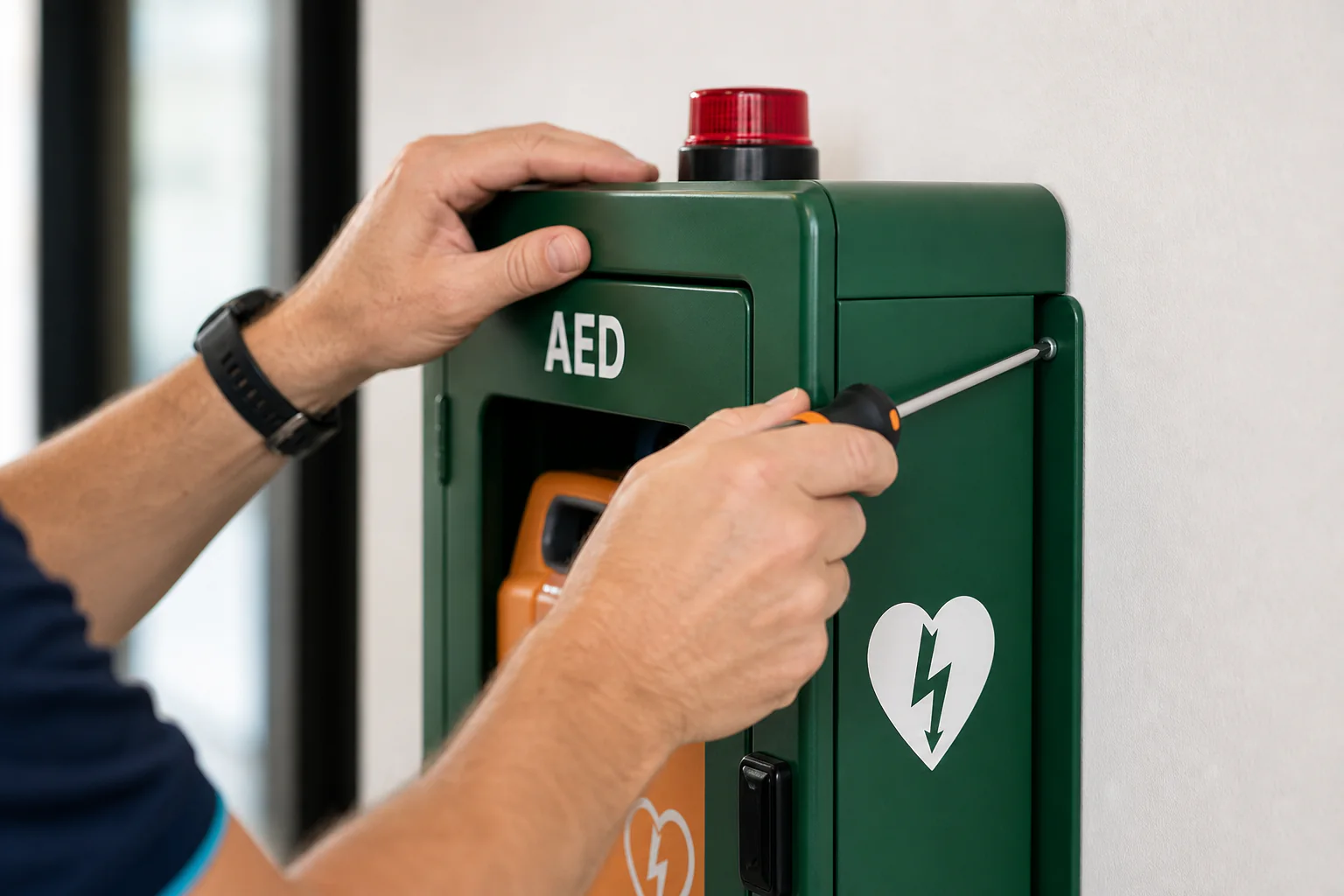
3. Cabinet selection. Construction environments are dirty, dusty and exposed. A standard internal cabinet survives in the site office. For external placements (on a scaffold-protected hoarding, or in the open at a remote site) IP55 is the floor; IP56+ is appropriate for sustained outdoor exposure or seasonal wet-weather work. Tamper-resistant cabinets matter on sites with after-hours access by subcontractors or trades.
4. Smart monitoring on remote and unstaffed sites. Where a site doesn’t have permanent staff overnight or on weekends, smart-monitored cabinets (with battery and pad status reporting, tamper alerts, GPS) save the need for a physical check that won’t happen anyway. The status appears on a dashboard the safety manager can scan in 30 seconds before each shift.
5. Training and induction. Site inductions already cover first aid, evacuation and emergency contacts. Adding 60 seconds on the location of the AED and 60 seconds on what to expect when you open one is a low-cost addition. Annual CPR/AED training for nominated first aiders pairs with the OHS Regulations’ requirement for an adequate number of trained first aiders.
6. Registration with Ambulance Victoria. Voluntary, free, and worth doing. Registration is at registermyaed.ambulance.vic.gov.au (the GoodSAM-integrated portal). For sites with multiple AEDs and multiple project phases, keeping the registry accurate as units are added or relocated is part of the maintenance schedule.
What an AED program isn’t
A few things worth being clear about — both for content honesty and so the reader doesn’t think they’ve ticked something they haven’t:
An AED isn’t first aid. It’s part of a broader first aid response that still needs trained first aiders, kits, and procedures. A construction site with an AED on the wall and no first aid plan isn’t compliant with the OHS Regulations on first aid; it’s just got one component of the response covered.
An AED program isn’t an OHS audit pass. WorkSafe Victoria looks at the whole safety system. Having an AED is good evidence under the s.21 duty; not having one isn’t an automatic finding against you, but it does become a question if a cardiac event occurs and the response was inadequate.
An AED doesn’t replace ambulance call-out. It’s the first few minutes’ bridge while paramedics are en route. The site emergency procedure still calls 000 first, and the AED gets used while the call is being made and bystanders are positioning.
What WorkSafe Victoria has actually said
WorkSafe’s published guidance on AEDs in the workplace (worksafe.vic.gov.au/safety-and-wellbeing/use-automated-external-defibrillator-aed-workplace) lays out the same case in WorkSafe’s own words:
“Very few people survive a cardiac arrest without immediate assistance. The use of an AED can improve the chances of a person’s survival dramatically.”
“Anyone can use an AED on someone who is suspected of being in cardiac arrest. You do not need specialised AED training.”
“Employers must provide ‘a safe and without risks to health’ working environment. Employers should consider whether it is reasonably practicable to have an AED on site as a risk control measure.”
That language — “must provide” the safe environment, “should consider” the AED — is the structure of the Victorian position. The duty is hard. The specific control is risk-assessed.
What to do about it
If you’re a construction company, principal contractor, or site safety manager in Victoria and you don’t have an AED program in place:
- Run the risk-assessment honestly. Does the site have any of: live electrical work, scaffold near overhead lines, isolated work, ambulance response over 8–10 minutes, 50+ workers on site at peak? If any are yes, the “reasonably practicable” answer is almost certainly yes.
- Decide the count and locations. One in the site office as the baseline. Additional per floor / per zone as the site scales.
- Pick a device and cabinet. TGA-approved unit. IP55+ for any outdoor placement. Tamper-resistant for unattended sites. Smart-monitored if the site doesn’t have daily physical attendance.
- Pair with training and procedures. First aider training (HLTAID011 or equivalent) including AED orientation. Site induction adds AED location and use.
- Register with Ambulance Victoria. Voluntary, free, and lets 000 call-takers direct to your device.
- Maintain it. Monthly visual check, pad/battery replacement per manufacturer schedule. A managed-service arrangement absorbs the operational overhead and keeps documentation current.
Fixed industrial sites face a version of the same reasoning — why electrocution risk tips the scale in Victorian industrial workplaces. Both sit under the duty explained in Victorian OHS duty of care. Our Victorian AED page covers the state position.
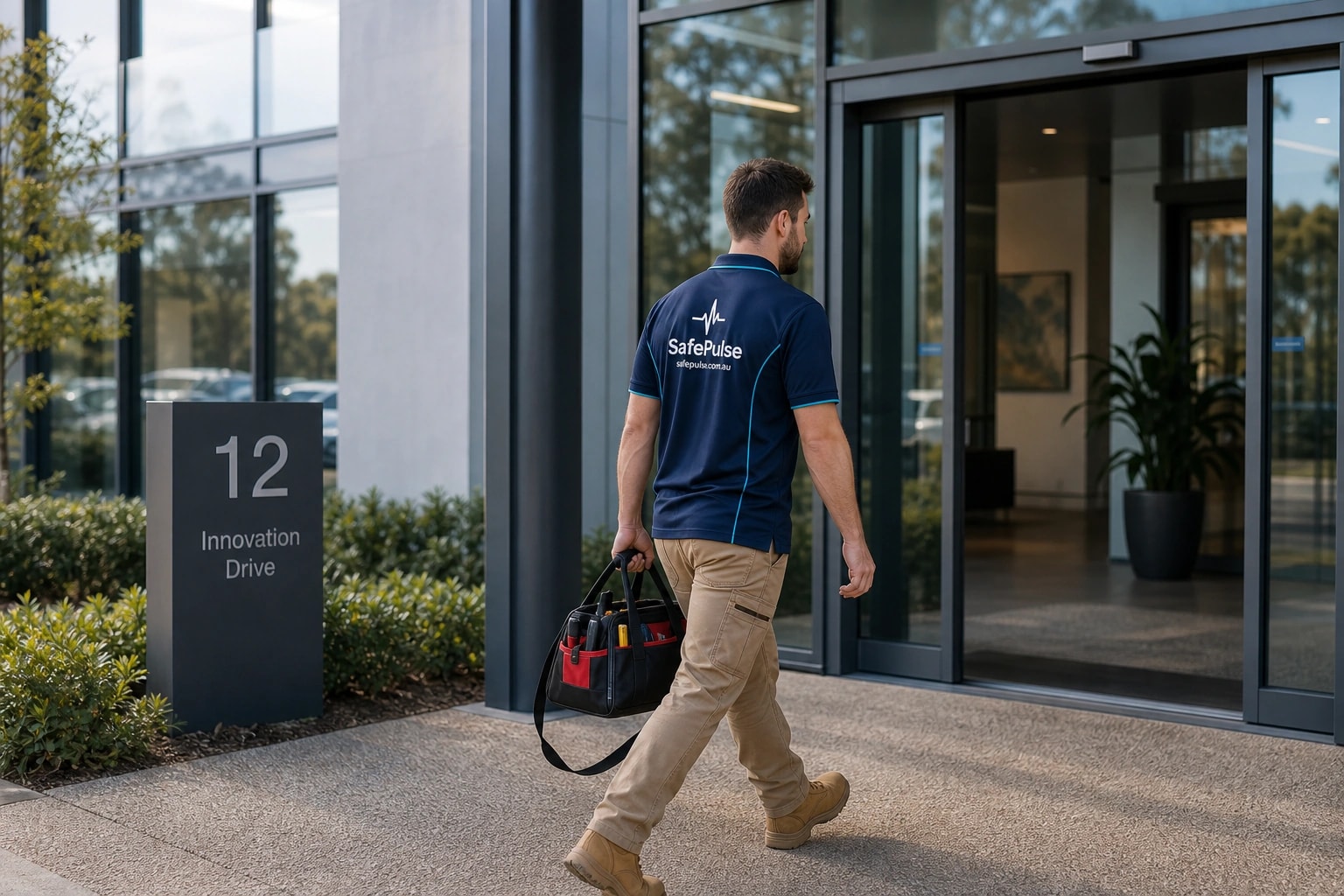
SafePulse installs and maintains AED programs on Victorian construction sites — single-build to multi-site contractors. We work to the same OHS framework you do: install, register, maintain, and document the program so it appears in your safety file the way an auditor would expect to see it. If you’d like to walk through what that looks like for a current project, get in touch.