Victoria has no law that requires an AED in an industrial workplace. No Act, no bill, no deadline. But if I had to pick the one type of site where the honest “should you have one?” question turns into a fairly clear yes, it’s a workplace where people work around electricity.
Here’s the logic, plainly. An electric shock can throw the heart into a chaotic rhythm called ventricular fibrillation. That’s cardiac arrest, and a defibrillator is the only thing that reverses it. So on a site where electrocution is a real hazard, the workplace itself creates the exact emergency an AED is built to treat. That changes the calculation in a way it doesn’t for a quiet office.
Let me walk through what Victorian law actually asks of you, and why the electrical risk profile is what tips it.
What Victoria actually requires
There’s no Victorian AED legislation. A search of Victorian consolidated legislation turns up no Act that requires defibrillators in commercial or industrial workplaces, and no bill has ever been tabled on it. So nobody’s going to fine you specifically for not having one.
What you do have is a general duty. Section 21 of the Occupational Health and Safety Act 2004 requires employers to provide and maintain, so far as is reasonably practicable, a working environment that’s safe and without risks to health. The OHS Regulations don’t name AEDs as required equipment — the detail sits in WorkSafe Victoria’s Compliance Code: First Aid in the Workplace (November 2021).
On defibrillators, the Code’s language is discretionary. It says employers should “consider whether it is reasonably practicable to have an automated external defibrillator in the workplace as these are not difficult to use and save lives.” That’s WorkSafe Victoria — the state’s workplace safety regulator — and “should consider” is the outer edge of the requirement. Not “must have.”
So the real question in Victoria isn’t “does the law force me to.” It’s “is it reasonably practicable, given the risks on my site?” And that’s where an industrial workplace answers differently to a shopfront.
Why “reasonably practicable” leans toward yes on an electrical site
The reasonably practicable test weighs the likelihood and severity of harm against the effort and cost of controlling it. Two things about an electrical industrial site push it toward having a defibrillator.
The first is the hazard itself. Manufacturing plants, EV and auto workshops, switchboard rooms, electrical contracting, plant maintenance, high-voltage equipment — these are environments where a cardiac arrest can be caused by the work, not just by an unlucky worker’s heart. When the mechanism of injury is on your site, the foreseeability of the emergency is higher, and a control that directly treats it is harder to argue away as impractical.
The second is time. An AED works best in the first few minutes of a cardiac arrest, and survival drops sharply with every minute that passes. Many industrial sites sit in outer-suburban or regional Victoria where ambulance response takes longer than it does in the CBD. Isolated work, large sites where it takes minutes just to reach the casualty, and a shift-work pattern that thins out the number of people around all stretch that clock further. The device on the wall buys back the minutes you can’t get from the ambulance.
Put those together — a hazard that can cause cardiac arrest, plus a response time that may be too slow to help — and the case for an AED stops being a nice-to-have. It’s a straightforward reading of the duty you already carry under section 21.
The ageing-workforce factor
There’s a background risk that applies to most industrial sites regardless of the electrical angle. The trades and manufacturing workforce skews older and more male than the general working population, and that’s the demographic most exposed to sudden cardiac arrest. Physically demanding work adds exertion to the mix. None of that is a legal trigger in Victoria — but it’s part of an honest risk assessment, and it’s why “we’re a low-risk site” doesn’t always hold up on closer inspection.
What good looks like on an industrial site
If you decide the case stacks up — and on most electrical sites it does — a few things matter for getting it right.
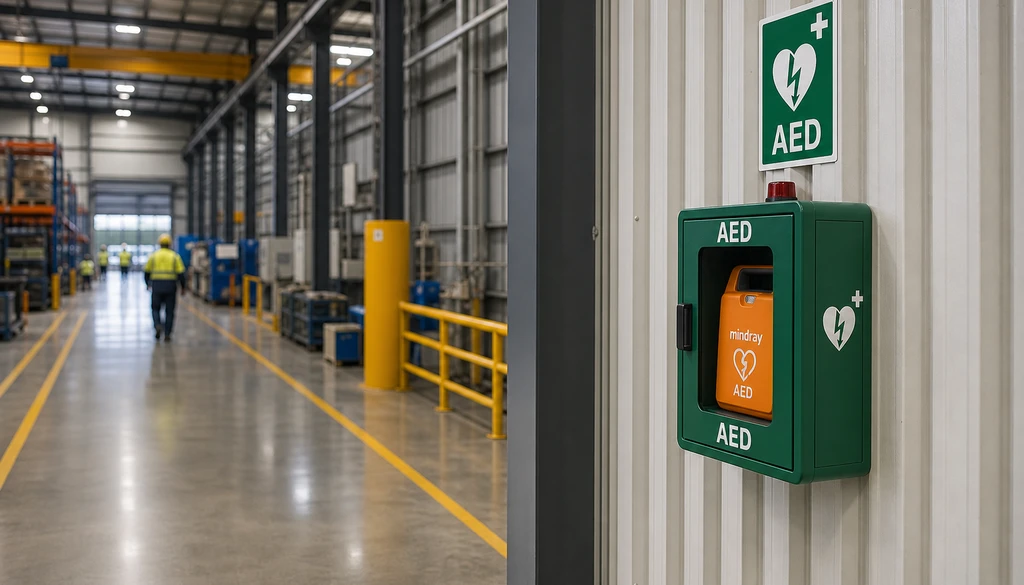
Placement. WorkSafe Victoria’s guidance is that AEDs “should be installed in well-known, visible and accessible locations” and “should not be locked.” On a big site that usually means more than one point, or a central location everyone knows, signed clearly. A defibrillator locked in the site office after hours isn’t much use to a night shift.
The cabinet and the environment. Industrial settings are dusty, wet, hot or cold, and knock things around. A cabinet with a sensible IP rating protects the unit. Industry practice is IP55 or above for outdoor or exposed positions — worth knowing that’s best-practice guidance, not a Victorian regulation, so treat it as sound engineering rather than a legal line.
A TGA-approved unit. Any AED sold and used in Australia must be approved by the Therapeutic Goods Administration. That’s a federal requirement and it applies in Victoria like everywhere else. Buy from a reputable supplier and it’s covered.
Maintenance. Pads and batteries expire. A unit that’s present but out of date can fail when it’s needed. Whoever owns the site’s safety gear needs to track expiry and replace on schedule — the same discipline you’d apply to any other critical safety equipment.
No training barrier. You don’t need certified staff before you install one. WorkSafe Victoria is clear that anyone can use an AED — the unit gives voice prompts and talks the user through it. Training is worthwhile, especially on a site with specific hazards, but it’s not a reason to delay putting the device on the wall.
Registering it — voluntary, but do it
Ambulance Victoria runs a free, voluntary AED register through the GoodSAM platform. There’s no legal requirement to register in Victoria, but it’s worth ten minutes. Once registered, your AED’s location is shared with Triple Zero call-takers, so if someone on your site calls 000 during a cardiac arrest, the dispatcher can point them straight to it. It also surfaces the device to nearby GoodSAM responders. Registration is at registermyaed.ambulance.vic.gov.au.
The bottom line for Victorian industrial sites
Nobody in Victoria is going to hand you a fine for not having an AED. But the general OHS duty doesn’t disappear just because there’s no defibrillator-specific law, and on a site where electricity can stop a heart, the reasonably practicable test does real work. The question WorkSafe Victoria wants you to have asked — and documented — is whether it’s practicable to have one. On an electrical or industrial site, the honest answer is usually yes.
Electrocution risk feeds the reasonably-practicable test set out in Victorian OHS duty of care and the WorkSafe Victoria Compliance Code. Construction sites raise the same issue on a changing site — see construction site AEDs in Victoria. Our Victorian AED page has more.
At SafePulse we install and maintain AEDs for commercial and industrial sites, including the parts that matter most here — placement across a large or hazardous site, a cabinet rated for the environment, and keeping the consumables in date so the unit works the day something goes wrong. If you’re weighing it up for a Victorian site, we’re happy to talk it through.