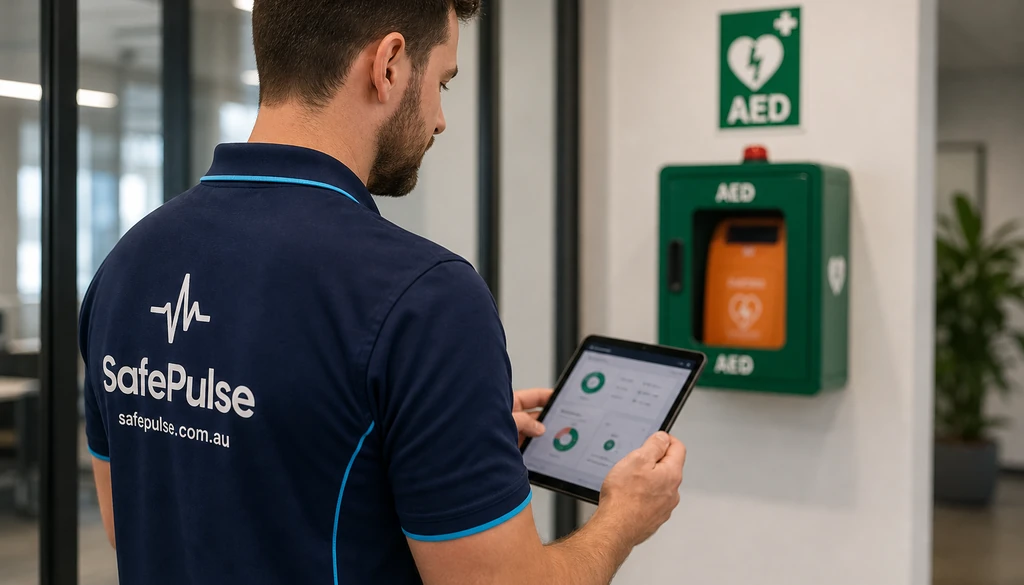
You’ve put an AED in your Victorian workplace. There’s one more job worth doing, it takes about ten minutes, and it costs nothing — registering the device with Ambulance Victoria through GoodSAM. Here’s exactly how it works, what you’ll need on hand, and why it’s worth the ten minutes even though no law in Victoria requires it.
First, the honest bit — registration is voluntary
Unlike South Australia, Victoria has no AED legislation, and there’s no legal requirement to register your device. We say that up front because plenty of suppliers blur the line, and a registration page isn’t a compliance obligation in Victoria.
What registration is, instead, is the single most useful free thing you can do with an AED after you’ve installed it. It’s the difference between a device that only your own people know about and a device that the ambulance system can point a stranger to when someone collapses nearby. That’s worth ten minutes.
Why register at all
Ambulance Victoria runs a free AED registry built on the GoodSAM platform — the same system New South Wales uses. When you register, your device’s location and access details feed two things:
- Triple Zero call-takers. If someone calls 000 reporting a cardiac arrest near your building, the call-taker can see your registered AED and direct a bystander to it. In cardiac arrest, the minutes spent finding a defibrillator are minutes that matter.
- GoodSAM Responders. Trained responders who’ve opted in get real-time alerts when there’s a cardiac arrest nearby, and those alerts include the location of registered AEDs. Your device becomes part of that network.
An unregistered AED helps the people who already know it’s there. A registered one helps everyone within reach of it.
What you’ll need before you start
Have these to hand before you open the form — it makes the whole thing quick:
- Your contact details and an email address (you’ll use it to manage the registration)
- The AED’s brand, model and serial number (on the device or its box)
- The electrode pad expiry date and the battery expiry date
- The exact location — street address plus where in the building the device sits (e.g. “ground floor, reception wall, left of the lifts”)
- The access hours — when the device can actually be reached (business hours only, or 24/7), and whether it’s publicly accessible or behind a staffed desk
That last point matters. Be honest about access hours. A device locked inside an office that’s only open 9-to-5 should be registered as exactly that, so the system never sends someone to a door they can’t get through.
Step by step
- Go to the registration form. Ambulance Victoria’s AED registry lives at registermyaed.ambulance.vic.gov.au, and the registration form itself runs through GoodSAM at goodsamapp.org/AV_AED.
- Create or sign in to a GoodSAM account. Setting up an account lets you come back and update the device’s details later — which you’ll want to do every time pads or the battery are replaced. It’s worth doing properly rather than as a one-off.
- Enter the device details. Brand, model, serial number, and the pad and battery expiry dates from your checklist.
- Set the location. Enter the address and place the marker accurately on the map. Add the in-building description so a responder isn’t hunting floor to floor.
- Set the access hours and accessibility. Choose the real availability — 24/7, business hours, or custom — and note whether it’s publicly reachable or via reception.
- Submit. That’s the registration done. Your device is now visible to Triple Zero and the GoodSAM responder network.
If you’ve got multiple devices across several sites, register each one separately so every location is mapped. If you’d rather not do it yourself, you can reach the Register My AED program by email at aed.register@ambulance.vic.gov.au.
Keeping the entry current
Registration isn’t quite set-and-forget. Two things keep it useful:
- A monthly check. Ambulance Victoria recommends assigning one or two people to check each month that the device is working and the pads and battery haven’t expired. It’s a two-minute look — a status light and two dates.
- Update the registration when consumables change. Every time you replace pads or the battery, update the expiry dates on the GoodSAM record. An entry showing expired pads is worse than useless — it tells the system there’s a working device where there might not be.
This is exactly the kind of small recurring task that quietly lapses once the install excitement wears off. Tie it to whoever already does your monthly safety walk-around and it won’t.
What Ambulance Victoria does if your AED is used
Worth knowing, because it’s a genuine benefit of being in the system. If your registered device is used in a public emergency, Ambulance Victoria will:
- Arrange to recommission the device so it’s ready to go again
- Download the patient data from the unit and pass it to the treating hospital
- Return the device, typically within 72 hours
- Provide free replacement electrode pads after a use in a public emergency
So registration isn’t only about being findable — it also means you’re not left working out how to get a used device back into service on your own.
A quick word on the bigger picture
Registration sits at the end of a chain, and it only works if the earlier links are sound. A registered AED with flat batteries or expired pads will still show up on the map — and still fail when someone needs it. WorkSafe Victoria’s guidance is blunt on this: the device has to actually work. So treat registration as the finishing step on a properly maintained device, not a substitute for maintaining it.
Where SafePulse fits
We supply, install and maintain AEDs across Victoria, and we handle the GoodSAM registration as part of the install — so the device is on the map from day one with accurate location and access details. Our maintenance plans keep pads and batteries in date and the registration record current, which means the entry Ambulance Victoria sees always reflects a device that’s genuinely ready.
Registration is voluntary in Victoria, which is worth reading against what the state does expect — Victorian OHS duty of care and the WorkSafe Victoria Compliance Code, which notes that registration helps cut the time taken to find a device. Our Victorian AED page has the state position.
If you’ve got an AED that’s never been registered, or you’re planning one and want the whole thing — install, registration and ongoing servicing — handled in one go, get in touch at safepulse.com.au/vic/.


