Almost every AED I’ve opened up that failed a check failed for one of two reasons: the pads were out of date, or the battery was flat. Not a fault, not a defect. Just a device nobody had looked at since the day it went on the wall.
So it’s worth being precise about what Australian law actually asks of you, because the answer changes depending on which state you’re standing in.
The short version
There’s one jurisdiction where maintaining your AED is a legal duty in its own right: South Australia. Everywhere else, maintenance isn’t named in legislation at all — it arrives indirectly, through your general work health and safety duty and the first-aid code of practice your state has adopted.
That doesn’t make it optional. It makes it less specific, which is a different problem. If your only rule is “maintain it per the manufacturer’s instructions”, you need to know what those instructions actually say.
South Australia: the only place it’s a legal duty
The Automated External Defibrillators (Public Access) Act 2022 (SA), supported by the 2024 Regulations, has applied to privately owned buildings in scope since 1 January 2026. It requires AEDs to be maintained in accordance with the manufacturer’s instructions, and failure to maintain one is listed as an offence — alongside failing to install, sign or register a device. Authorised officers can inspect premises and issue expiation notices.
Two details catch people out. The duty sits with the owner, not the tenant — a lease can shift who pays but not who’s answerable. And registration on the SA Ambulance Service AED Register is mandatory, with any change to location or access hours updated within two weeks.
If you’re in South Australia, we’ve written that up in detail in AED maintenance under SA law.
Everywhere else: the duty is real, just indirect
NSW, Victoria, Queensland, WA, the ACT, Tasmania and the Northern Territory have no AED-specific legislation. NSW came closest — three private member’s Bills, all lapsed, the last in May 2025. Nowhere else has an Act or a Bill before parliament.
What all of them have is a primary duty of care: ensure health and safety so far as is reasonably practicable, and provide first-aid equipment workers can actually get to. In Victoria that’s the Occupational Health and Safety Act 2004; elsewhere it’s the state’s version of the model WHS Act. The first-aid codes of practice then say a version of the same thing — you should consider an AED where there’s electrocution risk, ambulance delay, or large numbers of the public. Discretionary language, deliberately.
Here’s the part that matters for maintenance. Once you’ve decided to install one, the codes stop being discretionary about the state it’s kept in. Victoria’s Compliance Code: First Aid in the Workplace (November 2021, still current) says AEDs “should be installed in well-known, visible and accessible locations. They should not be locked.” The Northern Territory’s code ties placement and upkeep together in one line: devices “should be located in an area clearly visible, accessible and not exposed to extreme temperatures. They should be clearly signed and maintained according to the manufacturer’s specifications.”
| Jurisdiction | AED Act in force? | Maintenance duty | Registration |
|---|---|---|---|
| SA | Yes | Legal duty — failure to maintain is an offence | Mandatory (SA Ambulance register, 2 weeks) |
| NSW | No — three Bills lapsed | Via WHS duty + code; recommended | Voluntary (NSW Ambulance / GoodSAM) |
| VIC | No | Via OHS duty + Compliance Code; recommended | Voluntary (Ambulance Victoria / GoodSAM) |
| QLD | No | Via WHS duty + code; recommended | Voluntary (QAS — own-property alerts only) |
| WA | No | Via WHS duty; Bulletin No. 11 is explicit on upkeep | Voluntary (St John WA State Defib Network) |
| ACT | No | Via WHS duty + code; recommended | Voluntary (St John register — no government registry) |
| TAS | No | Via WHS duty + code; recommended | Voluntary (GoodSAM, also feeds LISTmap) |
| NT | No | Via WHS duty + code; recommended | Voluntary (St John NT First Responder app) |
The one regulator that put maintenance in the title
If you read one government document on this, read WorkSafe WA’s Health and Safety Bulletin No. 11 — Provision and maintenance of automated external defibrillators at workplaces, published September 2023 and last updated November 2024. It’s the only Australian regulator publication I know of with AED maintenance in its title, and it’s blunt about what goes wrong: flat batteries, expired pads, and devices that aren’t visible or accessible when someone needs them.
The reasoning it gives is why any of this matters:
“Defibrillation is the only way to restore a heart with a fatal heart rhythm back to normal. As a consequence, if an AED fails to operate when used on a person who is in cardiac arrest, first aid will not be effective or reduce the risk of fatality.”
That’s WorkSafe WA, and although it’s written for WA workplaces the logic isn’t state-specific. There’s no partial credit with a defibrillator — it either works when it’s picked up or it doesn’t. An unmaintained device gives you the appearance of cover without the substance, which is arguably worse than an empty wall, because nobody goes looking for a second option.
What “per the manufacturer’s instructions” actually means
Every jurisdiction lands on that phrase, so it’s worth unpacking. Exact intervals vary by make and model — always work from your own device’s instructions for use — but the pattern is consistent across the public-access units we install and service.
Pads expire most often. They’re a gel consumable with a shelf life of a few years from manufacture, not from the day you installed the device. Buy an AED with pads already a year into their life and you’ve got less runway than you think, and dried-out gel doesn’t adhere properly — adhesion is what delivers the shock.
Batteries need replacing on schedule, not on symptom. They last several years. Waiting for a warning indicator is the wrong model: by the time a battery is complaining, it’s already been the weak point in your response for a while.
The self-test does less than most owners assume. Modern AEDs run internal checks and show a status indicator, which is genuinely useful. But a self-test confirms the device’s electronics are healthy. It can’t tell you the pads are in date, the cabinet is undamaged, or that nobody’s parked a filing cabinet in front of it. Those checks are human.
Environment counts as maintenance. Heat degrades pad gel and shortens battery life, which is why the NT code names extreme temperatures explicitly and why outdoor placements need a properly rated enclosure. A device in a hot vehicle is ageing faster than the label interval assumes.
One live example of why your specific device’s instructions are the real source of truth: in 2025 the TGA published product corrections for two current Mindray public-access models — manual and configuration updates, not recalls — one covering battery drain associated with wireless self-test reporting. A generic maintenance schedule doesn’t catch that.
A routine that holds up anywhere in Australia
Ambulance Victoria’s cadence is a good national baseline, and refreshingly plain: assign one or two people to check monthly that the AED is functioning correctly and that the electrodes and pads haven’t expired. Underneath that monthly layer, a six-monthly service does the substantive work.
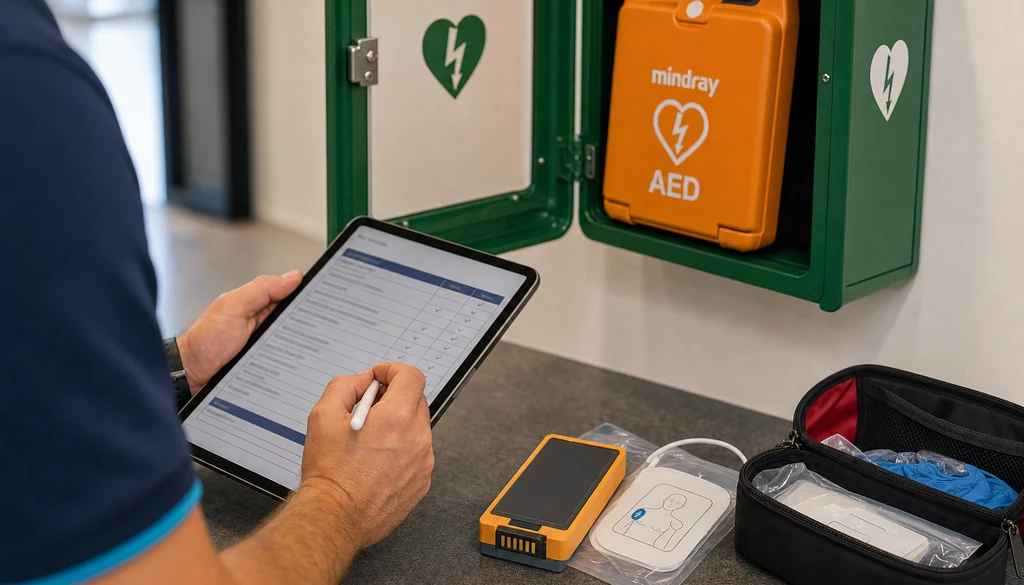
Monthly, by your own staff — under a minute. Status indicator showing ready. Pads and battery in date. Cabinet undamaged, signage legible, nothing stacked in front of the device. Named person, dated record.
Six-monthly, properly. Open the unit, replace pads and battery ahead of expiry rather than after it, check connections, confirm the placement still makes sense for how the building’s being used, and update the record.
After any use, immediately. Pads are single-use, and a deployed device isn’t ready again until it’s restocked and re-tested. Worth knowing in Victoria: Ambulance Victoria arranges recommissioning for registered devices used in a public emergency, downloads the patient data for the treating hospital, returns the unit within 72 hours and provides free replacement pads.
Whenever anything changes. New tenant, refit, relocated reception, changed access hours. In SA a location or accessibility change has to reach the SA Ambulance register within two weeks. Elsewhere it isn’t mandated — but a register entry pointing at a wall where the AED used to be is worse than no entry.
Keep it written down. In SA that record is what demonstrates you’ve met the duty. Everywhere else it’s what demonstrates you took a foreseeable risk seriously, and that’s the whole test under WHS law.
Registration isn’t maintenance, but it’s tied to it
Operators with sites in several states routinely assume one registration model applies everywhere. It doesn’t. SA is mandatory. NSW, Victoria and Tasmania run on GoodSAM, which alerts nearby registered responders and shows them the closest registered AED — Tasmania’s entries also feed the public LISTmap layer. WA uses St John WA’s State Defib Network and the NT the St John NT First Responder app. Queensland’s QAS register only helps if the arrest happens at your own property, and the ACT has no government registry at all.
The maintenance link is direct: several states collect pad and battery expiry at registration, so an entry you never revisit is a stale one. A device on a public map that turns out to be dead is worse than one nobody knew about.
What we’d suggest
In South Australia, maintenance is a legal obligation with an offence attached, so treat it that way. Everywhere else, nobody’s going to fine you for a flat battery — but you made a decision to rely on that device, and the reasonably-practicable test asks whether you followed through.
Either way the practical answer is the same: know your device’s actual intervals, put a named person on a monthly look, get a real service every six months, keep the record, and register it where your state offers it.
We install and maintain AEDs across all eight states and territories, with a maintenance plan bundled into every install so the checks aren’t left to memory. If you’ve got devices on site and you’re not confident when the pads expire, that’s the place to start — see how our installation and maintenance service works, or the practical side of upkeep in keeping your AED ready when it matters.
Frequently asked questions
Is AED maintenance legally required in Australia?
In South Australia, yes — failure to maintain an AED is an offence under the Automated External Defibrillators (Public Access) Act 2022. Everywhere else there’s no AED-specific law, so the obligation comes indirectly through your WHS or OHS duty and the state’s first-aid code of practice, which say devices should be maintained according to the manufacturer’s specifications.
How often should an AED be serviced?
Ambulance Victoria’s guidance is a sensible national baseline: a monthly check by a nominated person that the device is functioning and the pads haven’t expired, plus a fuller six-monthly service covering pad and battery expiry, connections, cabinet condition and placement. Restock and re-test immediately after any use.
How long do AED pads and batteries last?
Pads have a shelf life of a few years from manufacture, not from installation — check the printed date rather than assuming a full term. Batteries typically last several years and should be replaced on schedule, not when a warning appears. Intervals differ by make and model.
Who maintains an AED in a leased building?
In South Australia the Act places the duty on the owner, not the tenant — a lease can allocate cost but not the legal duty. Elsewhere it follows the WHS duty of whoever manages or controls the workplace, which in multi-tenant buildings can mean overlapping duties. Name it in writing either way.