Most of the attention on South Australia’s AED law has been about getting a device on the wall by the deadline. That’s the easy part. The part that quietly trips people up comes later: keeping it ready. The Act doesn’t just require you to install an AED — it requires you to maintain one. A defibrillator with flat batteries or expired pads isn’t a compliant AED, and on the day it’s needed, it’s not much of a defibrillator either.
Here’s what the law actually says about maintenance, what “per the manufacturer’s instructions” means in practice, and how to set up a routine that keeps you both compliant and genuinely rescue-ready.
What the Act says — and what it doesn’t
South Australia’s Automated External Defibrillators (Public Access) Act 2022 is the only AED law of its kind in the country. It puts a clear maintenance duty on building and facility owners, but it does it in a deliberately light-touch way.
The requirement is that an AED installed under the Act must be maintained in accordance with the manufacturer’s instructions. That’s the legal standard. The Act doesn’t hand you a fixed checklist or a mandated inspection interval — it points you back to whatever the maker of your specific device says, because a Mindray, a HeartSine and a Zoll don’t all have the same battery and pad cycles.
What the Act does make plain is that failure to maintain an AED is an offence. It sits in the same list of offences as failing to install one, failing to register it, or failing to put up the signage. So maintenance isn’t a soft recommendation under SA law — it’s part of staying compliant. The flexibility is only in how you do it, not whether you do it.
SA Health’s Best Practice Guide adds the sensible bit the Act leaves out: it recommends owners establish a regular inspection schedule, and it’s clear that the responsibility for that schedule sits with the owner of the building, facility or vehicle — not the tenant, not whoever happens to walk past it each day.
Who actually carries the duty
This is worth saying plainly, because it catches landlords out. Under the SA Act, the maintenance obligation falls on the owner, the same party who carries the install duty. If you own a building and lease it to a business, the legal duty to keep the AED maintained is yours, even though the tenant is the one in the building day to day.
In practice the smart arrangement is to put maintenance on a plan and document who’s doing what, so it doesn’t fall into the gap between “the owner assumed the tenant was checking it” and “the tenant assumed the owner had it handled.” That gap is exactly where expired pads live. If you’d like the broader picture of who’s responsible in shared and leased buildings, our piece on multi-tenancy AED responsibility in SA works through it.
What “per the manufacturer’s instructions” really means
Strip away the legal phrasing and AED maintenance comes down to a handful of practical things. Across the major brands, the recurring items are:
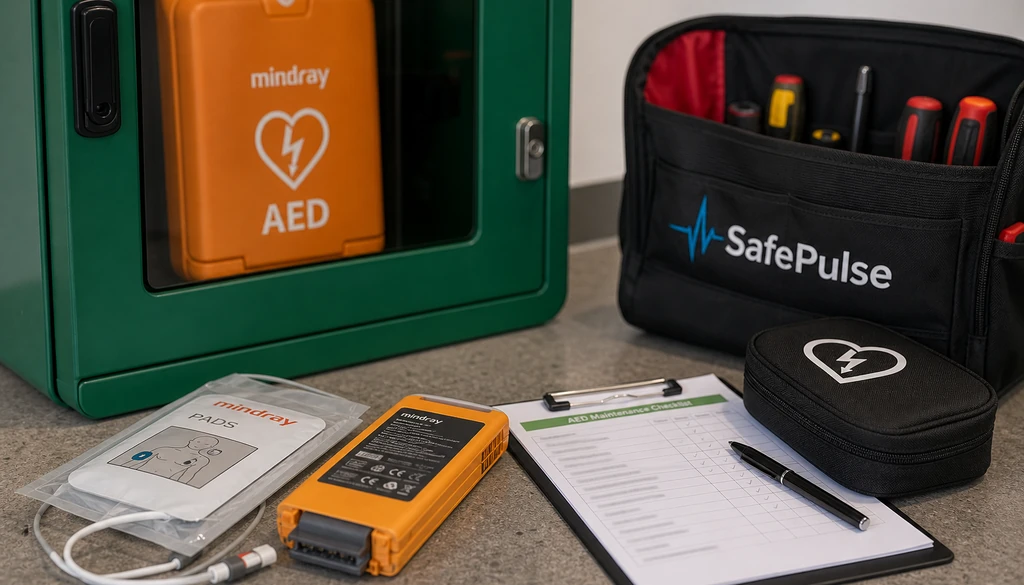
- Status checks. Every AED runs a self-test — most do it daily — and shows a ready indicator (a green tick, a flashing light, or a status window). Someone needs to actually look at it on a regular basis. A daily self-test the device passes is useless if nobody notices the day it starts failing.
- Pads. Defibrillation pads have a gel that dries out, so they carry an expiry date — typically two to four years depending on the brand. Expired pads are the single most common reason a public-access AED isn’t fit to use. They have to be replaced before they lapse, and you keep a spare set on hand.
- Battery. AED batteries have a finite standby life — often four to five years — and that life shortens every time the device delivers a shock or runs a self-test. They get replaced on the manufacturer’s schedule, not when they finally die.
- The device itself. A visual once-over for damage, the cabinet for tampering, and a check that the unit is clean, present and in its registered location.
None of this is complicated. The failure mode is almost never that someone couldn’t do it — it’s that nobody owned it, so it didn’t happen.
A workable inspection routine
The Best Practice Guide recommends a regular schedule but leaves the cadence to you. A routine that comfortably meets the manufacturer’s instructions for most commercial devices looks like this:
- Monthly (or whatever your device’s self-test cycle suggests): a quick visual — green light showing, cabinet intact, device present, nothing obstructing access.
- Every six months: a proper inspection — confirm pad and battery expiry dates, check the device has no fault codes, log the check.
- Ahead of expiry: replace pads and battery on the manufacturer’s timeline, not after they’ve lapsed. Diarise the dates the day you install, so they’re never a surprise.
- After any use: the device needs new pads (and often a battery check) before it goes back on the wall. A used AED is not a ready AED until it’s been reset and re-kitted.
Write it down. A simple maintenance log — date, who checked it, pad and battery dates, any action — is the thing that shows the duty was discharged. If an authorised officer ever asks, “ready” plus a record beats “I’m pretty sure someone looks at it.”
Maintenance and the rest of your obligations
Maintenance doesn’t sit on its own — it’s one strand of staying compliant under the Act, alongside registration and signage.
Your AED has to be registered on the SA Ambulance Service AED register within two weeks of installation, and if you ever move it or change its accessible hours, you update the register within two weeks again. That register is what Triple Zero call-takers use to send a bystander to your device, so keeping it accurate is part of keeping the AED useful. We walk through that process in our step-by-step guide to the SAAS register.
And maintenance only counts if the device is reachable. It still has to be publicly accessible and unlocked — a cabinet is fine, a locked cupboard isn’t — and the required signage has to stay in place. A maintained AED nobody can find or get to doesn’t do the job.
The honest reason this matters
You can treat maintenance as a compliance box, and that’s fair enough. But the real reason it’s in the Act is simpler. Survival from a cardiac arrest drops sharply with every minute that passes without defibrillation. The whole point of a public-access AED is that it works the first time, immediately, in the hands of someone with no training. Expired pads or a flat battery turn that device into wall furniture, and worse — because everyone in the building assumes the AED works, nobody’s planning to do anything else.
Maintaining it isn’t busywork. It’s the difference between a device that saves a life and a green box that gives everyone false confidence. For the broader, non-SA-specific picture of what “rescue-ready” looks like, our practical guide to keeping your AED ready is a good companion to this.
Where SafePulse fits
Every AED we install comes with a maintenance plan, because under SA law the device on the wall is only half the obligation. Our plans cover the six-monthly inspections, pad and battery replacement on the manufacturer’s schedule, and a record of every check — so the maintenance duty is genuinely handled, not just assumed. On our Smart installs, daily digital monitoring does the status-checking for you and flags a problem the moment it appears, rather than waiting for someone to walk past and notice.
For the hands-on side of that duty — what to actually check and how often — there’s the practical guide to keeping your AED ready and how often an AED needs to be serviced. Maintenance failures are also one of the more common compliance gaps we find, alongside others in common SA AED compliance mistakes. Our SA AED compliance overview covers where this fits in the Act.
If you’ve got an AED in a South Australian building and you’re not certain it’s being maintained to the standard the Act expects, the simplest fix is to put it on a plan. You can start with a site assessment, and for the legal baseline our overview of how the SA AED laws are playing out in 2026 covers where maintenance fits in the wider compliance picture.