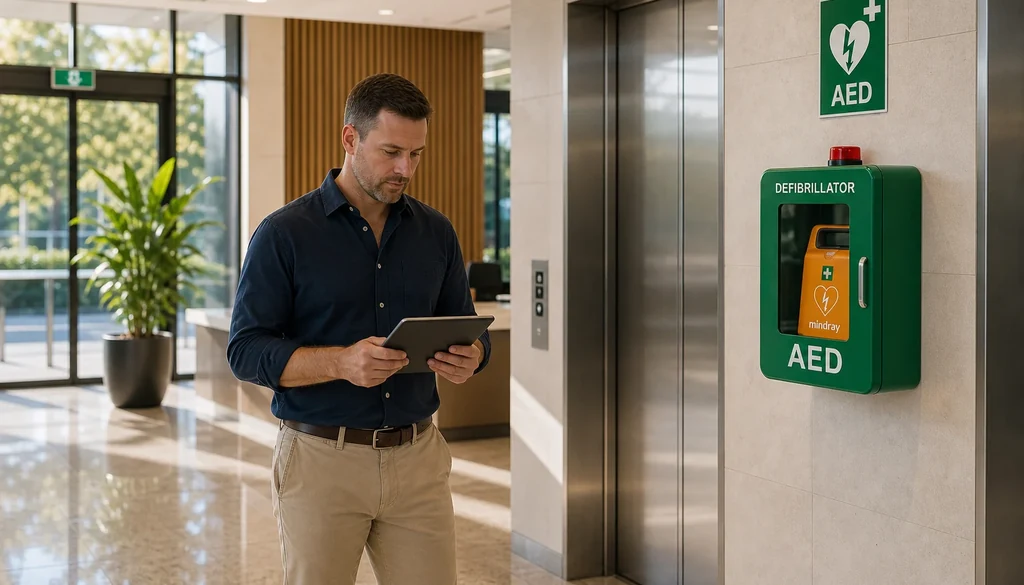
If you manage a commercial office building in the Brisbane CBD, Fortitude Valley, Milton or South Brisbane, the AED question lands differently in Queensland than it does in South Australia. SA has legislation that says you must. Queensland has the Work Health and Safety Act, the First Aid Code of Practice, and a Queensland Ambulance Service registry — but no AED-specific mandate. This piece is for the property managers and building owners working out what that actually means for their building.
The Queensland legal position, plainly
There is no Queensland Act or current Bill requiring AEDs in commercial buildings as of May 2026. The Queensland Parliament Bills register holds no AED-specific Bill (re-verified before drafting). Queensland sits under the Work Health and Safety Act 2011 (Qld) and the WHS Regulation 2011, with operational detail in the First Aid in the Workplace Code of Practice 2021.
The relevant regulation is WHS Regulation 2011 (Qld) reg 42 — Duty to provide first aid. It requires a Person Conducting a Business or Undertaking to ensure:
- Provision of first aid equipment, with workers having access
- Provision of first aid facilities where appropriate
- Adequate trained workers, or worker access to others who are trained
Nothing in reg 42 says “AED”. The detail of when an AED becomes part of “first aid equipment” comes from the Code of Practice. The Code treats AEDs as a risk-based consideration. You should consider providing one if there is:
- Risk of electrocution to workers
- Likely delay in ambulance services arriving
- Large numbers of members of the public present
For a Brisbane CBD office tower, factor 3 is where the case sits. Factor 1 applies only to specific roles (cleaning, maintenance, electrical). Factor 2 is fast in Brisbane CBD, though it gets slower the further out you move.
Who’s responsible — landlord or tenant
This is the question that comes up most often. In a multi-tenancy commercial building, who actually owes the duty to provide an AED?
The honest answer is: both, but in different ways.
The building owner (or property manager acting for the owner) controls the common areas — foyer, lifts, corridors outside tenancies, end-of-trip facilities, basement carpark, plant rooms. The owner is the PCBU for the people working in or visiting those common areas: building staff, cleaners, security, contractors, members of the public.
Each tenant is the PCBU for their own demised premises. They have their own first aid duty inside their tenancy.
For an AED program, the practical division is:
- The building owner provides the building-level AED (or AEDs) in common areas, typically in the main lobby and in upper-floor lift lobbies for larger towers
- Larger or risk-heavy tenants — a 200-person professional services firm on level 12, an aged care provider running a satellite clinic, a gym tenant — may install their own additional device inside their tenancy
A well-run commercial building has one or two AEDs in the common areas as a baseline, with the owner taking responsibility. That covers the duty for visitors, contractors and the building’s own staff, and provides a tenant-accessible device for cardiac events outside any tenancy.
The QAS registry — useful, but different to NSW or Victoria
Queensland Ambulance Service maintains its own AED registry, accessed via qld.gov.au/emergency/QAS/aed-registration-form and the QAS AED registration page.
A key thing to understand about QAS registration is what it does and doesn’t do, in the QAS service’s own words:
“Your AED location details will only notify the EMD if the suspected cardiac arrest occurs at your business or property. It will not generate an alert for calls from nearby businesses or properties.”
So registering your Brisbane office tower’s AED tells the Emergency Medical Dispatcher that you have a device on-site when someone calls 000 from your building. It does not alert nearby volunteer responders to your device the way NSW Ambulance’s GoodSAM-integrated registry does for buildings in Sydney.
For a property manager, the takeaway is: register the device anyway. The alert-back-to-the-building benefit is real, and the registry is the lightweight version of formal recognition.
Brisbane-specific factors
A few things that differ between Brisbane and the southern capitals when you’re laying out an AED program for a commercial office:
- Heat and humidity — Brisbane summers stress AED cabinets and pads more than Melbourne or Sydney. Specify a quality cabinet — ideally IP55+ even for indoor mounting near an entrance — and follow the manufacturer’s stated operating temperature range
- Vertical density — Brisbane CBD towers are tall but the precinct is compact. A device in a ground floor lobby is reachable from most floors within two to three minutes via the lift. Larger towers (more than 25 levels) should plan for a second device on a mid-level lift lobby to halve the worst-case retrieval time
- End-of-trip facilities — Brisbane buildings often feature significant cycling end-of-trip facilities (showers, lockers, bike racks). These are exercise-adjacent spaces where adult cardiac events are over-represented. A device near the end-of-trip entrance is worth considering for buildings with substantial bike commuter traffic
- Public domain interface — Brisbane CBD’s queen Street Mall, the Botanic Gardens edge, and the Riverside precincts mean some commercial buildings interface directly with high-foot-traffic public spaces. AEDs in those buildings are more likely to be called on by passers-by, which is worth factoring into placement decisions
A sensible AED program for a Brisbane office building
For a typical Brisbane CBD A-grade or B-grade office tower, 15–25 levels, 500–1500 workers, public foyer:
- Lobby AED — wall-mounted at 1.2–1.4 m, in a publicly accessible cabinet, visible from the main entrance. Near the concierge or security desk where someone can both see it and direct visitors to it
- Mid-tower AED for larger buildings — a second device on a mid-level lift lobby (typically level 10–15 in a 20+ storey tower)
- End-of-trip device — for buildings with significant cycling end-of-trip facilities
- Maintenance schedule — six-monthly inspection, pads replaced every 2–4 years per manufacturer, battery every 4–5 years
- Trained responders — building management and security staff trained in CPR and AED use. Concierge staff. Cleaner supervisor
For smaller boutique buildings (5–10 levels, 100–300 workers), a single ground-floor AED is the typical baseline.
Signage and the practical layout
Queensland has no statutory AED signage requirement. The recommended layout is the same as elsewhere:
- A sign above the cabinet at every AED location, using the Australian Resuscitation Council green-and-white AED symbol
- A sign at the main building entrance indicating an AED is on-site
- For multi-storey buildings, lift-area signage on each floor pointing to the AED’s level
Brisbane property managers occasionally ask whether they need anything beyond the standard signage to be “compliant”. The answer is no — there’s no statutory layer on top of the basic visibility requirement. Use the ARC symbol, mount the sign above the cabinet, keep it visible. That’s the entire requirement.
The cost vs the alternative
A Basic Install through SafePulse is $2,490 GST free per unit, with the maintenance plan at $40/month or $449/year. For a building running one or two devices, that’s a building-wide annual program cost in the $1,000–$2,000 range, on top of the one-off purchase.
For comparison: the cost of a single floor’s worth of carpet replacement is typically larger. The cost of one extra cleaning visit per quarter is roughly the same. AEDs aren’t a budget-bending line item for a commercial building — they’re a $50/floor/year add to the building’s facilities cost.
The alternative — a cardiac arrest in your foyer with no on-site device — is the version that becomes expensive, both ethically and reputationally.
What to do this quarter
If you manage a Brisbane commercial building and you don’t currently have an AED program:
- Walk the common areas with your facility manager. Identify where the device would go — lobby is the default
- Confirm your house rules and emergency response procedures cover AED retrieval and use
- Identify the building staff you’d want trained — concierge, security, building manager
- Get a quote. A Basic or Smart Install through SafePulse covers device, cabinet, signage, install, training advice and QAS registration
- Once installed, complete the QAS registration via the online form and add the device to your annual facilities audit schedule
If you’ve already got a program in place, the questions worth asking are: when were the pads last replaced, when was the device last inspected, and is it registered with QAS?
Where SafePulse fits
We supply, install and maintain AEDs across Brisbane, the Gold Coast and regional Queensland. We handle the QAS registration as part of every install. We run six-monthly maintenance visits and replace consumables before they expire.
The legal position behind all of this is set out in do Queensland commercial buildings need an AED in 2026, and the registration step has a Queensland-specific catch worth reading — QAS registry vs GoodSAM. Our Queensland AED page covers the state position.
If you’d like a walk-through of your building or a quote on a specific layout, get in touch via safepulse.com.au/queensland/ and we’ll come out.