For Western Australian sporting and community clubs, the Lotterywest Heart Grant — delivered through St John WA — has been the single most accessible AED funding pathway in the state for several years. The headline numbers are striking: around 1,001 devices distributed to NFP clubs at $249 each, against a $2,000 retail price, with around 40% going to regional WA. If you run a club and you’ve never heard of it, this piece is for you. If you’ve heard of it and you’re trying to work out whether it’s currently open, the short answer is no — and below covers what to do anyway.
Current status — application round closed (May 2026)
Before going further: as of last verification in May 2026, the St John WA Heart Grant page is showing the round as closed. There is no published opening date for the next round at the time of writing. St John WA’s wording on the page directs interested organisations toward a St John Safe Assessment in the interim rather than waiting on a reopen.
What that means in practical terms for a WA club thinking about an AED:
- If you were hoping to apply this quarter, you can’t. The page is closed
- The program has historically reopened in rounds. Whether a future round runs at the same scale depends on Lotterywest’s funding commitments at the time. None of that is presently confirmed
- Sit on the closed application form and monitor stjohnwa.com.au/st-john-heart-grant-application for any reopening announcement, but don’t time your AED purchase around an unverified future round
- The rest of this article is what you can actually act on now, plus the history of what the Heart Grant has done so you can decide whether to wait or proceed
What the Heart Grant has historically done
The Heart Grant program is documented in detail through the WA Community Impact Hub case study, “Keeping more WA hearts beating”. The published figures from that case study cover the period when the program ran at scale:
- Funded by Lotterywest at around $1.38 million of a $2.24 million total project cost
- Subsidised AEDs to not-for-profit sporting and community groups at $249 per unit against a then-retail price of around $2,000
- Distributed approximately 1,001 AEDs, with around 40% going to regional WA
- Grant condition: AED must be available to the public 24/7
- Recipients received a St John Safe Assessment of their facility and a $300 voucher toward first aid training
- Aboriginal organisations received additional co-contribution subsidies (13 organisations participated free of charge)
That model — heavily subsidised device, paid by the recipient at a fraction of cost, conditional on 24/7 public access, bundled with a safety assessment and training voucher — has been the gold standard for community AED rollout in Australia.
Why the Heart Grant has been so well-targeted to sport
The Heart Grant works because WA sporting clubs sit inside the WHS Code of Practice’s “delay in ambulance arrival” and “large numbers of members of the public” triggers, and because community sport in WA has a footprint that government grants alone don’t reach.
A typical WA community footy club — Aussie Rules, soccer, rugby, basketball, netball — runs Saturday morning matches, Tuesday and Thursday training, family attendance, an older volunteer base, and very often a regional location 10 to 60 minutes from the nearest ambulance station. That set of factors makes a club exactly the kind of public-access AED site St John WA’s Community First Responder team is set up to support.
The 24/7 public access condition is what differentiated the Heart Grant from a pure “club AED” subsidy. The device wasn’t locked inside the changeroom — it had to be mounted in an outdoor weatherproof cabinet, accessible at any hour. That meant the AED wasn’t just for the club; it became part of the State Defib Network, discoverable by anyone in the area in an emergency.
What if the Heart Grant isn’t currently open
If your club needs an AED and the Heart Grant page is closed, the pathways available are smaller, but they exist.
Project Defib (national)
Project Defib subsidises Defibtech Lifeline VIEW units to Australian sporting clubs at around $1,600 per club. It’s national, not WA-specific, and it’s a different device line to what most installers default to in Australia, but the subsidy is real.
Alpha Sport Heart Starter ($500 toward an AED package)
Alpha Sport runs the Heart Starter Grant — a $500 grant toward an AED package — to community sporting clubs. Smaller than the historical Heart Grant subsidy, but easier to access and still meaningful against the retail price.
Local council community grants
Many WA local councils run small community grant rounds (typically $500–$5,000) that have funded AEDs in the past. There’s no central register of these — you’d need to check your council’s current grants page. The City of Perth, City of Stirling, City of Joondalup, City of Wanneroo, City of Mandurah, City of Geraldton and most regional councils run something. If you’ve never asked, ask your local council’s community development officer.
DLGSC sport and recreation grants — not the answer
The WA Department of Local Government, Sport and Cultural Industries administers a long list of sport and recreation grants — CSRFF, KidSport, Club Night Lights, Every Club, the inclusion programs and others. As of May 2026, none of these are AED-specific. Don’t apply to them thinking you’ll fund an AED through that route — you won’t. The closest WA analogue to a state government AED grant is the Lotterywest-via-St-John pathway covered above. There isn’t a DLGSC equivalent.
Self-fund through the club
The honest fallback for most clubs is self-funding, often via fundraising or a sponsor. A Basic Install through SafePulse is $2,490 GST free with a maintenance plan included. That’s a single fundraising effort for many community clubs — a sausage sizzle weekend, a small grant from a major sponsor, a club committee allocation from the annual surplus.
What a Heart Grant-style program looks like for clubs that fund their own
Even if you’re not getting the $249 subsidised unit through St John WA, the program design that the Heart Grant built around is still the right model for a sporting club. It’s worth following.
Mount the device outside, in a weatherproof cabinet
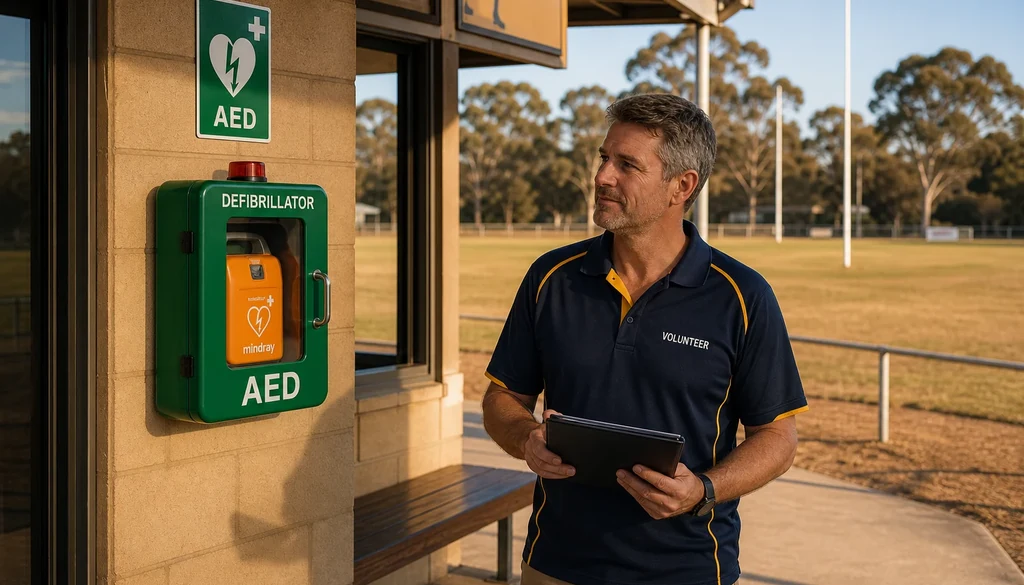
A clubhouse with an AED locked inside the equipment room during the week is doing half the job. The same AED in an IP-rated outdoor cabinet on the clubhouse wall — accessible 24/7 — multiplies its value massively. Your club becomes the AED resource for the surrounding 500 m radius.
Register with St John WA’s State Defib Network
WA uses St John’s Community First Responder app and State Defib Network — not GoodSAM. Registration is voluntary and free. Once registered, your AED is visible to St John WA call-takers and to the volunteer first responders nearby. Registration enquiries: first.responder@stjohnwa.com.au or (08) 9334 1418.
Train a roster of volunteers
CPR and AED use is straightforward — the device walks the user through it. Practical training for two to four committee members or volunteers per active day means there’s always someone with hands-on familiarity at training and game days.
Maintain the device on schedule
This is where WorkSafe WA’s Bulletin No. 11 keeps coming back to. The Bulletin flags maintenance failures — flat batteries, expired pads, devices not visible or accessible — as the leading reason AEDs fail when actually used. Pads expire every 2–4 years depending on the model. Batteries every 4–5 years. A device that hasn’t been touched since installation is a device with a real chance of not working.
Comparison: where the funding sits today
| Pathway | Amount | Status (May 2026) | Suitable for |
|---|---|---|---|
| Lotterywest Heart Grant via St John WA | ~$249 per unit (heavily subsidised) | Closed — no current round | NFP sport/community when round opens |
| Project Defib | ~$1,600 per club toward Defibtech Lifeline VIEW | Open (national) | Sporting clubs choosing a Defibtech unit |
| Alpha Sport Heart Starter | $500 toward AED package | Open | Community sporting clubs |
| Local council community grants | $500–$5,000 typical | Varies by council | Clubs across WA |
| DLGSC sport and recreation grants | Various, not AED-specific | Open | Facility/equipment broader needs (not AED-funding pathway) |
| Self-fund through club | Full price | Always available | Any club able to fundraise or sponsor-fund |
What WA clubs should not assume
A few things worth flagging:
- The Heart Grant is not a permanent open program. It runs in rounds, dependent on Lotterywest funding. Don’t tell your committee “we’ll just apply when we’re ready” without checking the page is open
- Registration with St John WA does not equal funding. Registering your AED with the State Defib Network is free and useful, but it doesn’t subsidise the device — it’s a post-purchase step
- GoodSAM does not operate in WA. WA uses St John’s own First Responder app and State Defib Network. Be careful with content from eastern-state sources that refers to GoodSAM as if it covers WA
- No WA legislation requires your club to have an AED. WHS duty applies, the Code of Practice supports AED provision in clubs through its trigger factors, but there’s no AED-specific Act in WA. Don’t claim there is
Where SafePulse fits
We supply, install and maintain AEDs across WA, from Perth metro through the South West and into regional WA. For clubs self-funding, we can quote a Basic Install at $2,490 GST free, including the outdoor cabinet (IP55+), signage, install, registration with St John WA, and the maintenance plan.
Grant rounds come and go; the WHS duty doesn’t. For where WA actually stands, see do Western Australian commercial buildings need an AED in 2026, and once a club has a device, registering it on St John WA’s State Defib Network puts it on the map. More at our Western Australian AED page.
If your club is waiting on a Heart Grant round and trying to decide whether to wait or proceed, we’re happy to talk it through. Get in touch via safepulse.com.au/wa/.