If you’ve registered an AED in NSW or Victoria, you’ve used GoodSAM. Same platform, same workflow, same outcome — a Triple Zero call-taker and a pool of nearby volunteer responders both know where your device is when a cardiac arrest is called in.
If you’re trying to do the same thing in Queensland, you’ll find a different setup. The Queensland Ambulance Service runs its own AED registration program through the Queensland Government website — not GoodSAM. And the difference between the two isn’t cosmetic. It changes what happens when someone calls 000 from near your AED.
This piece walks through how QAS registration works, what it does and doesn’t do, and the practical implications for Queensland property managers and business owners deciding where to place an AED.
The headline difference
In NSW and Victoria, registered AEDs are visible to two groups during a cardiac arrest:
- The Triple Zero call-taker, who can direct the caller to the nearest AED
- The pool of nearby GoodSAM Responders — trained volunteer first responders within roughly 500 metres — who get pinged to attend with the AED
In Queensland, registered AEDs are visible to one group: the QAS Emergency Medical Dispatcher (EMD), who can direct the caller to the nearest AED only if the cardiac arrest occurs at your business or property.
QAS’s own language is unambiguous:
“Your AED location details will only notify the EMD if the suspected cardiac arrest occurs at your business or property. It will not generate an alert for calls from nearby businesses or properties.”
That’s a meaningful structural difference. In NSW or Victoria, registering your AED contributes to a wider safety net for the surrounding area. In Queensland, it primarily serves your own site.
It’s still worth doing. But the value proposition is narrower, and that has implications for how Queensland businesses think about placement, public access and the role of community-AED programs.
How QAS AED registration works
The Queensland AED registry sits inside Queensland Health, operated by QAS. Registration is voluntary — there’s no Queensland law requiring AEDs to be registered.
The process:
- Register a new AED via the Queensland Government online form at qld.gov.au/emergency/QAS/aed-registration-form
- Update or remove an existing registration via the QAS AED registration page at ambulance.qld.gov.au/our-services/aed-registration
- The owner/operator’s contact details, AED location and device details are collected
- QAS may contact the registered party periodically to keep the register current
It’s a standard form-based registration — no app to install, no responder pool to join, no integration with a national volunteer responder network.
Why QAS isn’t on GoodSAM (as far as we can tell)
GoodSAM is a UK-developed platform that’s been adopted by ambulance services in NSW, Victoria, South Australia, the Northern Territory (partially) and elsewhere. It alerts trained volunteer responders within a defined radius of a cardiac arrest to attend and bring the nearest registered AED.
QAS doesn’t currently use it. As of the most recent review, the QAS AED registration page doesn’t reference GoodSAM, and there’s no publicly available documentation of a QAS–GoodSAM integration equivalent to NSW Ambulance or Ambulance Victoria. A separate “GoodSAM Responder” program may operate in some Queensland contexts, but the AED registry itself sits with QAS independently.
If QAS does integrate GoodSAM in future, the registry’s reach would broaden. For now, the QAS registry is a property-only system — alerting on cardiac arrests at the registered address, not from nearby addresses.
What this means for Queensland AED placement
A few practical implications fall out of the QAS-only model:
1. Public-access placement still matters — for a different reason
In NSW and Victoria, registering a publicly accessible AED on GoodSAM contributes to the wider community responder network. A registered AED in a shopping centre foyer might be retrieved by a GoodSAM Responder to attend a cardiac arrest two streets away.
In Queensland, that same registered AED won’t be alerted to a nearby incident. The retrieval has to happen the old-fashioned way — a bystander finds the AED because they walk past it, see signage, or remember where it is.
The implication: visible placement and signage matter more in Queensland than in GoodSAM jurisdictions. The AED’s discoverability for bystanders is the primary mechanism for getting the device to a nearby incident, because the registry won’t bridge the gap automatically.
2. Local council and community AED maps fill some of the gap
Where QAS doesn’t publish a searchable public AED map, some Queensland local councils do. The City of Gold Coast publishes a list of council-owned community AED locations at goldcoast.qld.gov.au/Services/Safety-security/Community-safety/Defibrillators-in-the-community. Brisbane, Sunshine Coast, Townsville and others have varying levels of council-published AED data.
For Queensland AED owners, listing on the relevant local council’s community register (where one exists) is a parallel discoverability play. It doesn’t substitute for QAS registration, but it adds a public-facing channel that GoodSAM jurisdictions don’t need because GoodSAM itself plays that role.
3. The volunteer responder gap
The most significant operational gap in Queensland is the absence of a GoodSAM-style trained-responder pool. In NSW, a cardiac arrest within roughly 500 m of a Trusted Responder triggers an alert; the responder attends with the AED. In Queensland, that bridging response doesn’t exist as a state-wide ambulance-integrated layer.
Some Queensland community-AED initiatives partially fill that role — local council CPR awareness programs, sport-specific AED training, individual workplace first-aid teams — but none are statewide and ambulance-dispatched. The result is a heavier dependence on bystander CPR and bystander AED retrieval, which is exactly what good signage and visible placement enable.
4. Registration is still worth doing
Despite the narrower reach, registering with QAS:
- Directs your own staff and members of the public on your premises to your AED through the 000 dispatcher
- Keeps QAS aware of the device’s existence, maintenance status and any change in availability
- Contributes to the broader public health picture that informs future policy and funding decisions
Don’t skip it because the registry is narrower than NSW or Victoria’s. Skipping it leaves you out of the one ambulance-integrated channel that does exist.
How QAS compares to other jurisdictions
| Factor | NSW | Victoria | Queensland |
|---|---|---|---|
| Registry operator | NSW Ambulance | Ambulance Victoria | Queensland Ambulance Service |
| Platform | GoodSAM | GoodSAM | QAS (own platform via qld.gov.au) |
| 000 dispatcher alert for AED at registered site | Yes | Yes | Yes |
| Volunteer responder alert for nearby cardiac arrest | Yes (GoodSAM Trusted Responders) | Yes (GoodSAM Trusted Responders) | No |
| Public-facing AED map | No (responder-app only) | No (responder-app only) | No (some council maps fill gap) |
| Registration mandatory | No | No | No |
| Registration cost | Free | Free | Free |
The Queensland picture isn’t worse on every dimension — registration is free, the process is simple, and the 000-dispatcher visibility for the site itself works the same way. But the absence of GoodSAM integration means the wider responder safety net that NSW and Victorian AED owners participate in by default isn’t part of the Queensland model.
What that means for Queensland businesses choosing where to put an AED
The QAS-only model nudges placement decisions in a few directions:
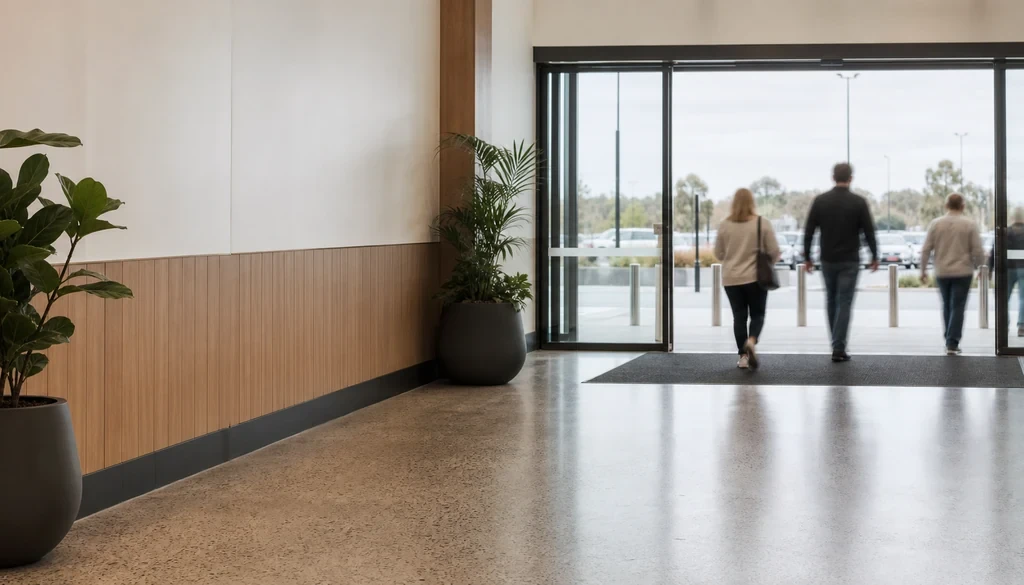
- Make the AED visible from outside the building where possible. A unit visible from the public footpath through a glass entrance is more useful in Queensland than the same unit in an internal corridor, because public discoverability is the primary mechanism for the AED reaching a nearby cardiac arrest.
- Invest in good signage. Directional signage from the building entry, prominent signage near the AED itself, and where the building is on a main pedestrian thoroughfare, a public-facing sign indicating an AED is on the premises. The standard Australian Resuscitation Council AED symbol is the universal language.
- 24/7 accessibility, where building security allows. An AED locked inside a building from 5pm to 8am is useful to staff during business hours and useless after that. For premises that can support it — sporting clubs with verandah-mounted cabinets, fuel stations, community centres, after-hours-accessible retail — outdoor-rated public-access placement (IP55+) materially extends the device’s reach.
- Combine QAS registration with local council registration. Where the council runs a community AED map, list there too. Multiple discoverability channels compensate for the absence of the GoodSAM responder layer.
The maintenance question is the same everywhere
Whatever the registry, an under-maintained AED fails when it’s needed. The most common failure modes are flat batteries, expired pads and units that have been moved without being re-set in their cabinet. QAS may periodically contact registered owners to check device status — but the responsibility for maintenance rests with the owner.
For Queensland businesses, a monitored maintenance package removes most of the under-maintenance failure modes. SafePulse’s Smart Install package includes AED Alert 2.0 — daily status reporting, live tamper alerts and GPS theft tracking. The maintenance differential ($25/month Smart vs $40/month Basic) effectively pays back through removed manual inspection load, and verification of the device’s status sits inside an admin dashboard rather than requiring a fortnightly walk-around.
Practical approach for Queensland AED owners
- Register with QAS. Free, voluntary, via qld.gov.au/emergency/QAS/aed-registration-form.
- Choose placement for discoverability. Visible from public-facing entry points. Not locked. Mounted 1.2–1.4 m from the floor.
- Invest in signage. Near the AED and from main entry points. ARC-approved symbol. Public-facing signage where the premises are on a pedestrian thoroughfare.
- List on the relevant local council community AED register if one exists for your council.
- 24/7 access where building security allows. Outdoor-rated cabinets (IP55+) for any external placement; consider QLD heat and humidity in unit and cabinet selection.
- Maintain per manufacturer instructions. A monitored package removes most of the volunteer-checking failure modes.
- Provide CPR/AED training to nominated staff, particularly because Queensland doesn’t have the GoodSAM responder layer to lean on.
Where SafePulse fits
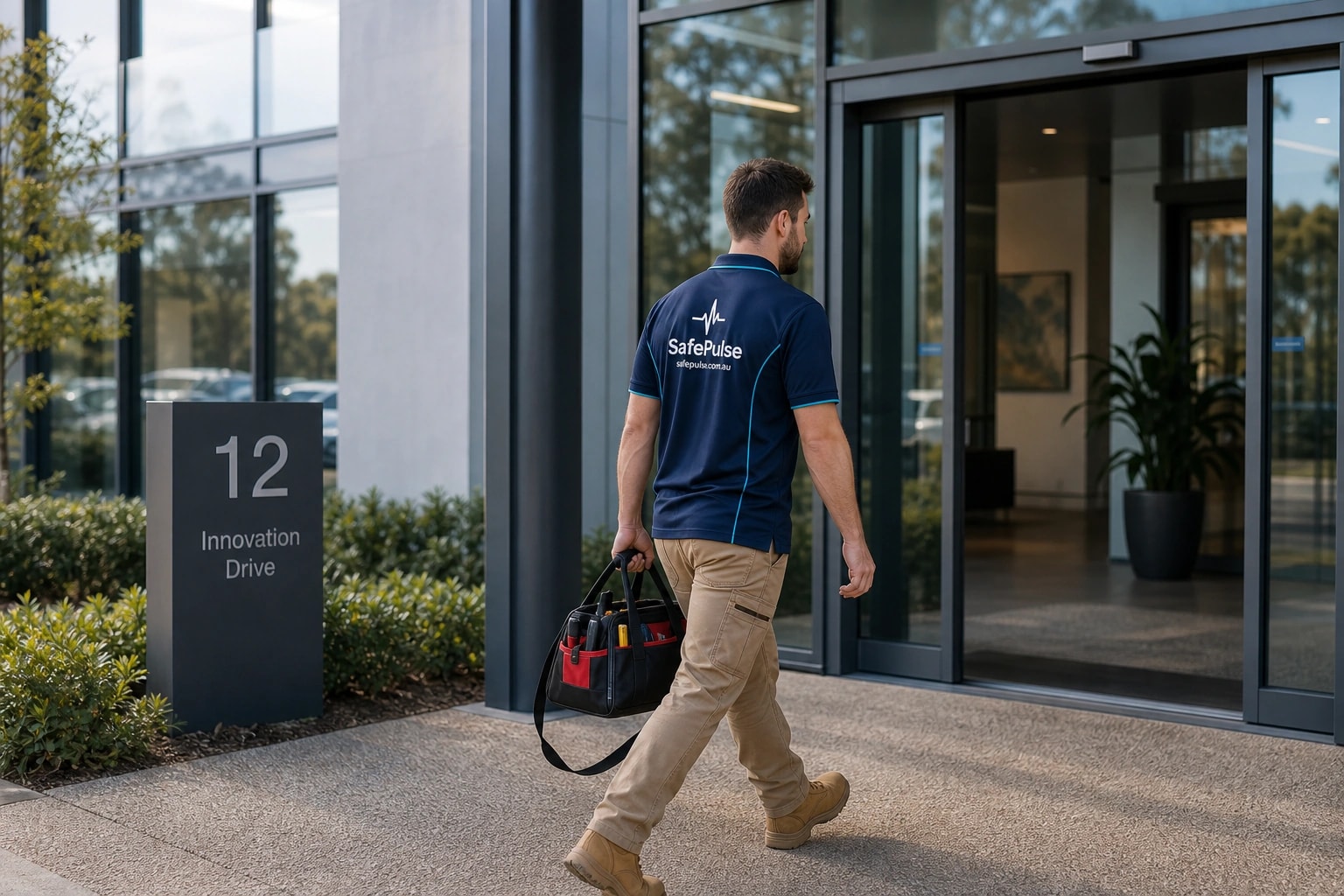
We install AEDs in commercial buildings, sporting venues, hospitality sites and community facilities across Queensland. Each install is a TGA-approved Mindray unit, IP-rated cabinet, mandatory signage, an 8-year warranty, and QAS registration as part of the package. The Smart Install adds AED Alert 2.0 monitoring — particularly relevant in Queensland where the absence of the GoodSAM responder layer means visible, discoverable placement and reliable maintenance carry more weight.
If you’re scoping AED provision for a Queensland site or property portfolio, see our Queensland AED solutions or send us the site details and we’ll come back with a scope.
The bottom line
Queensland’s AED registry is operated by QAS rather than integrated with GoodSAM. That means the registry alerts the dispatcher only when a cardiac arrest is reported at your registered address — not when one is reported nearby. The wider responder safety net that NSW and Victorian AED owners participate in by default doesn’t exist as a state-wide layer in Queensland.
That changes the calculus of placement and discoverability — but it doesn’t change the value of registering. Free, simple, and the one ambulance-integrated channel that does exist. The most useful thing a Queensland AED owner can do beyond registration is make the device visible, signed, accessible, and maintained — and where the local council operates a community AED register, list there too.
The register’s own-property limitation matters most where there’s no nearby device to fall back on, which is the case made in construction and electrical trades in Queensland. For the legal position generally, there’s do Queensland commercial buildings need an AED in 2026 and our Queensland AED page.
If QAS integrates GoodSAM in future, this article will need updating. The QAS AED registration page is the source of truth — check it before relying on any specific claim about reach.