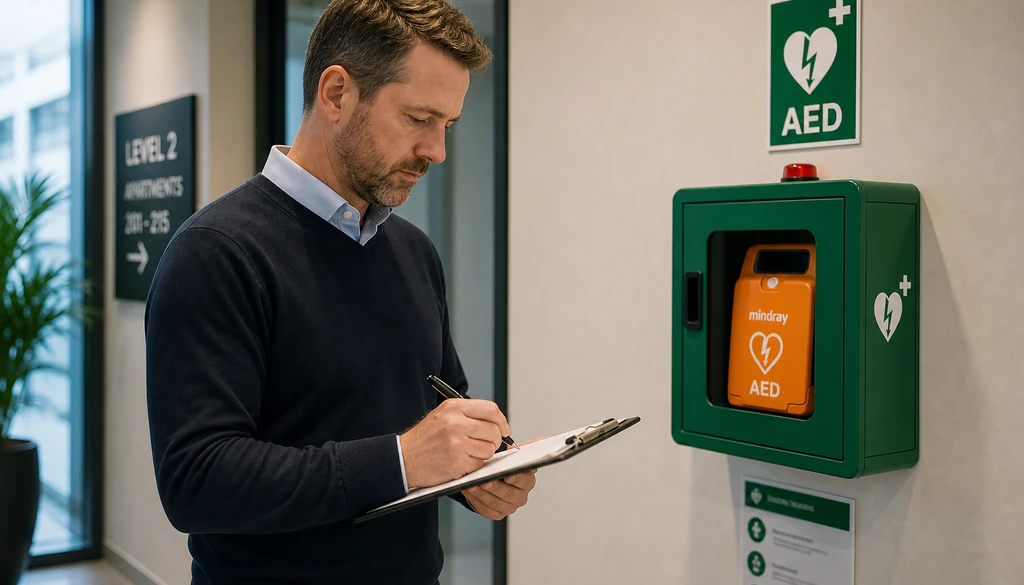
If you run a caravan park in South Australia, here’s a fact that catches a lot of operators off guard: your park needs an AED, and it has needed one since 1 January 2026. It doesn’t matter how big the site is, how many vans you’ve got, or whether your reception is the size of a garden shed. Caravan parks are named in the legislation, so the obligation lands on you the same way it lands on a 600-square-metre office block.
This piece walks through why parks are in scope, who carries the duty, how many devices you actually need, and where the device has to go. It’s the practical version, not the legal one.
Why caravan parks are in scope at all
Most of the South Australian AED rules turn on floor area. A “relevant building” only gets caught once it hits 600 square metres of internal floor space, and the number of devices scales up from there. That’s the test people remember, and it’s why a lot of park operators assume a modest reception block slips under the line.
It doesn’t, and here’s why. The Automated External Defibrillators (Public Access) Act 2022 (SA) lists a set of designated buildings and facilities that always require at least one AED, regardless of size. Caravan parks are on that list. So are residential parks with 12 or more residents. The 600-square-metre threshold is irrelevant for a designated facility — being a caravan park is the trigger, not the size of the building.
That’s the single most common misunderstanding we see. A park owner measures the reception, finds it’s 40 square metres, and concludes they’re exempt. The size test was never the one that applied to them.
Who’s actually responsible
The duty falls on the owner, not the tenant or the manager running the day-to-day. Under the Act, “owner” means the person who holds the estate in fee simple — or, where the land is held from the Crown under a lease or licence, the lessee or licensee.
For most privately owned parks that’s the freehold owner. If you operate a park on leased Crown land — and a fair few South Australian coastal and riverland parks do — the duty sits with you as the lessee. Either way, it’s not something you can push onto a site manager or a contractor. If you own or lease the park, the obligation is yours.
How many AEDs you need
For the overwhelming majority of parks, the answer is one.
Here’s the logic. A designated facility needs at least one AED full stop. You’d only need more than one if both of these were true: the park is used for commercial purposes (almost always yes), and the publicly accessible floor area is more than 1,200 square metres.
That second part is where parks come out light. The publicly accessible floor area isn’t the size of your land — it’s the internal floor space the public can walk into without a key, a code or an appointment. At a caravan park that usually means reception, a camp kitchen, an amenities block and maybe a small shop or games room. Add those up and you’re rarely anywhere near 1,200 square metres of indoor public space.
SA Health’s own worked example makes the point. It describes a caravan park sitting on five thousand square metres of land with a 35-square-metre reception. The publicly accessible floor area is just that reception, so the requirement is one AED. The campsites, the roads, the grassed areas — none of that counts as publicly accessible floor area in a building.
If you run a large holiday park with a big indoor complex — a function room, an indoor pool hall, a sizeable café and shop — it’s worth actually measuring the publicly accessible internal floor space. If it tops 1,200 square metres, the scaling table in the Regulations kicks in and you may need a second device. But that’s the exception. Plan on one, and confirm by measuring if your indoor footprint is genuinely large.
Where the AED has to go
Getting the count right is the easy part. Placement is where parks need to think a bit harder, because a caravan park isn’t a climate-controlled office.
A few rules apply to every in-scope building, and they matter here:
- It has to be publicly accessible. Someone needs to be able to get to the device themselves, or request it immediately — for example from a staffed reception. It can’t be locked away in an office that’s shut at 6pm if the park is open and occupied overnight.
- It can’t be behind a key or a code that stops someone reaching it in an emergency. A cabinet with an alarm is fine; a locked cupboard isn’t.
- Mount it at 1.2 to 1.4 metres off the floor, in a visible, high-traffic spot. Reception is the obvious home — but think about access outside office hours.
That last point is the real one for parks. Your highest-risk hours don’t always line up with reception being staffed. A device locked inside a reception that closes overnight isn’t doing the job the Act intends. Plenty of operators solve this by mounting the AED in an external, alarmed cabinet on the reception wall or near the amenities block, so it’s reachable around the clock.
If you do go outdoors, pay attention to the cabinet’s IP rating. South Australian parks cop everything from Riverland heat to coastal salt air, and an AED is an electronic device. An outdoor-rated cabinet (IP55 or better is the usual industry mark) keeps dust, water and temperature swings off the unit. The Act asks you to choose an AED with an IP rating appropriate to the environment — outdoors at a park, that’s not a box to tick lightly.
Signage and registration — the two steps people forget
Two obligations get missed even by operators who’ve installed a device:
Signage. You need a sign near the AED, and a sign at or near the building entrance telling people an AED is nearby. SA Health publishes templates. It’s a small job, but missing signage is one of the offences listed under the Act, so it’s worth doing properly rather than improvising with a printed A4.
Registration. Every AED installed under the Act has to be registered on the SA Ambulance Service AED Register within two weeks of installation. The register is what a Triple Zero call-taker uses to point a caller to the nearest device. If you move the unit or change its access hours, you’ve got two weeks to update the record. It’s free, it’s quick, and it’s the step that turns your device from a wall ornament into something the emergency system can actually use.
A practical approach for park operators
If you’re a South Australian park owner working out where you stand, here’s the short version:
- Accept you’re in scope. Caravan parks are a designated facility. Size doesn’t get you out of it.
- Plan on one AED unless your indoor public areas genuinely exceed 1,200 square metres — measure if you’re a large holiday park.
- Place it for 24/7 access, not just reception hours. An external alarmed cabinet usually solves this.
- Spec it for the environment — proper IP rating if it’s going outdoors.
- Put up the signage and register it with SA Ambulance within two weeks.
None of this is heavy lifting. The trap isn’t the cost or the complexity — it’s the assumption that a small reception means the rules don’t apply. They do, and they have since the start of the year.
Where SafePulse fits
We install and maintain AEDs across South Australia, including at parks where the device needs to live outdoors and stay rescue-ready through a Riverland summer. When we fit one out, we handle the placement call, the right outdoor-rated cabinet, the signage and the SA Ambulance registration, and our maintenance plan keeps the pads and battery in date so the unit works the day it’s needed.
Caravan parks are one of several designated facilities that need a device regardless of size — the wider list and the size-scaling rules are in our South Australian AED compliance overview and how many AEDs your building needs. Once installed, registration with SA Ambulance is the next step.
If you run a park and you’re not certain whether you’re compliant, the honest first step is a quick look at your site and your public floor areas. Get in touch at safepulse.com.au and we’ll work out exactly what your park needs — usually one device, placed properly, registered and signed.


