If you own or manage a Canberra commercial building with Commonwealth Government tenants, you’re operating across two work health and safety regimes at once. Your building, your common areas and your direct staff sit under the Work Health and Safety Act 2011 (ACT), regulated by WorkSafe ACT. Your Commonwealth tenant — and that tenant’s staff — sit under the Work Health and Safety Act 2011 (Cth), regulated by Comcare. Neither Act mandates an AED. Both Acts impose a duty of care that gives AED provision a clear path through.
This matters in Canberra in a way it doesn’t anywhere else. Roughly 40% of the ACT workforce is employed by the Commonwealth or ACT public sectors. A Civic, Barton, Belconnen, Tuggeranong or Gungahlin office building is very likely to have at least one Commonwealth tenancy — APS agency, statutory authority, contracted services — sitting alongside the private-sector tenants. The landlord-tenant safety conversation gets layered.
This piece is for the landlord, owner or strata manager of a Canberra commercial building with Commonwealth tenancy. It walks through what each regime requires, where the AED conversation actually sits, and how to make a defensible call without overreaching what either regime obliges you to do.
The two regimes — short version
State / Territory: WorkSafe ACT and the ACT WHS Act
The Work Health and Safety Act 2011 (ACT) and the WHS Regulation 2011 (ACT) impose a primary duty on PCBUs — including building owners and managers — to ensure the health and safety of workers and others, so far as is reasonably practicable. The Work Health and Safety (First Aid in the Workplace Code of Practice) Approval 2020, commencing 8 September 2020, gives practical content to that duty.
The Code is the Safe Work Australia model code, adopted in the ACT. It treats AEDs as discretionary, with the standard three trigger factors: risk of electrocution, delayed ambulance response, large numbers of workers or members of the public. Recommendation: AEDs should be located in clearly visible, accessible areas, should not be exposed to extreme temperatures, and should be maintained per the manufacturer’s specifications.
Failure to install an AED is not in itself an offence under ACT WHS law. The duty that does bite is the broader s.19 PCBU duty.
Federal: Comcare and the Commonwealth WHS Act
The Work Health and Safety Act 2011 (Cth), administered by Comcare, applies to Commonwealth public service workplaces — APS agencies, Commonwealth statutory authorities, and certain self-insured corporations covered under the Comcare scheme. The federal Act mirrors the model national WHS framework; the primary duty is structurally identical to the state and territory regimes.
Comcare’s published first aid guidance covers AEDs as a discretionary, risk-assessed item. Comcare’s specific recommendations:
- Workers should be trained on how to use the AED
- The AED should be readily accessible — “not locked in a cupboard or in a person’s office”
- AEDs are designed to shock a heart in irregular rhythm, not to start a stopped heart
Comcare does not mandate AED installation in Commonwealth buildings. There is no Commonwealth equivalent of the SA Act. Whether an APS agency installs an AED in its tenancy is the agency’s call, made against its own risk assessment.
Where the duty for the AED actually sits
The most common landlord question in this market: “If my Commonwealth tenant wants an AED, is that my responsibility or theirs?” The honest answer is that the regimes don’t carve it up cleanly.
A few principles that work in practice:
1. Tenants own their tenancy first aid duty. The PCBU running operations inside a tenanted floor is responsible for first aid arrangements covering its workers. For a Commonwealth tenant, that’s a Comcare-regulated duty. The tenant decides whether to install an AED inside the tenancy.
2. Landlords own common-area first aid duty. Lobbies, lifts, foyers, common toilets, public corridors — these are landlord-controlled spaces and the landlord’s WHS duty (under the ACT Act) applies. Visitors, contractors, and tenants moving through common areas are the population the duty protects.
3. The two duties often point to a shared AED program. In practice, a single AED in a lobby or central common area serves the building’s combined population — Commonwealth tenant staff, private tenant staff, contractors, visitors. The landlord typically owns the device because it’s mounted in landlord-controlled space; tenants might co-fund or contribute under outgoings.
This isn’t different in principle from any multi-tenant building. What’s different in Canberra is the layered regulatory environment, the size of the Commonwealth tenant share, and the particular care needed when tenants and landlord want their respective duties documented clearly.
How Comcare actually frames the AED conversation
Comcare’s office safety tool (comcare.gov.au/office-safety-tool/workplace-safety/first-aid) treats AEDs as part of broader first aid provisioning. The framing is consistent with the model national code: an AED is a risk-based control, valuable in workplaces where the foreseeable cardiac event rate justifies provision.
Three things worth noting about how Comcare’s guidance reads for a Canberra office building landlord:
1. It’s risk-assessed, not prescriptive. Comcare doesn’t say “all APS agencies must have an AED.” It says agencies should consider AED provision against their risk profile. In practice, most large Canberra APS tenancies do install AEDs — but the decision sits with each agency.
2. Access matters as much as installation. “Not locked in a cupboard or in a person’s office” is Comcare’s plain phrasing. An AED locked behind tenant-only security doors during business hours, then unreachable after-hours when contractors and security are the only people present, fails the access test on Comcare’s own framing.
3. Training is recommended. Comcare’s wording recommends training, which differs from the underlying device design (AEDs talk users through the process without training). Training matters more in a Commonwealth context where staff are expected to be able to respond and document what they did.
What the landlord should think about
For a Canberra commercial building landlord, the practical AED conversation comes down to four questions:
1. Is there an AED in the building today?
If yes — where? Who owns it? Is it in landlord-controlled space, or inside a tenant’s tenancy? Is it accessible to other tenants and to visitors? Is it registered? Is it maintained?
A building with a single tenant-owned AED locked behind a swipe-card door on the third floor is, functionally, a building without an AED for everyone else. That’s the typical pattern we find on first-visit audits.
2. If no, where should one go?
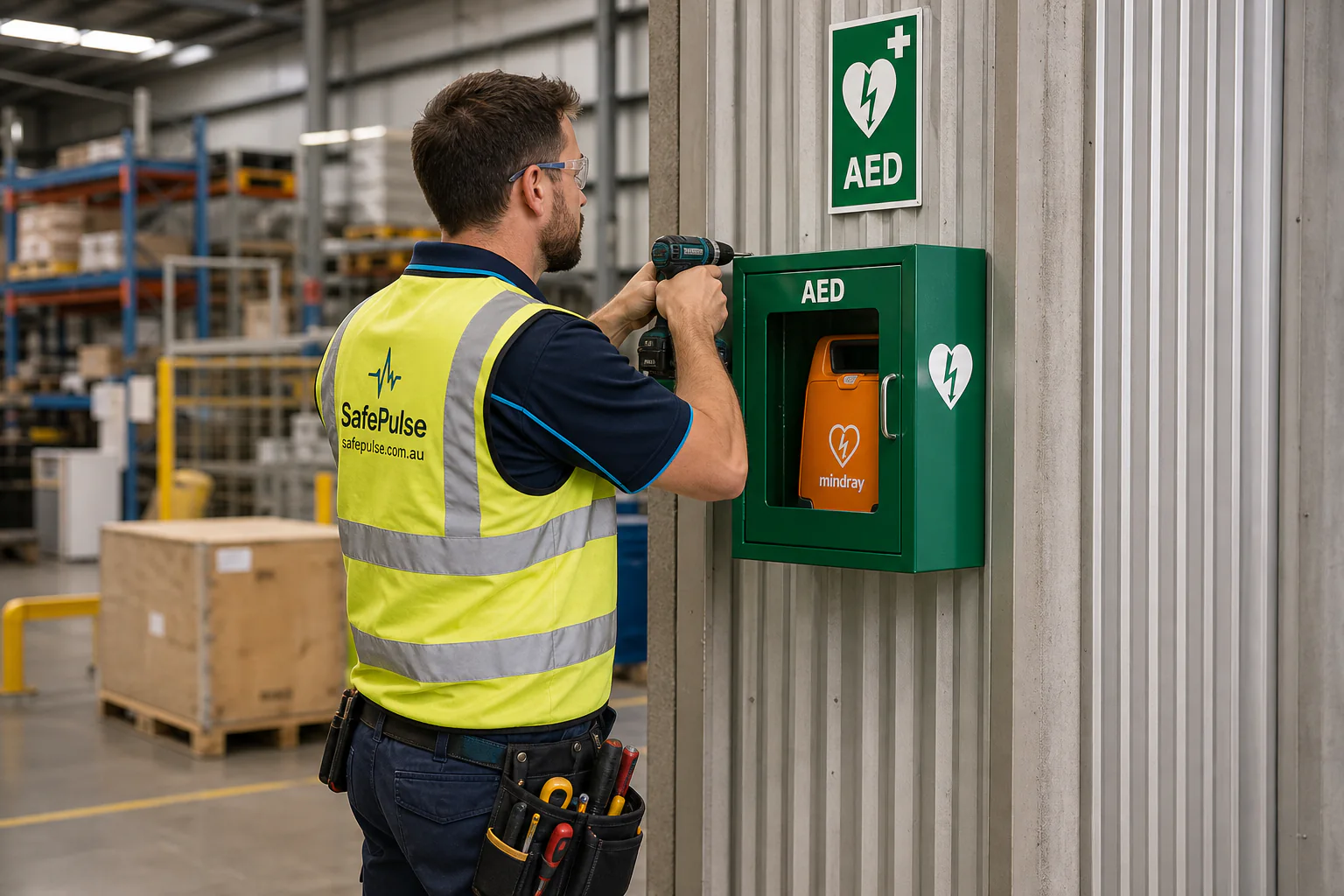
The default landlord-owned location is the main lobby or building reception. Mounted at 1.2–1.4 m from the floor, signed clearly, not locked. Visible from the main entry, accessible 24/7 to security and building management. From there, additional units scale by building size — one per floor for taller buildings, one per substantial tenancy for very large floor plates.
For Canberra’s typical mid-rise commercial stock — Civic and Barton offices in the 4–12 storey range — one AED in the lobby plus one on the upper floors is a defensible default.
3. Who pays?
A landlord-owned AED in a landlord-controlled common area is straightforwardly a building expense. Whether that flows through outgoings depends on the lease and the building’s outgoings model. For Commonwealth tenants, the lease will usually have specific provisions about what flows through outgoings; an AED program is generally recoverable but worth confirming on a building-by-building basis.
For tenant-owned AEDs inside tenancies, the tenant funds the device, the install and the maintenance. The landlord’s responsibility is usually limited to providing any necessary make-good or wall-mount approvals.
4. How does it get maintained?
A landlord-owned AED needs a documented maintenance schedule — monthly visual check, pad and battery replacement per manufacturer schedule. For a single-AED building this is light-touch. For a multi-AED building or a multi-building portfolio, smart monitoring (battery, pad and tamper status reported to a dashboard) takes the operational overhead off the building manager.
The maintenance cost is small. The cost of having a device on the wall that doesn’t work when it’s needed isn’t.
Where the ACT registry picture matters
A specific Canberra wrinkle: the ACT does not have a government-run, Triple Zero-integrated AED registry equivalent to SA’s or NSW’s. The ESA’s public-facing AED page provides instructions on AED use only — no registry, no GoodSAM integration, no public AED map directly operated by the ACT Government.
ACT AED locations are tracked through three non-government channels:
- The St John Ambulance Australia AED register (aed.stjohn.org.au) — the national St John registry. Per Heart Foundation guidance, this is the de facto ACT registry path.
- The St John First Responder app — the same data, surfaced as a free public app.
- StreetBeat (streetbeat.life) — the publicly-funded outdoor AED program run by St John Ambulance ACT.
What this means for a Canberra building landlord: register your building’s AED with the national St John register. Don’t expect Triple Zero in the ACT to direct callers to your registered AED automatically — that integration isn’t confirmed in publicly available ESA/ACTAS material. The St John register surfaces the device through the First Responder app, which trained responders use.
For a Commonwealth tenant inside the building, their own AED (if separately installed) should also be on the St John register. Two AEDs in the same building, both registered, both visible to responders — that’s the desired state.
Two specific scenarios
Scenario A: Single Commonwealth tenant, multi-floor
A Commonwealth tenant taking the full upper floors of a Civic building. The agency runs its own AED program inside its tenancy, mounted at agency-controlled locations, with agency-funded training. The landlord runs a separate AED in the ground-floor lobby covering common areas, visitors and after-hours contractors. Two programs, two regulators, one shared building. Both programs registered on the St John register.
This is the cleanest pattern. Each PCBU owns their patch; nothing is in dispute.
Scenario B: Mixed tenancy, no dominant Commonwealth presence
A typical Barton or Belconnen office building with several smaller Commonwealth tenants alongside private-sector tenancies. Individual agency AED programs are uneven — some agencies have, some don’t. The landlord-funded common-area AED carries the load for visitors, contractors and tenants without their own units.
In this scenario the landlord’s program does most of the work. The conversation with each tenant becomes one of awareness (“here’s where the building AED is; here’s the procedure”) rather than a duty hand-off.
What this isn’t
A few clear lines worth drawing:
Landlords can’t transfer their common-area WHS duty to tenants. The duty in landlord-controlled space stays with the landlord. A clause in a Commonwealth lease that says “tenant is responsible for first aid in common areas” doesn’t shift the underlying statutory duty — it shifts an operational arrangement, but WorkSafe ACT still looks to the landlord for the common-area duty.
A Commonwealth tenant’s WHS regime doesn’t change the landlord’s WHS regime. The landlord operates under the ACT Act and is regulated by WorkSafe ACT. The Commonwealth tenant operates under the Cth Act and is regulated by Comcare. Each runs its own line. The AED conversation can run jointly without the legal regimes merging.
No AED-specific Commonwealth obligation exists. Comcare hasn’t issued an instrument mandating AEDs in Commonwealth buildings. The 2022 ACT motion that sought to mandate AEDs in ACT government buildings was watered down by amendment and didn’t become law. As of May 2026, neither regime mandates the device.
What to do about it
If you own or manage a Canberra commercial building with Commonwealth tenancy:
- Audit what exists. Walk the building. Find every AED. Check who owns it, where it sits in the landlord/tenant split, whether it’s accessible, whether it’s maintained, whether it’s registered.
- Identify gaps in common-area cover. Lobby, main lift bank, after-hours entry points. If there’s no AED accessible to a visitor or contractor in those spaces, that’s the first gap to close.
- Run the conversation with Commonwealth tenants. Confirm whether each tenant runs its own AED program. Document the building’s combined cover for your own records.
- Install in common areas where needed. Landlord-funded, mounted at 1.2–1.4 m, not locked, signed, registered with the national St John register.
- Document and maintain. Monthly visual check, pad and battery on manufacturer schedule. For multi-building portfolios, smart monitoring is worth the operating cost.
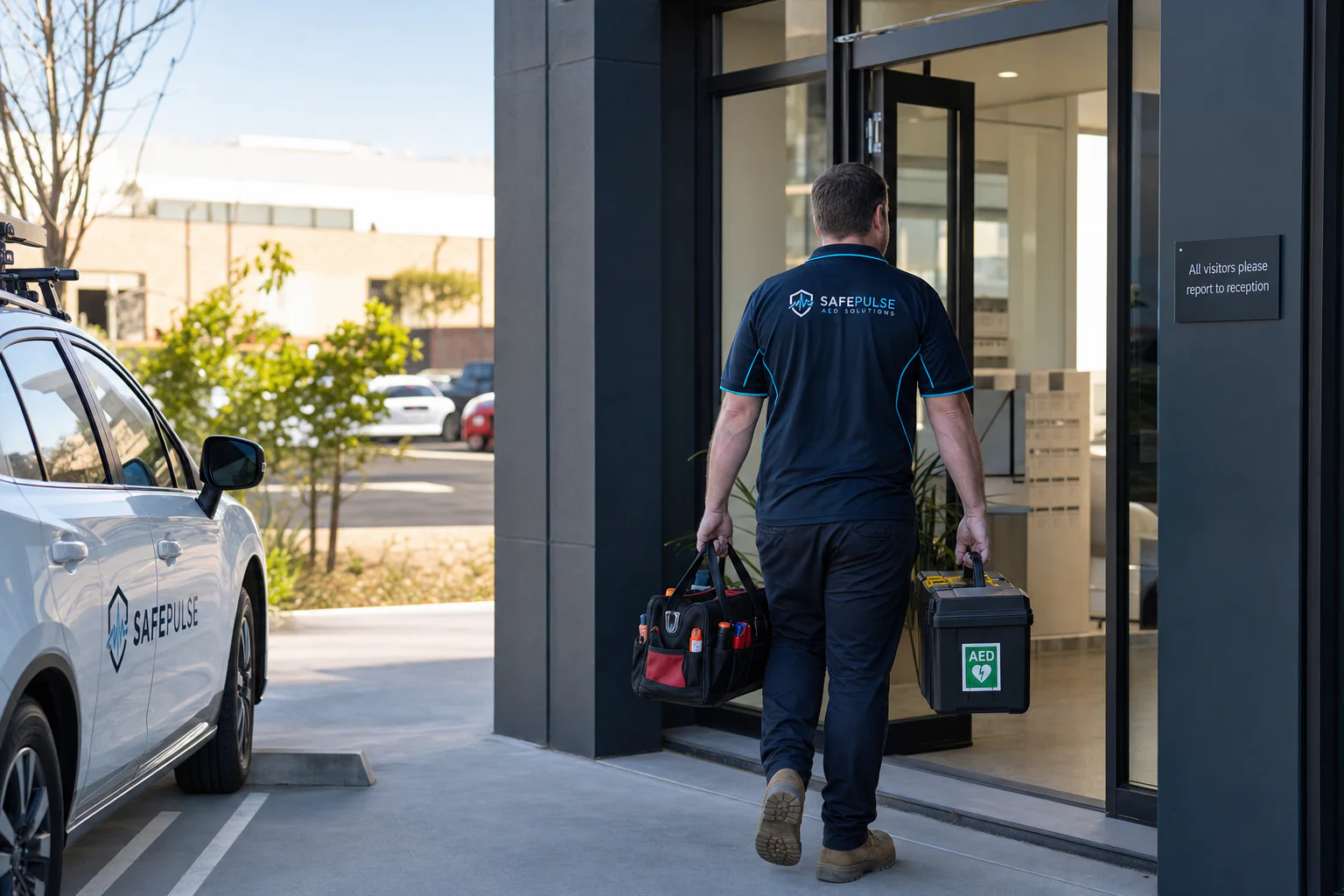
SafePulse installs and maintains AED programs for commercial buildings across Canberra. We work with landlords on common-area programs and with tenants on tenancy-level programs — typically separately, sometimes jointly when the building’s setup makes that the right call. If you’d like a walk-through of what an AED program would look like in your building, get in touch.