Cradle Mountain. Wineglass Bay. The Tarkine. Bay of Fires. Maria Island. Cape Pillar. Tasmania’s tourism economy runs on places that take time to reach — and that’s the exact reason ambulance response in those places takes time to arrive. For tourism operators running lodges, eco-resorts, charter boats, walking tours, dive operations and remote-area accommodation, the geography that draws the visitor is the geography that lengthens the time-to-shock if anything goes wrong.
Tasmania doesn’t have AED legislation. There’s no Act, no Bill before Parliament, and no equivalent of South Australia’s mandatory compliance regime. What Tasmania does have — and the reason this article exists — is a First Aid in the Workplace Code of Practice that names “likely delay in ambulance services arriving at the workplace” as one of three trigger factors for AED provision. On a charter boat off the Tasman Peninsula, or at a lodge two hours from the nearest ambulance station, that trigger isn’t theoretical.
This piece walks tourism, wilderness and remote-area operators through how Tasmania’s WHS framework treats AEDs, why the ambulance-delay trigger lands harder here than almost anywhere else in Australia, where AEDs are already deployed in the parks network, and how to think about an AED program for a remote-area tourism operation.
The Tasmanian framework — short version
There is no Tasmanian Act or Regulation that requires an AED in any commercial setting. A scan of Tasmanian Parliament Bills introduced in 2024 and 2025 returned no Bill with “defibrillator”, “AED” or “Automated External” in the title. The Work Health and Safety Act 2012 (Tas) (No. 1 of 2012) and the Work Health and Safety Regulations 2022 impose the general first aid duty on PCBUs.
Practical content for that duty sits in WorkSafe Tasmania’s First Aid in the Workplace Code of Practice, effective from 27 May 2020. The Code mirrors the Safe Work Australia model. The relevant AED passage (model code wording):
“You should consider providing an AED if there is a risk to workers at your workplace from electrocution, if there would be a delay in ambulance services arriving at the workplace, or where there are large numbers of members of the public.”
“While cardiopulmonary resuscitation (CPR) can prolong life, defibrillation is the only way to restore a heart with a fatal heart rhythm back to a normal heart rhythm.”
“AEDs are designed to be used by trained or untrained people. They provide audible step-by-step instruction on how to use them and how to perform CPR.”
This is discretionary — “should consider” — not mandatory. Failure to install an AED is not, in itself, an offence under Tasmanian WHS law. What does drive provision is the broader PCBU duty to ensure, so far as reasonably practicable, the health and safety of workers and others — and on a remote tourism operation, the ambulance-delay trigger materially shifts what’s reasonably practicable.
Why the ambulance-delay trigger lands hard in Tasmania
Tasmania is the most decentralised mainland Australian state on the population/area split. Ambulance response times outside greater Hobart and Launceston are materially longer than metropolitan response times — and tourism operations are, by definition, often outside the metropolitan footprint.
A few specific contexts:
National park gateways and beyond. Cradle Mountain–Lake St Clair, Freycinet, Tasman, South Bruny, Maria Island — the trailhead is often the closest an ambulance can get. Anything inland from the trailhead requires Parks and Wildlife or volunteer search and rescue mobilisation, often involving helicopter evacuation. Time-to-shock in those locations starts at “hours”, not “minutes”.
Charter and dive operations. Vessel-based tourism operating off the East Coast, Tasman Peninsula, Bruny Channel, the Furneaux Group and the West Coast. Ambulance response to a vessel offshore involves either return-to-port time plus a wharf ambulance, or helicopter winch — both measured in tens of minutes to hours.
Remote lodges and eco-accommodation. Wilderness lodges, off-grid retreats, fishing lodges in the central highlands, multi-day walking accommodation. Many of these sit 60–120+ minutes from the nearest ambulance station by road. Some are accessible only by 4WD, boat or aircraft.
Touring and station-stay operations. Pastoral properties offering tourism stays, multi-day touring operations, working farms — the access geography is the asset.
For all of these settings, the Code’s “delay in ambulance arrival” trigger applies in the everyday sense, not as a theoretical risk factor. The “reasonably practicable” answer to AED provision is, in most cases, clearly yes.
The clinical case — quickly
Survival from out-of-hospital cardiac arrest drops sharply with each minute that passes before defibrillation. Even on the optimistic estimate, every minute matters. Where the next defibrillator is potentially hours away — on a vessel offshore, at a lodge two hours from the nearest town, on a remote trail — the device on the wall is the only intervention that addresses the time-to-shock variable in any meaningful way.
Two qualifiers worth being honest about:
Not every cardiac arrest is shockable. Modern AEDs analyse the rhythm and only deliver a shock when one’s indicated. For non-shockable rhythms (asystole, PEA), CPR alone is the intervention. An AED on the wall doesn’t change non-shockable presentations; it shifts the dial on shockable ones.
An AED doesn’t replace evacuation planning. It’s the intervention in the first few minutes while the broader emergency response — 000 call, road or air ambulance, police, parks, rescue helicopter — is mobilised. A remote tourism operation needs an AED and a documented emergency response plan, not one or the other.
Where AEDs are already deployed in Tasmania
A noteworthy feature of Tasmania’s public AED footprint: the Tasmanian Government has been actively funding community AEDs through the Community AED Fund ($500,000 commitment, delivering 180 free units over two years), and Tasmania now has more than 1,300 publicly accessible AEDs registered statewide as of April 2026.
Among that footprint are several notable remote-area placements verified through Parks and Wildlife Service references:
- Cradle Mountain gateway (Cradle Mountain–Lake St Clair National Park)
- Wineglass Bay car park (Freycinet National Park)
- Jetty Beach campground (South Bruny National Park)
- Fortescue Bay (Tasman National Park)
This matters for two reasons. First, the precedent: parks-network AEDs in some of Tasmania’s most remote tourism settings exist because the responsible operators (Parks, council, community organisations) have made the same risk-assessment call this article is describing. Second, the gaps: those four placements are visible to a tourism operator nearby, but a vessel offshore, a lodge inland, or a touring vehicle on a 4WD track is still operating outside the deployed network.
Tourism operators sitting in Tasmania’s remote tourism geography aren’t being asked to be the first to install an AED — they’re being asked to extend a network that already exists in the highest-visibility public sites.
What an AED program looks like for a remote tourism operation
The right program depends on what the operation does and where it does it. A few common patterns:
Lodge / eco-resort / fixed accommodation
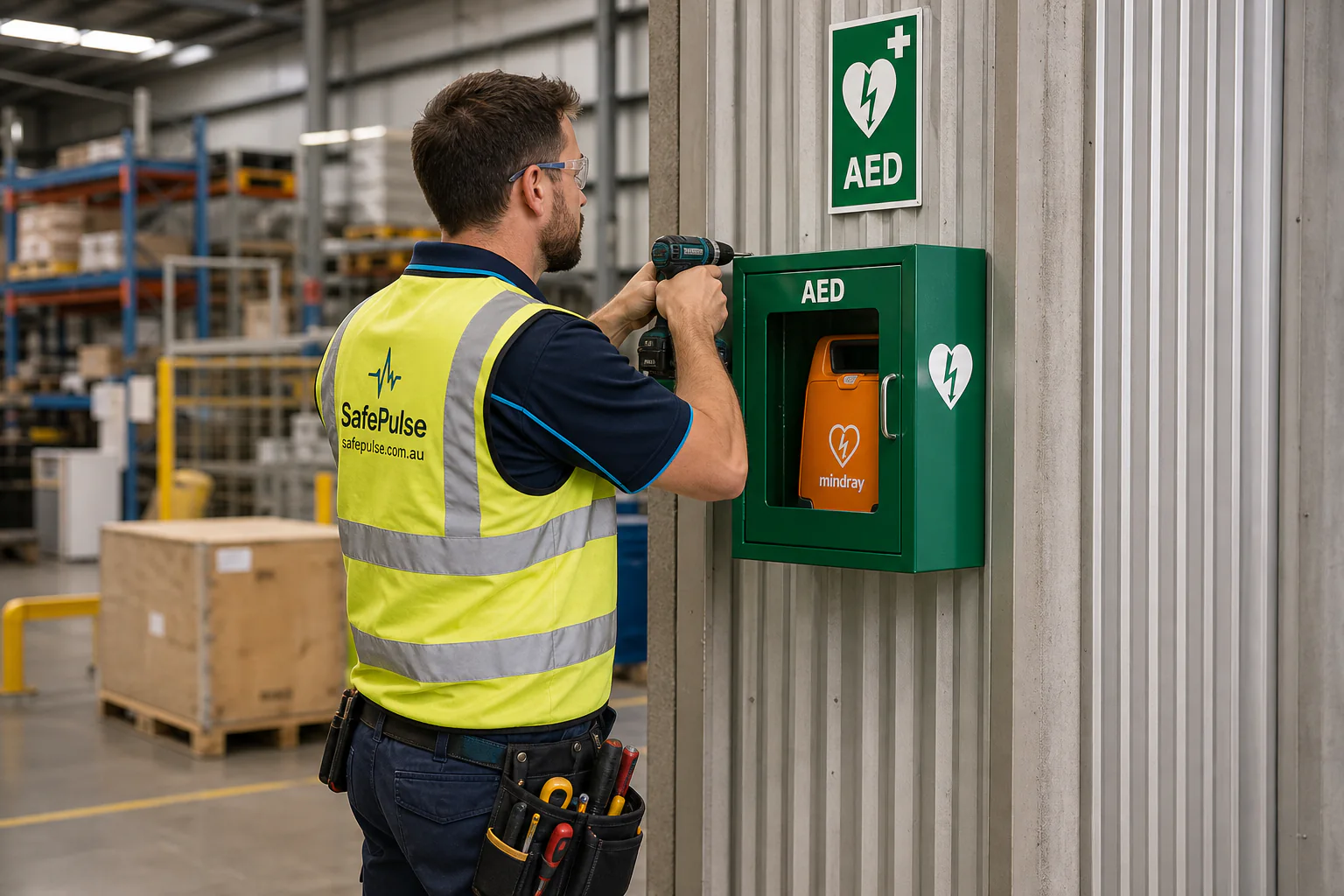
Where: Reception or central guest services area is the natural location. Mounted visible, signed, not locked. For larger properties with separate accommodation blocks or dining/activity buildings spaced across a site, a second unit at the most distant occupied building.
Cabinet: IP55 minimum, with IP56+ appropriate for high-humidity, coastal or sustained outdoor exposure. Tasmanian conditions — wet, cool, sometimes alpine — don’t generally push extreme high-heat operating ceilings, but coastal salt air and Tarkine humidity make corrosion resistance and IP rating meaningful.
Maintenance: Monthly visual check by site staff. Pad and battery replacement per manufacturer schedule. Smart-monitored cabinets that report status to a central dashboard are particularly valuable on operations where the on-site team’s time is better spent on the guest experience than the maintenance log.
Charter, dive, and vessel operations
Where: On-board. Marine environment specification — IP rated for splash exposure, secured against vessel movement, accessible to crew and passengers without unlocking. For multi-vessel fleets, one per vessel is the default.
Cabinet: Marine-grade enclosure. IP67 or higher if exposed to spray; secure mounting that holds in heavy seas. Manufacturer guidance on marine deployment matters here — not every AED is rated for sustained vessel use.
Maintenance: Visual check before each departure. Pad and battery on manufacturer schedule. Post-event recommissioning if the device has been used.
Training: Skipper and at least one additional crew member trained. The crew member who first reaches a casualty needs to know where the device is, how to open the cabinet, and how to start the cycle.
Touring / multi-day walking / 4WD operations
Where: Vehicle-mounted or with the guide. For multi-vehicle touring operations, one per vehicle. For walking tours where the guide carries the kit, the AED moves with the guide.
Cabinet: For vehicle-mounted, a vehicle-rated enclosure that handles vibration, dust and the temperature swings of a parked vehicle. For walked-in units, a hard-shell case that protects against impact and weather.
Maintenance: Before each trip departure as part of the standard pre-trip safety check. Pad and battery on manufacturer schedule.
Training: Every guide trained, with the AED orientation built into the standard guide qualification cycle.
Pastoral / station-stay operations
Where: Main accommodation building (guest-side) and main station building (worker-side) where these are separated. For larger stations with isolated outbuildings, vehicle-mounted units for the operational vehicles.
Cabinet: Outdoor-rated. Many station environments combine heat, dust and seasonal humidity that argue for IP56+ and thermostatic control on exterior placements.
Maintenance: Documented monthly check. Smart monitoring helps on operations where the property is large enough that an unmonitored unit could sit with a flat battery for weeks before anyone notices.
Voluntary registration — and why it’s worth doing in Tasmania
AED registration in Tasmania runs through Ambulance Tasmania’s partnership with GoodSAM. Registration is voluntary, free, and meaningful — registered devices appear in the GoodSAM Responder app and on the LISTmap public AED layer (Land Information System Tasmania, thelist.tas.gov.au).
Registration is at goodsamapp.org/TAS_AED. The form collects device brand, model, serial number, maintenance dates, paediatric pad availability, accessibility (PIN, instructions), availability hours, location, and owner contact details (private — not published).
For a tourism operator, registration achieves three things:
- Triple Zero call-takers can direct callers to your AED if someone reports a cardiac emergency at or near your operation.
- GoodSAM Responder volunteers with the app installed see your device when responding to nearby emergencies.
- Your device appears on LISTmap and on Ambulance Tasmania’s public AED Locator — useful for any future visitor or local who needs to find an AED in your area.
The maintenance dates field is worth taking seriously — if your pads or battery have expired and the registration shows that, the device won’t be useful even if someone finds it. Registration is a maintenance discipline as much as a discovery aid.
What this isn’t
A few clear lines:
An AED program isn’t the same as legal compliance. Tasmania doesn’t mandate AEDs. A tourism operator with an AED program isn’t “compliant with AED law” — there isn’t one — they’re discharging the broader WHS first aid duty in a way the Code supports.
Parks and Wildlife isn’t doing the work for you. The fact that Parks has deployed AEDs at major trailheads doesn’t mean a remote tourism operator nearby is covered. A trailhead AED at Wineglass Bay car park is hours away from a lodge in the Freycinet hinterland.
An AED program isn’t a substitute for a broader emergency response plan. A remote tourism operation needs a documented evacuation procedure, communication plan, and casualty management plan. The AED is one component.
What to do about it
If you operate a Tasmanian tourism, wilderness or remote-area operation and you don’t have an AED program:
- Run the risk assessment honestly. What’s the realistic time-to-paramedic at your site? If it’s more than 8–10 minutes, the Code’s “delay in ambulance arrival” trigger applies clearly.
- Decide the count and locations. One at the main occupied location as the baseline. Additional units for vessels, vehicles or geographically separate occupied buildings.
- Pick the right device and cabinet. TGA-approved, IP55+ for outdoor or coastal placement, marine-rated for vessel use, hard-shell for walked-in units. Coastal Tasmania asks for higher corrosion resistance than inland.
- Train the team. Site staff, guides, skippers, vehicle drivers. The first responder on-site is the one who matters; the device only saves the time it’s used to save.
- Register with Ambulance Tasmania via GoodSAM. Free, voluntary, and surfaces the device through the GoodSAM app and LISTmap.
- Document the maintenance. Monthly visual check, pad and battery on manufacturer schedule. Smart monitoring is worth the operating cost for remote operations.
SafePulse installs and maintains AED programs for tourism operators across Tasmania — from city-edge accommodation to remote-area lodges and vessel operations. We specify for the environment, register with Ambulance Tasmania, and maintain on documented schedules with smart monitoring options for sites where physical inspection isn’t practical. If you’d like to walk through what an AED program would look like at your operation, get in touch.