If you run a Northern Territory community group, sporting club, or not-for-profit and you’ve been looking at AED funding, the St John NT Heart Grant is the program to know about. It’s the only NT-specific publicly funded pathway that places AEDs into community hands — funded through the Northern Territory Government Community Benefit Fund and administered by St John Ambulance (NT).
This piece is a practical guide to the Heart Grant: what it is, who it’s for, how it’s structured, what the current round status looks like, and what to do if the round is closed but you still need an AED on the wall.
Headline up front: the 2025 round is closed. All 50 AED kits in that round have been allocated. St John NT has indicated future rounds will be announced, but as of May 2026 there’s no open application. The rest of this piece covers how the program works (for when the next round opens) and what your options are between rounds.
What the Heart Grant is
The Heart Grant is a competitive grant program run by St John Ambulance (NT), funded by the Northern Territory Government Community Benefit Fund. It places AED kits — and associated training — with community facilities, sporting clubs, not-for-profits and similar community organisations across the Territory.
The structural shape:
- What’s provided: AED kits and training to recipient organisations. The 2025 round allocated 50 kits.
- Who runs it: St John Ambulance NT — also the contracted ambulance provider for the entire Territory, and operator of the Triple Zero call-taking centres in Darwin and Alice Springs.
- Where the money comes from: Northern Territory Government Community Benefit Fund (NTCBF).
- Where to apply: stjohnnt.org.au/heartgrant.
The 50 AEDs from the 2025 round represent more than a 10% increase to the 477 publicly accessible AEDs currently registered in the Northern Territory via the St John NT First Responder app. That’s a meaningful expansion of community AED footprint for a single round.
Why it exists
The Heart Grant exists because of the specific operating reality of the Northern Territory.
NT has the smallest state/territory population in Australia — roughly 250,000 people across 1.4 million square kilometres. The population is concentrated in Darwin and Palmerston, with secondary nodes in Alice Springs, Katherine, Tennant Creek, and Nhulunbuy. Outside those nodes, the population thins fast and ambulance response time stretches with it.
The NT First Aid in the Workplace Code of Practice names “likely delay in ambulance arrival” as one of three trigger factors for AED provision. For most of the Territory’s geography, that trigger applies by default. But for community organisations — small sporting clubs, remote community centres, volunteer organisations — finding the capital to buy an AED out of operating budget is a meaningful barrier.
The Heart Grant addresses that gap. By subsidising the device entirely (not just a portion of the cost), it makes AED provision accessible to community groups who otherwise couldn’t fund a unit through their own cash flow.
Who’s eligible
St John NT hasn’t published a detailed public eligibility matrix for the Heart Grant. The published descriptions and historical recipient pattern indicate the program is aimed at:
- Community sporting clubs (AFL NT, NTFL, AAA Tennis NT, soccer, hockey, basketball, lawn bowls etc.)
- Community facilities (community halls, neighbourhood centres, men’s sheds)
- Not-for-profit and charity organisations
- Schools and early-childhood centres (where not separately funded)
- Volunteer-run public-access locations
What’s typically not eligible:
- Commercial businesses (for-profit operators)
- Government departments (separately resourced)
- Private clubs that aren’t community-purpose
Specific eligibility for any open round is set by St John NT. If you’re not sure whether your organisation fits, the published guidance for the relevant round is the authoritative source — but the historical pattern is community-purpose and not-for-profit.
What you get
Recipients in past rounds have typically received:
- An AED kit — the device itself, plus the associated pads, cabinet, signage and accessories needed for a working installation.
- Training — CPR and AED orientation for nominated staff/volunteers from the recipient organisation, typically delivered by St John NT.
- Registration on the St John NT First Responder app — so the device is visible to St John dispatchers and to anyone using the First Responder app to locate a nearby AED.
What’s typically not included in the grant:
- Ongoing maintenance (pads and battery replacement on the manufacturer’s schedule, generally every 2–4 years for pads and 4–5 years for batteries)
- Installation by an external contractor (recipients are generally expected to install their own kit, with St John guidance)
- Replacement units if the original is lost, damaged or stolen outside warranty
Recipients carry the maintenance and operational cost. The grant funds the device and initial training; everything from year one onwards sits with the recipient.
How to apply (when a round is open)
The application process for the Heart Grant typically runs through the St John NT website (stjohnnt.org.au/heartgrant). The general structure of past rounds:
- Round opens: Announced via St John NT website and social media, with a published application window.
- Eligibility check: Applicants confirm their organisation fits the round’s eligibility criteria.
- Submission: Applications submitted via the St John NT online form. Most rounds ask for organisation details, intended AED location, accessibility (24/7 or restricted hours), the cardiac arrest risk profile of the location, and capacity to host the device and maintain it long-term.
- Assessment: St John NT assesses applications against the round’s selection criteria. Limited number of kits available per round, so the program is competitive.
- Notification: Successful applicants are notified, with placement and training arranged thereafter.
A few things that strengthen an application based on the general pattern of community AED grant programs nationally:
- Public accessibility. Devices accessible 24/7 to anyone in the community (mounted in an outdoor cabinet, for example) tend to be preferred over devices accessible only during organisation operating hours.
- Location of need. Sites with longer ambulance response times, higher cardiac risk demographics, or higher community throughput tend to score well.
- Maintenance capacity. Evidence the organisation can manage pad and battery replacement, monthly visual checks, and post-event recommissioning long-term.
- Training plan. Evidence the organisation will use the included training and maintain CPR/AED capability over time.
What to do if the round is closed
As of May 2026, the 2025 Heart Grant round is closed. If you’re a community organisation looking at AED funding and timing isn’t on your side, a few options:
1. Monitor for the next round
St John NT has indicated future rounds will be announced. The St John NT Heart Grant page and St John NT’s broader communications channels (website, newsletter, social) are where the announcement will land. Worth subscribing or checking back periodically — Heart Grant rounds historically close fast once they open.
2. Consider other funding pathways
There is no other NT-specific government AED grant program identified in publicly available sources as of May 2026. Some adjacent options:
- NT Community Benefit Fund (the broader fund the Heart Grant draws from) sometimes runs general-purpose community grants where AEDs may fit under safety equipment categories. Check nt.gov.au/community/community-grants-and-funding.
- Local council grants — Darwin, Palmerston, Litchfield, Alice Springs and other NT councils run periodic community grant rounds. AEDs sometimes fit under safety or community wellbeing categories.
- National programs — Project Defib (projectdefib.com.au) is a national charity program subsidising Defibtech Lifeline VIEW units to Australian sports clubs at $1,600 per unit. NT clubs are eligible alongside clubs in other states.
- Industry-specific programs — Some sport peak bodies run their own AED programs for affiliated clubs. Worth checking with your code’s NT branch.
3. Self-fund
For many NT community organisations, self-funding the device is the only realistic path between Heart Grant rounds. The total cost of an AED program is the device, cabinet (outdoor-rated for NT conditions — see below), installation, NT St John First Responder app registration, and ongoing maintenance. Spread across a 5–7 year device life, the annual cost is small relative to a season’s other expenses.
If you can’t fund the full program at once, a phased approach works: the device and basic cabinet first, then maintenance built into the annual operating budget from there.
NT-specific considerations
Whether the device is grant-funded or self-funded, NT placement has some particular considerations the broader Australian guidance doesn’t always emphasise.
Cabinet specification matters more than elsewhere
The NT First Aid in the Workplace Code of Practice explicitly says AEDs “should be located in an area … not exposed to extreme temperatures.” Most consumer AEDs cap at around 50°C operating temperature, and pad gel degrades faster at sustained elevated temperatures. For NT outdoor placements — and many community AED sites are outdoor for 24/7 access — that translates into a real cabinet specification:
- IP55 minimum for outdoor placement; IP56+ for sustained tropical wet-season exposure.
- Thermostatic control for cabinets in direct sun. A cabinet on a north or west-facing wall in Darwin, Palmerston, Katherine or Alice Springs can run materially above ambient during summer.
- Light-coloured powder-coated steel as a default outdoor finish; stainless steel for coastal placements.
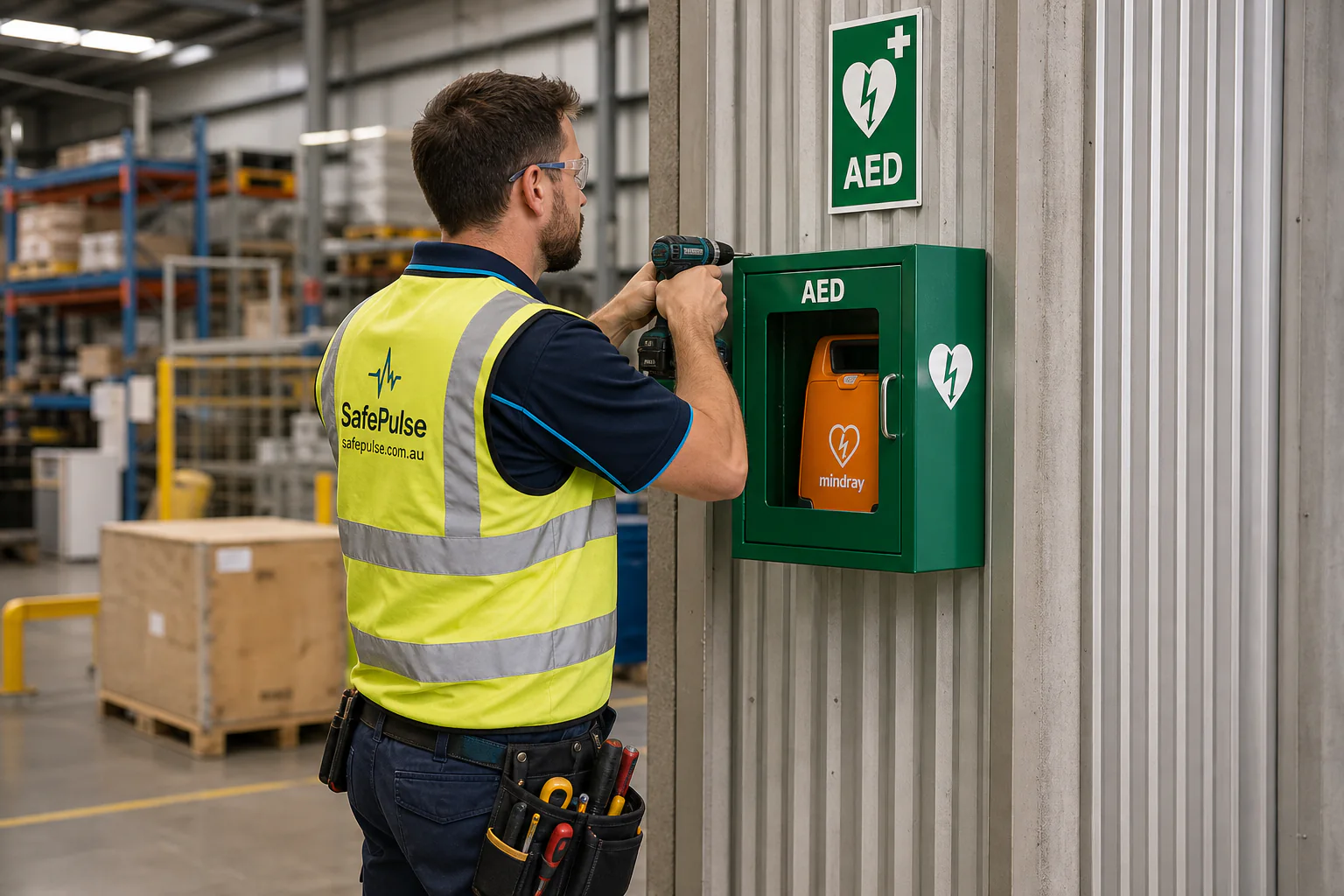
- Hardened enclosure for placements in unsupervised public areas where vandalism or theft is foreseeable.
We covered this in detail in AEDs in the Heat: Why NT Workplaces Need to Think About Cabinet Placement — worth reading alongside this piece if you’re planning an installation.
Registration is via St John, not GoodSAM
Unlike NSW, Victoria, SA, Tasmania and ACT, the Northern Territory does not use the GoodSAM platform. The NT registry runs through the St John NT First Responder app — free, iOS and Android. When a member of the public calls 000 using the app, GPS coordinates feed the operator and the dispatcher gains visibility of registered nearby Public Access Defibrillators.
Registration is voluntary, free, and the recommended path for any NT AED — grant-funded or self-funded.
Remote and Indigenous community placement
Public access defibrillation in remote Indigenous communities is a real public health concern but a sensitive market. There’s no NT-specific Indigenous AED program identified in publicly available sources. The Heart Grant is the closest funded pathway. Where SafePulse is involved in remote community AED conversations, the right path is community/health-service-led rather than commercial-led — the device gets placed because the community wants it placed, in a location and on terms that work for the community.
What this isn’t
A few clear lines:
The Heart Grant isn’t a guaranteed pathway. It’s competitive, time-limited, and not always open. A community organisation that needs an AED can’t sit on its hands waiting for the next round indefinitely.
The Heart Grant doesn’t fund commercial operators. If you run a for-profit business, you’re outside the eligibility scope and the grant isn’t an option. The path for commercial operators is self-funding.
Getting the device doesn’t end the obligation. Recipients carry ongoing maintenance — pad and battery replacement, monthly visual checks, post-event recommissioning. The grant funds the device; the ongoing program is the recipient’s.
What to do about it
If you’re a NT community organisation working through AED funding:
- Check the St John NT Heart Grant page (stjohnnt.org.au/heartgrant) for the next round’s status. Subscribe or check back periodically if the round is closed.
- In parallel, check Project Defib (projectdefib.com.au) if you’re a sporting club open to the Defibtech Lifeline VIEW model.
- Check your local council’s grants page for any current safety or community wellbeing rounds that might fit.
- Plan the full program, not just the device. Cabinet (outdoor-rated for NT conditions), installation, registration with St John NT, ongoing maintenance, CPR/AED training for nominated staff/volunteers.
- If a grant doesn’t land in your timing, self-fund. The cost spread across a 5–7 year device life is small relative to the gap between an organisation with an AED and one without.
- Register with St John NT when the device is installed. The First Responder app is the NT registry.
SafePulse installs and maintains AED programs for organisations across the Northern Territory — both grant-funded and self-funded. We specify cabinets for NT outdoor conditions, install, register with St John NT, and run a maintenance schedule that documents itself. If you’d like to walk through what an AED program would look like for your organisation, get in touch.