Mining is one of Western Australia’s largest industries and one of its most regulated. Pretty much every safety control on a WA mine site is either mandated, audited, or both — but defibrillators sit in an unusual position. The Work Health and Safety (Mines) Regulations 2022 don’t specifically require an AED. The general Work Health and Safety Act 2020 doesn’t either. Neither does the WorkSafe WA Code of Practice or Bulletin No. 11.
What does require an AED, in practice, is a competent first-aid risk assessment. And on a remote mining site — where ambulance response is measured in hours not minutes, and where electrical hazard exposure is part of the job — the conservative answer to that assessment is almost always: yes, this is reasonably practicable.
This piece walks through what the WA framework actually says about AEDs on mining sites, why the two trigger factors that matter most are particularly acute on remote sites, and how a mining AED program differs from one on a metropolitan office floor. It’s written for mine site WHS officers, emergency response coordinators, and operations managers who own the call.
The WA framework — what’s mandatory, what isn’t
Mining sits under the same WHS Act as everyone else
The Work Health and Safety Act 2020 (WA) commenced on 31 March 2022 — WA was the last state in Australia to adopt the model WHS framework. It replaced the previous Occupational Safety and Health Act 1984. For mining, the Act is supplemented by the Work Health and Safety (Mines) Regulations 2022, which give mining-specific operational detail (high-risk work, ventilation, principal hazard management, emergency response planning) on top of the general WHS duty.
Neither the Act nor the Mines Regulations specifically require AEDs at mining workplaces. There’s no clause that names defibrillators as required equipment.
What the WHS framework does require is the primary duty of care under section 19: a Person Conducting a Business or Undertaking (PCBU) must ensure, so far as is reasonably practicable, the health and safety of workers and others. Section 19’s “reasonably practicable” test is the door through which AED provision walks.
The Code of Practice covers mining workplaces
The WA First Aid in the Workplace Code of Practice was published by WorkSafe WA on 14 July 2022. Critically — and this matters for mining — the Code applies to workplaces under both the General Regulations and the Mines Regulations. There’s no separate first-aid Code for mining; the same document covers a CBD office and a Pilbara mine site.
The Code treats AEDs as a discretionary, risk-assessed item. The three trigger factors:
- Risk of electrocution to workers
- Likely delay in ambulance arrival
- Large numbers of members of the public present
The third trigger doesn’t really apply to remote mine sites. The first two apply hard.
WorkSafe WA Bulletin No. 11
WorkSafe WA published Health and Safety Bulletin No. 11 — Provision and maintenance of automated external defibrillators at workplaces on 18 September 2023 (last updated 19 November 2024). It’s currently the most direct WA-government guidance on AEDs in the workplace, and it applies to mining as much as to any other industry.
Verbatim from the Bulletin:
“Defibrillation is the only way to restore a heart with a fatal heart rhythm back to normal. As a consequence, if an AED fails to operate when used on a person who is in cardiac arrest, first aid will not be effective or reduce the risk of fatality.”
The Bulletin emphasises both provision and maintenance — flat batteries, expired pads, devices not visible/accessible — which can cause the device to fail when called on. The maintenance message has particular weight on mining sites, where AEDs may sit unused for years between operational use but need to work in the first minute they’re needed.
Why remote mining trips the “reasonably practicable” test
Two of the three trigger factors in the WA Code are amplified on remote and isolated mine sites.
Delayed ambulance response
WA’s ambulance service is delivered by St John WA across a service area of about 2.5 million square kilometres, including Christmas Island. In metropolitan Perth, response times look like metropolitan response times anywhere — minutes, not hours. In the Pilbara, the Kimberley, the Goldfields, the Mid-West and the South-West, the equation changes completely.
For remote operations — gas processing in the Carnarvon Basin, iron ore in the Pilbara, gold in the Goldfields, lithium in the Greenbushes corridor — ambulance response can be measured in hours, and often involves aerial evacuation (Royal Flying Doctor Service or contracted air ambulance). The Code is explicit that delayed ambulance arrival is one of the three trigger factors for AED consideration. The conservative interpretation on a remote mine site is that this trigger applies by default.
The clinical relevance: survival from out-of-hospital cardiac arrest drops sharply with each minute that passes before defibrillation. Even on the optimistic estimate, every minute matters. On a remote site where the next defibrillator might otherwise be on a flying doctor 90 minutes away, the device on the wall is the only intervention that addresses the time-to-shock variable in the way it needs to be addressed.
Electrocution risk
The first trigger in the WA Code is the risk of electrocution to workers. Mining operations carry that risk in several places:
- High-voltage haul roads and substations
- Underground and surface electrical infrastructure
- Conveyor systems with electrical drives
- Workshops, switchboards and electrical maintenance work
- Mineral processing plants
- Renewable energy infrastructure increasingly common on mine sites (solar farms, wind installations, battery storage)
Electrocution doesn’t always cause cardiac arrest — but when it does, the rhythm is often shockable. Ventricular fibrillation following an electrical contact is one of the cleanest indications for AED use that exists. The presence of meaningful electrocution risk and the absence of an AED is the kind of mismatch a competent WHS risk assessment doesn’t sit comfortably with.
Other factors particular to mining
Mining sites also stack on factors that aren’t named in the three triggers but raise the foreseeability of cardiac events:
- Concentrated workforce. Even on remote sites, the on-site population is often in the hundreds — accommodation camps, shift handovers, contractor presence during shutdowns. Absolute event rate scales with population.
- Ageing workforce in skilled trades. The trades workforce on Australian mining is, on average, older than the general workforce. Cardiac arrest rates climb with age. The foreseeability calculation reflects that.
- Shift work and circadian load. Long shifts, FIFO rosters, and night work have known cardiovascular health correlates.
- Heat stress. Pilbara summer conditions add cardiovascular strain to even routine outdoor work.
None of these individually mandates an AED. Together, they tilt the risk-assessment answer firmly toward provision.
What a mining AED program looks like
A mining-grade AED program doesn’t look like one in a CBD office tower. The environmental, operational and access constraints are different. Practical elements:
Where the units go
1. Each occupied permanent location. The wash-down bay, the mess, the workshop, the office complex, the gatehouse. Anywhere with consistent on-site staffing.
2. The site medical / first-aid facility. If the site has a medic on shift, the medic’s location is one obvious AED location.
3. Major work fronts. On a large active mining operation, defibrillator availability needs to scale with the physical footprint. A unit at the workshop doesn’t help if a worker collapses at a pit face 2 km away.
4. Vehicle-mounted units on remote-area patrols. Light vehicles operating in remote areas — supervisory patrols, contractor service vehicles — benefit from in-vehicle AEDs given the time it takes for any other unit to reach a remote incident.
Cabinet and device specification
WA mining environments are tough on equipment. Dust, vibration, heat, sometimes wet and humid, sometimes salt air on coastal sites. Specification matters:
- TGA approval. Mandatory for any AED sold in Australia.
- IP55 minimum for outdoor or semi-outdoor cabinet placements. IP56+ for harsh environment work.
- Operating temperature range matching the site. Most consumer AEDs cap at around 50°C — Pilbara summer ambient + cabinet solar gain can push beyond that. Outdoor cabinets in direct sun should have thermostatic control.
- Hardened enclosures for high-traffic-vehicle areas (crusher floors, workshops) where impact damage is foreseeable.
- GPS-monitored cabinets for vehicle-mounted or remote-area units, where physical theft and impact damage need monitoring.
Maintenance — the bit that’s often the weakest link
WorkSafe WA’s Bulletin No. 11 calls out under-maintained AEDs as a specific concern. On a mining site, the failure modes are particularly acute: the device might sit unused for years between operational use. A maintenance schedule that doesn’t account for that fails the device when it’s called on.
A mining AED program needs:
- Monthly visual inspection documented in the site’s maintenance log
- Daily self-test (the device handles this; the monitoring layer flags failures)
- Pad replacement per manufacturer schedule (typically every 2–4 years; sooner if heat exposure has been significant)
- Battery replacement per manufacturer schedule (typically every 4–5 years)
- Post-event recommissioning if the device has been used in an actual cardiac event
- Smart monitoring that reports battery, pad status, tamper and offline status to a central dashboard — particularly valuable on multi-site or remote operations
Most mature mining operations integrate AED status into their broader EHS management system, with documented evidence sitting alongside other safety-critical equipment.
Training
WA WHS doesn’t require AED-specific training — the device walks any responder through the process — but mining sites typically run combined first-aid + AED + remote-area training as part of the standard induction and refresher cycle. The relevant nationally recognised unit for remote workforce first aid is HLTAID013 — Provide first aid in remote or isolated site.
Registration
Voluntary, but worth doing. Registration in WA is via the St John First Responder app and the State Defib Network, not GoodSAM. St John WA is the contracted ambulance provider for the state and operates its own custom platform. Registration goes through the CFR Registration Form on stjohnwa.com.au, or by contacting first.responder@stjohnwa.com.au / (08) 9334 1418.
For a multi-site mining operation with multiple AEDs across multiple operations, bulk registration with St John WA keeps the State Defib Network accurate and ensures the AED is visible to St John’s State Operations Centre call-takers if a 000 call comes in from the site.
What this isn’t
Two things worth being clear about:
The Mines Regulations 2022 don’t name AEDs. A reading of the WA framework that says “the regulations require AEDs on mine sites” overstates what the law says. The duty that drives AED provision is the general primary duty under section 19, given practical content by the First Aid Code of Practice. It’s the s.19 / Code path, not a mining-specific mandate.
An AED isn’t a substitute for the broader emergency response plan. Remote mining sites typically have an Emergency Response Plan (ERP) that covers cardiac events, including liaison with St John WA, the Royal Flying Doctor Service, and any on-site medical facility. The AED is one component in that plan — the in-the-first-minutes intervention while the broader response is mobilised.
What to do about it
If you’re a WHS officer, emergency response coordinator or operations manager at a WA mining operation and you’re auditing your AED program:
- Pull the first-aid risk assessment. Does it specifically address electrocution risk and delayed ambulance response in the context of AED provision? If not, that’s the gap to close.
- Count and locate the existing units. Map them against where workers actually concentrate and against the major work fronts.
- Check the maintenance log. Are pads and batteries within manufacturer-specified life? Are monthly visual checks documented? If the answer to either is “I’m not sure,” that’s the next gap.
- Confirm cabinet specification. Particularly for outdoor units — IP rating, thermostatic control, hardening for the operating environment.
- Confirm registration. All units listed on the St John WA State Defib Network.
- Confirm training. Site induction includes AED location and use; nominated first aiders carry current HLTAID-equivalent qualifications.
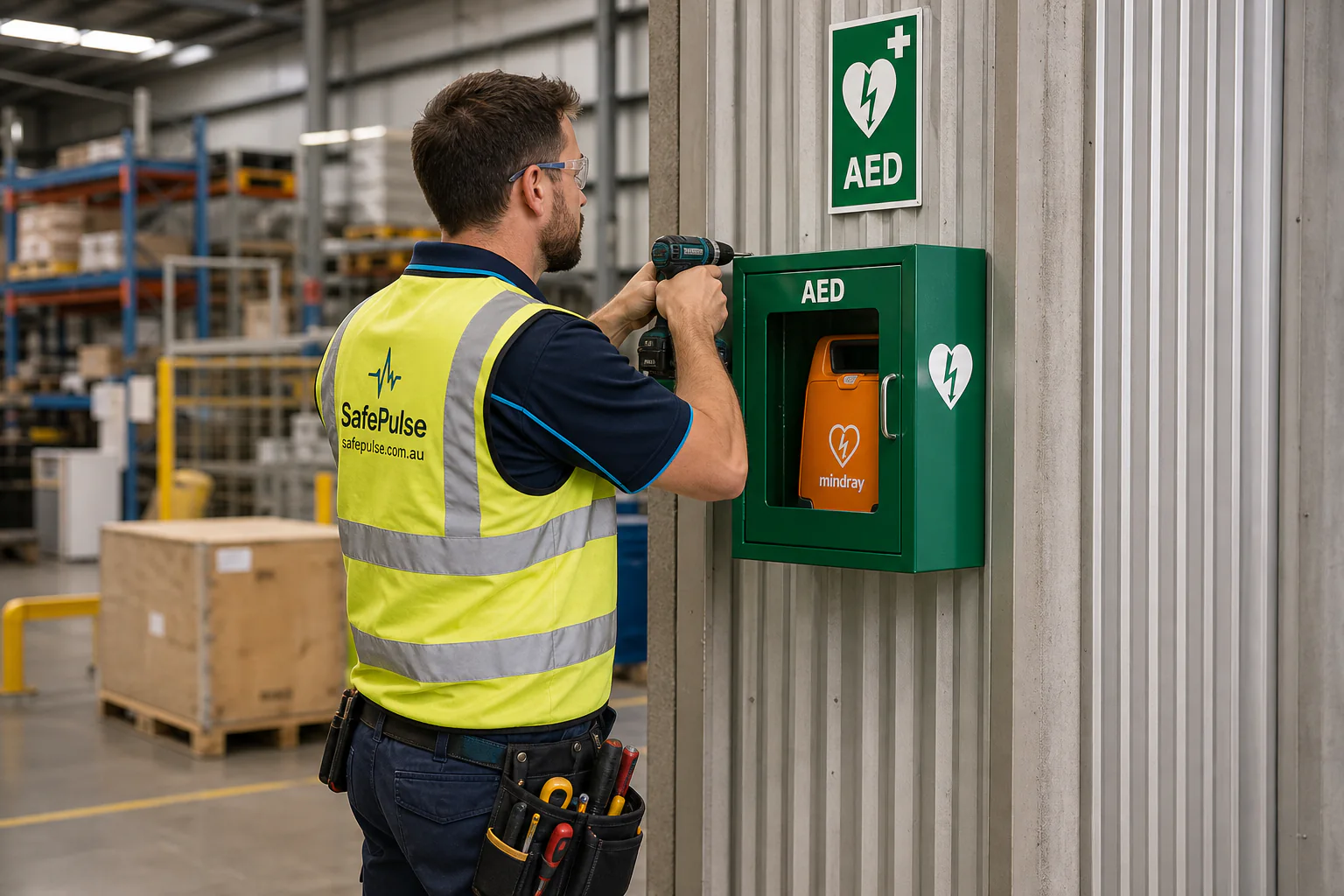
SafePulse provides AED programs to commercial operations across WA, including remote sites. We specify devices and cabinets for the environment, install, register with St John WA, and maintain on documented schedules — with smart monitoring options for sites where physical inspection by an external contractor isn’t practical. If your operation needs an AED program audit or a fresh install, get in touch.