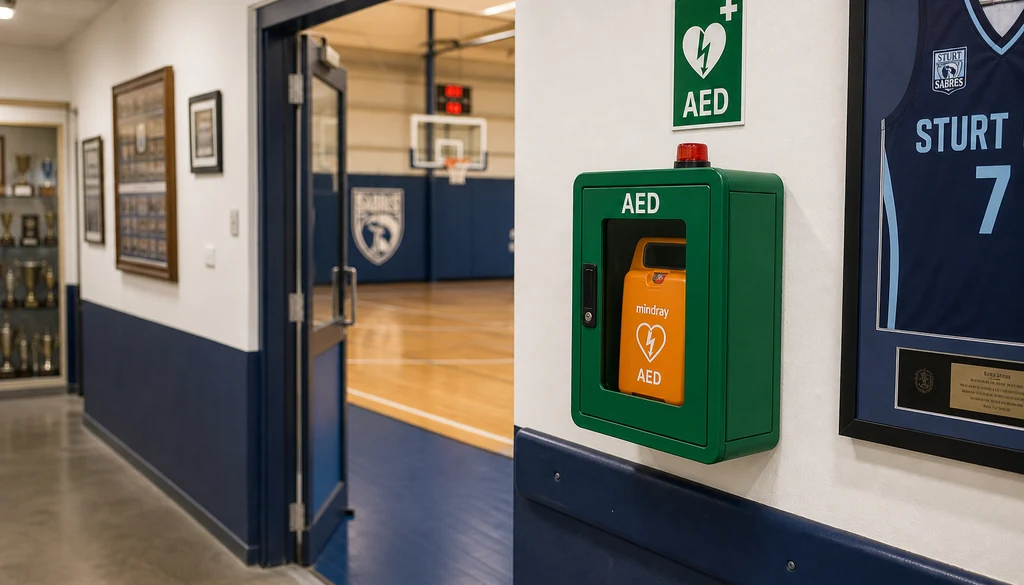
Canberra is about to become one of the first cities in the world with a publicly accessible defibrillator in every suburb. That’s a genuinely good story, and it’s the reason club committees keep asking us the same question: so can we get one funded?
The answer is yes, probably, but not through the route most people assume. There is no ACT Government defibrillator grant. What the ACT has instead is a philanthropy-driven community program that’s doing the work government hasn’t, plus a general sport grant that might cover a device if you ask the right question first.
Here’s the honest map of what’s actually available.
First, the legal position, because it isn’t the reason to act
The ACT has no AED legislation. No Act, no mandate, no deadline, no penalties, and nothing before the Legislative Assembly. We re-checked the Bills register and Hansard before writing this.
The closest the Territory has come was a 2022 motion by Leanne Castley MLA calling for AEDs to be made mandatory in ACT government schools, workplaces and on buses. The government amended it to strip the mandate out, leaving a commitment to “support” greater availability. That was four years ago and remains the most recent AED-specific action in the Assembly.
So nobody is going to fine your club for not having one. Our foundation piece walks through what the ACT does and doesn’t require: do ACT commercial buildings need an AED in 2026.
What does apply is the general first aid duty under the Work Health and Safety Act 2011 (ACT), detailed in the First Aid in the Workplace Code of Practice adopted in 2020. That Code says you should consider providing an AED where there’s a risk of electrocution, where ambulance arrival would be delayed, or where large numbers of workers or members of the public are present.
For a club, the third factor is the one that lands. Saturday morning at a suburban ground puts a few hundred people on site, and the highest-risk group there usually isn’t the players. It’s the parents, the volunteers on the barbecue, the committee members in the clubrooms and the older members who’ve been coming for thirty years.
Route 1: StreetBeat, and what it actually is
The StreetBeat program, run by St John Ambulance ACT under its Defib in Your Community banner, is the leading community AED story in Canberra and it’s worth understanding properly before you approach anyone else.
StreetBeat installs publicly accessible outdoor defibrillator cabinets in Canberra suburbs, available around the clock. As at mid-2026, 47 units are installed, with a further 77 funded, and the stated goal is one publicly accessible AED in every Canberra suburb by the end of 2026.
Two things make it unusual. First, it isn’t government-funded. The bulk of the current expansion came from philanthropy, with more than $350,000 from Frederik Paulsen and Mat Franklin covering the 77 new units, alongside support from Capital Chemist, GoodLoop Mutual and Community Bank Canberra. Second, it’s built around public street access rather than facility ownership. The device goes on a wall the whole suburb can reach, not inside a locked clubhouse.
What that means for your club. If your ground or clubhouse sits somewhere with genuine 24/7 public access, and your suburb doesn’t have a StreetBeat unit yet, it’s absolutely worth contacting St John Ambulance ACT to ask about hosting one. Hosting a community device is a legitimate way to get a defibrillator onto your site at no capital cost.
But be clear about the trade. A StreetBeat unit is a public asset sited at your location, not club equipment you control. It needs to stay publicly reachable, which usually rules out anything behind a locked gate or inside a building that’s shut six days a week. If your real need is a device that travels to away games or lives in the first aid room, this isn’t the program.
St John ACT has also donated AEDs directly to major ACT sporting codes in the past, so if you’re affiliated with a state sporting organisation, it’s worth asking your peak body what came down through that channel before you buy anything.
Route 2: The Club Enhancement Program, with one question you must ask first
The ACT Government’s Sport and Recreation Investment Scheme includes the Club Enhancement Program, which provides between $500 and $20,000 to ACT sport and active recreation clubs, district associations and state sporting organisations. It funds equipment, training, and improvements to club capability and capacity.
This is the closest thing the ACT has to an AED funding pathway, and it comes with a caveat we’re not going to paper over.
AEDs are not explicitly named in the published eligible expenditure list. The list does include non-consumable equipment retained by the club that doesn’t require regular replacement, giving examples that include training and safety equipment. A defibrillator arguably sits inside that description. Arguably is not the same as confirmed.
Before you build an application around a defibrillator, contact ACT Sport and Recreation directly and get the eligibility answer in writing. Ask two things: whether an AED qualifies as eligible equipment under the current guidelines, and whether the ongoing consumables cost, pads and battery, can be included or must be excluded. Round timing shifts, so check the SmartyGrants portal for what’s currently open rather than relying on a program page that may be describing last year.
The ACT does not run a dedicated defibrillator grant equivalent to the NSW Office of Sport’s Local Sport Defibrillator Grant Program. If a supplier’s website suggests otherwise, it’s confusing your Territory with New South Wales.
Route 3: What clubs actually end up doing
Here’s the pattern we see, in Canberra and everywhere else, and it isn’t a failure.
Clubs that decide a defibrillator matters usually stop waiting and fund it themselves. A season fundraiser. A local business sponsorship with the sponsor’s name on the cabinet. Splitting the cost with a co-tenant club that shares the ground. Occasionally a single member who’s had a cardiac event in the family and wants it dealt with.
That works better than it sounds. A defibrillator is a one-off capital purchase with a modest ongoing consumables cost, and it’s an unusually easy thing to raise money for. Businesses that hesitate over a new scoreboard will often put their name to the device that could save somebody in the clubrooms. If your ground is shared between a winter and a summer code, one device between the two halves both the cost and the maintenance burden.
The genuinely bad outcome is the middle path: deciding you need one, applying for a closed or ineligible round, and then doing nothing for two seasons while you wait for an answer.
Registration, and the ACT’s particular gap
Once you’ve got a device, register it. This is where the ACT differs from most of the country, and it matters.
The ACT has no government or ambulance-service AED registry. There’s no Territory equivalent of the SA Ambulance register or NSW Ambulance’s GoodSAM integration. AED locations in Canberra are held by St John Ambulance ACT through the national St John AED register and the St John First Responder app, plus the StreetBeat map. All of it voluntary, none of it government-run. We’ve written about that gap in the ACT has no government AED registry.
Register your device on the St John register anyway. It surfaces the location through the First Responder app, which trained responders and increasingly the general public use to find the nearest device. What we won’t tell you is that a Triple Zero call-taker in Canberra will automatically direct a caller to it, because that integration isn’t confirmed in publicly available ESA or ACT Ambulance material. Anyone promising you otherwise is guessing.
The part clubs forget to budget for
Whether the device arrives free, funded or bought outright, the ongoing cost is yours.
Pads expire, typically on a two to four year cycle, and they expire whether or not the device is ever used. Batteries have their own replacement interval. Devices run a self-test, but a self-test doesn’t tell anyone anything if nobody is looking at the status indicator, and clubrooms are exactly the environment where a device sits unwatched from one season to the next.
Put one person’s name against it. Diary the pad and battery expiry dates the day it’s installed, not the week they lapse. If your club’s volunteer base turns over every couple of years, which most do, write the responsibility into the role rather than attaching it to a person.
The other half of it is training. Any AED will talk an untrained person through the sequence, and that’s real. But a coach who’s opened the cabinet once in a training session will move faster than one reading the instructions for the first time with a person on the ground. Run it through a pre-season briefing along with your concussion and heat policies.
Where to start
If you’re a Canberra club, the sequence is short.
Ask St John Ambulance ACT whether your suburb is in the StreetBeat rollout and whether your site could host a unit. Ask ACT Sport and Recreation, in writing, whether an AED is eligible under the current Club Enhancement Program round. If both come back no, budget for it as a one-off capital item and find a sponsor, because the fundraising case is easier than almost anything else on your committee’s list.
Then put it somewhere unlocked, sign it, register it with St John, and give someone the job of watching the dates.
The related pieces on Canberra facilities are AEDs in Canberra body corporate office buildings and independent and Catholic schools in the ACT, which cover the same voluntary framing for different sites.
If you’d like a hand working out what your club actually needs, one device or two, where it should go, and what the ongoing cost looks like, we install and maintain AEDs across the ACT with servicing built into the install. Start at our ACT AED page.


