Residential aged care sits under two rulebooks at once, and neither of them mentions a defibrillator.
The federal framework governs the care. The Territory’s work health and safety law governs the workplace. An aged care home in Katherine has to satisfy both, and the thing that decides whether a defibrillator makes sense isn’t in either document. It’s the drive time to the nearest ambulance.
Start with what isn’t true
The Northern Territory has no AED-specific legislation. We re-checked the Legislative Assembly’s bills register this month and there’s still no Bill, on this or anything close to it.
The strengthened Aged Care Quality Standards don’t mandate defibrillators either. They came into force on 1 November 2025 when the Aged Care Act 2024 replaced the 1997 Act, and Standard 5 covers clinical care, including identifying, monitoring and responding to clinical deterioration. It sets an outcome. It doesn’t hand you an equipment list, and it doesn’t name a defibrillator anywhere.
South Australia is the only jurisdiction that does mandate them, and residential aged care is designated under the SA Act. A provider operating homes in both Adelaide and Darwin is legally required to have one at the Adelaide site and not at the Darwin one. That’s the actual state of play, and it’s worth being clear about it before anyone quotes a compliance deadline at you.
The two frameworks, and the gap between them
Here’s the structural point that makes aged care different from every other building type we write about.
The WHS duty runs to workers. Under the Work Health and Safety (National Uniform Legislation) Act 2011, a PCBU has to provide first aid equipment and access to it, first aid facilities where appropriate, and access to trained first aiders. Your care staff, kitchen staff, maintenance and admin people are all covered. The NT WorkSafe First Aid in the Workplace Code of Practice is what puts defibrillators into that picture, and it’s discretionary — you should consider one where there’s electrocution risk, ambulance delay, or large numbers of the public.
The Aged Care Act framework runs to residents. That’s where clinical deterioration, care planning and clinical governance live.
So the people at the highest cardiac risk in the building — the residents — aren’t the people the WHS trigger is written about. And the standard that does cover them doesn’t specify equipment.
That isn’t a loophole to hide in. It’s the reason this decision gets made on judgement rather than on a checklist, and it’s why writing down your reasoning matters more here than almost anywhere else.
Two of the Code’s three triggers apply cleanly enough. An aged care home isn’t a public building in the shopping centre sense, so the public-numbers trigger is a stretch. Electrocution isn’t yours. Ambulance delay is the one that carries it, and in the Territory it carries it a long way.
The distance question, honestly
St John Ambulance is the Territory’s contracted ambulance provider. It runs the road ambulance service and the two Emergency Communications Centres in Darwin and Alice Springs that take Triple Zero calls. In the NT, “the ambulance service” and “St John” are the same thing.
Ambulance stations sit at Casuarina, Parap, Palmerston, Humpty Doo, Katherine, Nhulunbuy, Tennant Creek and Alice Springs. If your home is in Darwin or Palmerston, response times are metropolitan and the delay trigger is weak. Be honest about that in your assessment rather than overclaiming it.
Outside those nodes it’s a different conversation, and the Code goes further than a general warning. It says extra first aid considerations may be necessary for workers in remote or isolated areas, and that where access is difficult because of travel time, poor roads or weather, arrangements should include aerial evacuation.
Read that plainly. When the regulator tells you to plan for aerial evacuation, it’s telling you nothing is arriving inside the window that matters for a cardiac arrest. A defibrillator on the wall isn’t a nice supplement to the ambulance response in that setting. For those few minutes it is the response.
Wet season access is part of this too. A road that’s fine in July and cut in February changes your effective response time twice a year.
What on-site clinical staff does and doesn’t change
Most residential homes have registered nurses on site, and that genuinely changes the picture. You have people trained to recognise deterioration and start CPR immediately, which is more than most workplaces can say.
What it doesn’t change is the physics. CPR keeps circulation going. It doesn’t restore a shockable rhythm. The Code says this directly — CPR can prolong life, but defibrillation is the only way to return a heart in a fatal rhythm to a normal one.
Two practical follow-ons:
Check your after-hours picture, not your day-shift picture. Overnight staffing is thinner everywhere. If your assessment is built on the Tuesday morning roster, redo it on the Sunday 3am roster.
Skilled staff make a device more useful, not less. A trained RN with a defibrillator on the wall is the best version of this scenario. Nobody needs certification to operate one — the Code is explicit that AEDs are designed for trained and untrained users and talk the operator through it — but having clinical staff means it gets to the resident faster.
Heat is a specification problem here, not a footnote
This is the part that’s genuinely different in the Territory, and it’s where we see the most avoidable mistakes.
The NT Code says devices should be located somewhere clearly visible, accessible, and not exposed to extreme temperatures, clearly signed and maintained to the manufacturer’s specifications. That’s not generic advice in a place where a covered walkway hits temperatures an air-conditioned corridor never sees.
Most units have an operating ceiling around 50°C and the pad gel degrades in sustained heat. So:
- Inside the conditioned building is the default. Corridors, foyers, nurses’ stations. Not a plant room, not a covered breezeway, not an unconditioned store.
- If a device has to sit anywhere exposed — a detached activities building, a maintenance shed, a bus used for outings — it needs an enclosure rated for it. IP56 or above, with thermostatic control where it’s in direct sun.
- Check the manufacturer’s stated range against your site, not against the Bureau’s average for the nearest town. A wall in afternoon sun is not the same as the shade temperature.
We’ve written about heat and cabinet placement in NT workplaces in more detail, and everything in it applies here.
Placement inside a home
Aged care has one placement quirk worth knowing. Under the SA Act, the requirement that devices be publicly accessible doesn’t apply to aged care facilities, which recognises something true everywhere: these are secure residential environments, not public buildings.
The Territory has no equivalent rule because it has no Act at all. But the principle holds. You’re not placing for a member of the public who’s never been in the building. You’re placing for your own staff, at 3am, moving fast.
That means:
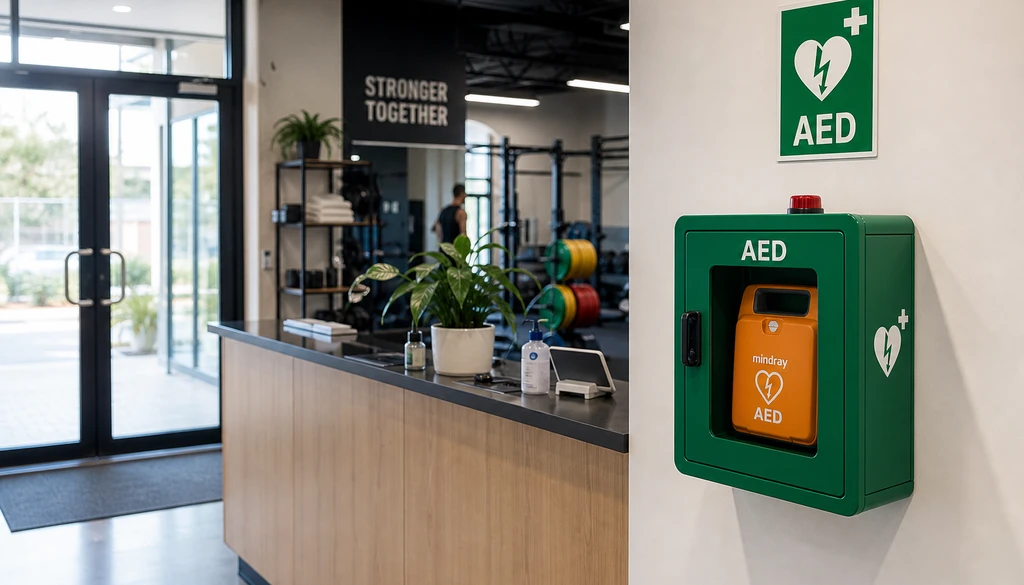
- Mounted between 1.2 and 1.4 metres, in the sightline staff already use
- Central to the resident wings rather than tucked behind reception
- Signed clearly enough that agency and casual staff find it without asking
- Never locked behind a code or a key
In a spread-out single-storey home — which describes most Territory facilities — one device at reception can be a very long way from the far wing. Walk it at speed before you decide one is enough.
Registration and funding
Registration. The Territory doesn’t use GoodSAM. Registration is through the St John NT First Responder app, it’s free, and it’s voluntary. There’s no law requiring it. Register the device with its real location and access details so a dispatcher can direct someone to it. In a secure residential facility the external benefit is limited, but it costs nothing and it puts your device on the map.
Funding. St John NT’s Heart Grant, backed by the NT Government Community Benefit Fund, is the Territory’s main subsidy route. It’s competitive, aimed at community organisations, sporting clubs and not-for-profits, and it places a limited number of kits per round. The 2025 round closed on 30 June 2025 fully allocated, and no 2026 round had been announced at the time of writing.
Not-for-profit providers may be worth a look at it. Commercial operators generally won’t qualify. Either way it’s not a plan you can build a rollout around, and it supplies a device rather than the ongoing servicing.
Keeping it ready
A defibrillator is only worth having if it works on the day. Pads and batteries expire, and in the Territory heat accelerates that.
Give it to a named person, not a department. Fold a monthly status check into an existing round rather than creating a new form nobody fills in. Diary the pad and battery expiry dates the day the unit goes on the wall. Maintain it to the manufacturer’s specifications, which is what the Code asks for and what any assessor would expect to see logged.
Where to start
If you operate residential aged care in the Territory, the assessment is short and it’s yours to write.
How far is the nearest ambulance, in the wet as well as the dry? What does your overnight staffing look like? How far is the furthest resident room from where a device would go? What did you decide, and why?
That document is the thing that matters, whichever way it lands.
We install and maintain defibrillators across the Northern Territory, including heat-rated enclosures, St John NT registration and ongoing servicing. Start at our Northern Territory page, or read whether NT commercial buildings need an AED for the wider position. If you manage property in the Top End, the Darwin and Palmerston guide covers the metro picture.