Buying the defibrillator is the easy part. Deciding where it goes is the decision that determines whether it ever gets used.
I’ve installed a lot of these, and the pattern is consistent. The devices that would work in a real emergency are the ones somebody thought about for ten minutes before we drilled. The ones that wouldn’t are the ones that went wherever there happened to be free wall.
Here’s how to make that decision properly.
Start with the round trip, not the wall
There’s one number that governs everything else: survival from cardiac arrest falls away sharply with every minute that passes before defibrillation. Within the first few minutes the odds are genuinely good. After ten they’re close to nothing.
So the test isn’t “can someone find the AED”. It’s the round trip — somebody has to realise what’s happening, leave the patient, get to the device, and get back. Aim to keep that under about three minutes from anywhere in the building, and remember you’re measuring it on the worst version of the journey, not the best.
Walk it yourself. Not the route you know, the route a panicking visitor would take. Wait for the lift. Try the fire stair door. Do it at the time of day when the fewest staff are around. Most people are surprised by how far a device that looked central actually is.
A few things that quietly add minutes:
- Lifts. A device one floor away is only close if the lift cooperates. In a multi-storey building, plan on stairs.
- Long single-corridor floorplates. A device at one end of a 100-metre floor doesn’t cover the other end, no matter what the floor plan suggests.
- Security doors. Any door that needs a pass is a door that stops somebody who doesn’t have one.
- Split levels and mezzanines. Easy to miss on a plan, slow in reality.
The rules that actually exist
Most of Australia gives you guidance rather than rules. South Australia gives you both, and it’s worth knowing which is which.
South Australia is the only jurisdiction with AED legislation in force. Under the Automated External Defibrillators (Public Access) Act 2022, a device in an in-scope building must be publicly accessible — a member of the public has to be able to get it themselves, or request it at something like a security desk. It cannot be installed in a cabinet or container that needs a key or an access code, because that defeats immediate emergency access. If it isn’t fixed to a wall, it has to be returned to the same spot after every use. Signage is required both near the device and outside near the building entrance. Aged care facilities are the one carve-out from the public accessibility requirement.
SA is also the only place that tells you how many. Once a commercial building’s publicly accessible floor area passes 1,200 m², a scaling table sets the count — and the reason that table exists is distance. Two devices in a large centre aren’t redundancy, they’re coverage. We’ve worked the calculation through in how to calculate publicly accessible floor area.
Everywhere else runs on the WHS or OHS first-aid codes, which say much the same thing in softer language. The model code used across most states says an AED should be located somewhere clearly visible, accessible and not exposed to extreme temperatures, clearly signed and maintained to the manufacturer’s specifications. WorkSafe Victoria’s Compliance Code puts it plainly: AEDs should be installed in well-known, visible and accessible locations, and they should not be locked.
That last point is the one people fight hardest, so it’s worth being direct about it.
Locking the cabinet is the most common mistake we see
The instinct is understandable. It’s an expensive piece of equipment on a wall in a public corridor, and somebody is responsible for it.
But a locked cabinet moves the device from “available” to “available to whoever has the key, if they’re on site, if they can be found”. In South Australia that arrangement isn’t compliant. Everywhere else it defeats the purpose of the thing you just paid for.
If security genuinely is a concern, the answer isn’t a lock. It’s an alarmed cabinet that anyone can open but that makes a noise when they do, positioned in a staffed or camera-covered area. The alarm handles the deterrence, and it doubles as an alert that something is happening. In practice, theft of defibrillators from commercial buildings is rare, and the cost of the device being unreachable once is far higher than the cost of replacing it.
Height, mounting and the things installers get wrong
The settled convention across Australian guidance is to mount the cabinet or bracket 1.2 to 1.4 metres from the floor. That puts it in natural eyeline, reachable by most adults, and usable by someone in a wheelchair.
Beyond height:
- Keep it out of the traffic line but in the sightline. A cabinet that gets knocked by trolleys ends up damaged; a cabinet behind a pot plant ends up invisible.
- Sign it properly. The green AED symbol above the cabinet, and in a large building, floor-level signage near the lifts telling people which floor it’s on. If you have to explain where it is, the signage isn’t doing its job.
- Match the enclosure to the environment. Anything outdoors, semi-outdoors, or in an unconditioned shed or plant room needs a rated cabinet — IP55 or above is the general benchmark, and hotter or more exposed sites warrant better. Check the device’s own operating temperature range against the conditions where you’re putting it, not the local average. Pad gel degrades in sustained heat.
- Don’t leave it loose in a vehicle or a drawer. Devices that live in a drawer stop being findable within about a fortnight of the person who put them there going on leave.
Where to put it, by building type
Office towers. Ground-floor lobby near reception is the usual anchor, because it’s staffed, visible and where an ambulance arrives. In a tall building, one lobby device does not cover level 14 — plan a second on an upper floor, ideally near the lift core, and tell every tenant it exists.
Multi-tenant buildings and strata. Common areas are the right home, because they’re the only spaces everyone can reach. The harder question is who owns the device and its maintenance. In SA that’s answered by the Act — it’s the building owner’s duty, not the tenant’s. Elsewhere it’s a negotiation, and it needs settling in writing before the device goes up. See who’s responsible in a multi-tenant building.
Retail and shopping centres. Long internal distances make this a coverage problem more than a placement problem. Centre management offices and main entries are the anchor points, and one device at one end of a mall is not a plan.
Warehouses and industrial sites. Put it where the work happens, not in the front office. Add a rated enclosure if the space isn’t conditioned, and factor in that the person who collapses may be the one who was working alone.
Gyms and sporting facilities. Reception or the main thoroughfare, reachable from both the gym floor and any outdoor courts or fields. Unstaffed 24-hour gyms need the device on the member side of any locked door.
Aged care and clinics. Near the nurses’ station or the main circulation route. SA exempts aged care from the public accessibility requirement, so the device can sit in a staff-controlled area — but it still has to be somewhere staff can reach in seconds.
Schools. Front office is the default and it’s usually wrong on its own, because the biggest crowds are at weekend sport and evening events when the office is locked. If the oval and hall get community use, consider an externally mounted cabinet.
Two devices, or one?
Work it from the round trip, not the floor area. If any regularly occupied part of your site is more than about a ninety-second walk from the device, a second one is doing real work. That threshold gets crossed faster than people expect in tall buildings, long single-level sites, and anywhere with a separate outdoor area.
In South Australia, if the building is commercial and the publicly accessible area is over 1,200 m², the count isn’t a judgement call — the scaling table decides it.
Placement isn’t finished until people know
The most common reason a defibrillator goes unused isn’t distance. It’s that nobody in the room knew there was one in the building.
So the last three steps matter as much as the drilling. Put it in the site induction, for staff and contractors both. Mark it on the floor plan and the emergency plan. And register it — with SA Ambulance if you’re in South Australia, where registration is mandatory within two weeks of installation, or with the voluntary registry in your state so a Triple Zero call-taker can point someone at it.
Then give one person the job of checking the pads and battery dates. A perfectly placed device with expired pads is a decoration, which is the subject of what AED maintenance actually requires around Australia and, for the servicing cadence specifically, how often an AED needs to be serviced.
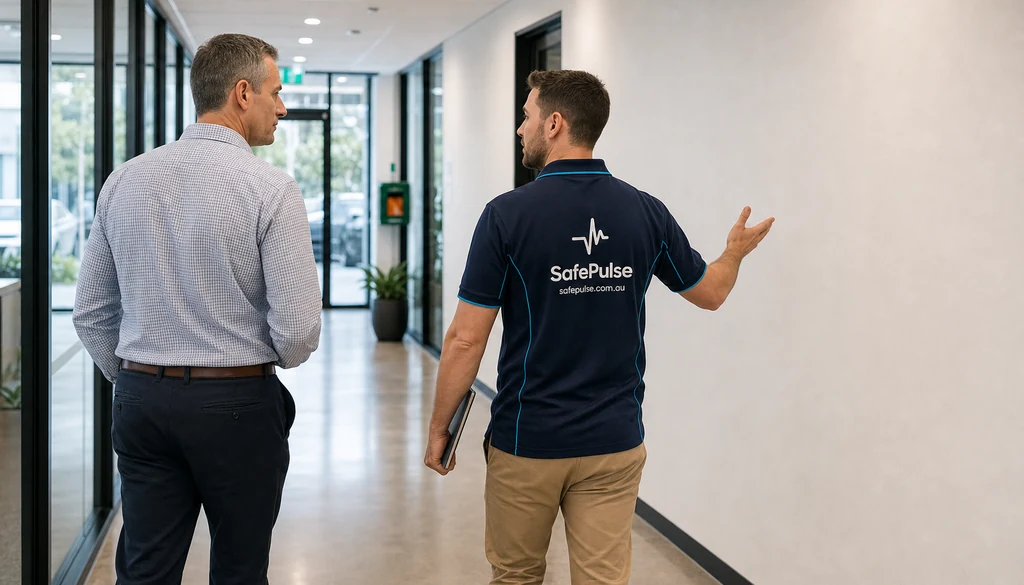
If you’d like someone to walk the building with you and work out the coverage properly, that’s a site assessment and it’s what we do before every install. Have a look at our installation and maintenance services, or how many AEDs your building needs if you’re still sizing it up.


