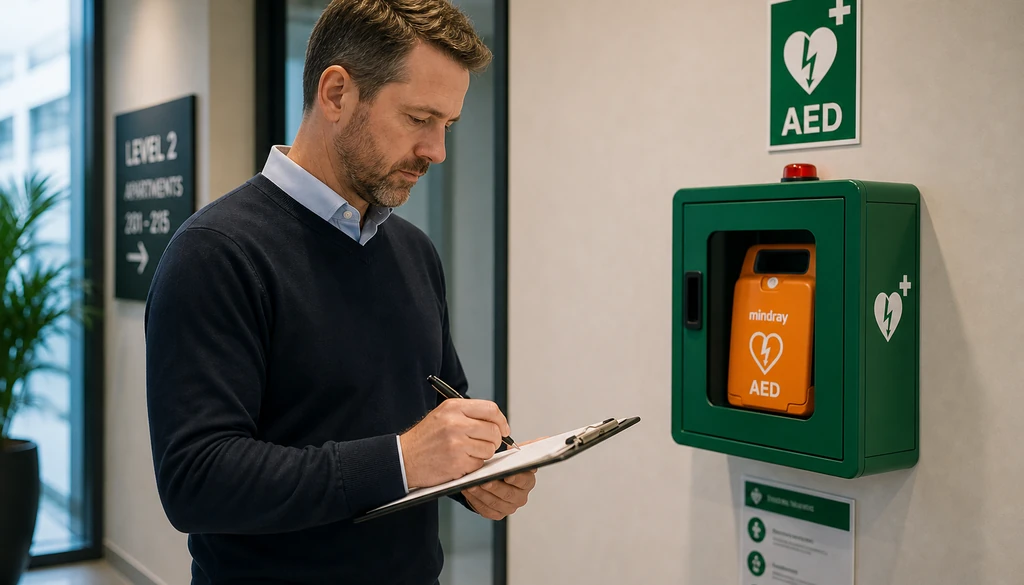
Alice Springs is its own kind of commercial market. It’s a real town centre with offices, retail, accommodation and a steady stream of visitors passing through to Uluru and the West MacDonnells — but it sits a long way from anywhere, in a climate that runs from 40-degree summer afternoons to near-freezing winter nights. For anyone managing commercial property in the Centre, those two facts — distance and heat — shape the AED conversation more than any law does.
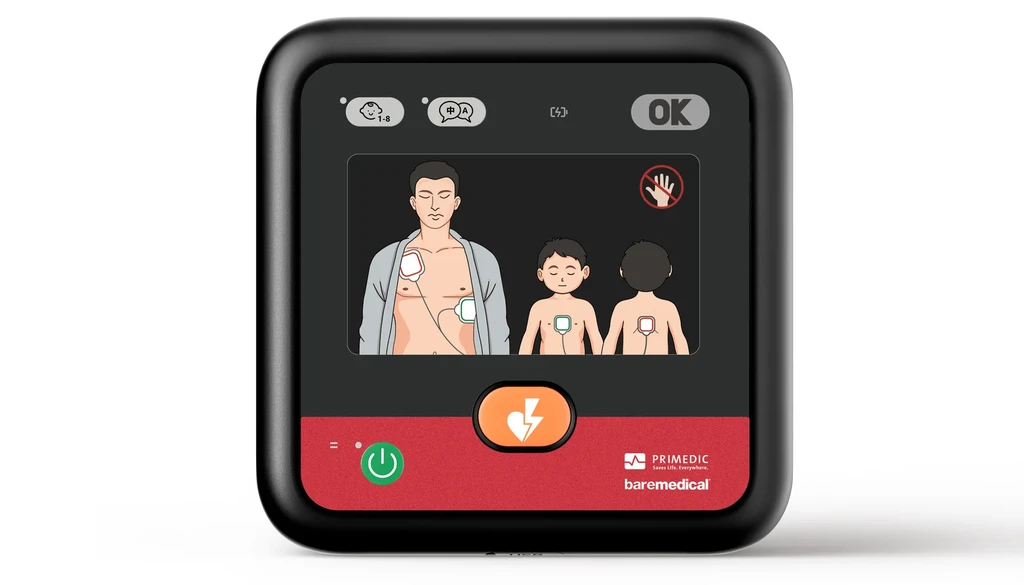
Here’s a practical guide to whether you need a defibrillator, where it goes, and the couple of things that genuinely matter in Alice that don’t matter the same way in a Darwin office tower.
The legal position: no mandate, but a duty you already hold
Start with the honest version. The Northern Territory has no AED-specific legislation, and no AED Bill has been identified before the NT Legislative Assembly. There’s no minimum building size, no compliance deadline, and no penalty for not having a device. South Australia is the only state in the country with a mandate in force — and it stops at the SA border. If anyone tells you Alice Springs commercial buildings are “required” to have an AED, they’ve confused the NT with SA.
What you do have is a general first aid duty under the Work Health and Safety (National Uniform Legislation) Act 2011 (NT). NT WorkSafe’s First Aid in the Workplace Code of Practice gives that duty its practical shape, and it treats an AED as a risk-based consideration. You should consider providing one where there’s a risk of electrocution to workers, a likely delay in ambulance arrival, or large numbers of members of the public present.
For most Alice Springs commercial settings, it’s the middle trigger that does the heavy lifting.
Why ambulance delay is the live factor in the Centre
Alice Springs has its own St John ambulance station — and St John Ambulance NT is the contracted ambulance provider for the whole Territory, not a charity sitting alongside it. So in town, a response isn’t measured in hours. But the Centre’s reality is that “in town” is a small circle surrounded by a lot of country.
The moment a worksite, accommodation property, tourism operation or facility sits out past the town’s edge — and plenty in the Alice economy do — the “delay in ambulance arrival” trigger the Code names becomes real. The Code is explicit that extra first aid considerations apply for workers in remote or isolated areas, where travel time, road conditions or weather stretch response. The further your site is from the Stuart Highway and the station, the stronger the duty-of-care case for an on-site device gets.
Cardiac arrest survival falls with every minute before defibrillation. When the ambulance is genuinely minutes away, an AED buys time. When it might be longer because of where you are, that device stops being a nice-to-have and starts being the most defensible risk control on your site. We make the broader Territory version of this case in our guide to whether NT commercial buildings need an AED.
The heat problem — and it’s a real one in Alice
This is where the Centre needs more care than almost anywhere. The NT Code of Practice says, in plain terms, that an AED “should be located in an area clearly visible, accessible and not exposed to extreme temperatures.” That isn’t boilerplate up here.
Most consumer-grade AEDs have an operating temperature ceiling around 50°C, and — just as importantly — the gel on the defibrillation pads degrades in sustained heat. A device left in an un-airconditioned shed, a vehicle cab, or a wall mount in direct sun through an Alice summer can quietly cook itself out of readiness without anyone noticing until the day it’s needed.
So for Alice Springs the rules of thumb are:
- Indoors and air-conditioned is the easy answer. A reception area, foyer or office corridor that stays climate-controlled is the natural home for the device, and a standard cabinet is fine.
- Outdoors or semi-exposed — an outdoor entrance, a yard, a remote site — needs a proper outdoor cabinet rated IP56 or higher, ideally with thermostatic control, and you should check the specific device’s stated temperature range before you rely on it.
- Never a vehicle dash, an unconditioned storeroom, or a sun-facing exterior wall with no enclosure.
We go deeper on cabinet selection and heat in our piece on getting AED placement right in the NT heat — it’s the single most important thing to get right in this climate.
Registration runs through St John NT, not GoodSAM
One more thing that’s different up here. The NT doesn’t use the GoodSAM platform that NSW, Victoria and SA run on. Registration is done through the St John NT First Responder app — free, on iOS and Android — and it’s voluntary, not a legal requirement.
It’s still worth doing. When someone calls Triple Zero through the app, it sends GPS coordinates to the operator and gives the dispatcher visibility of registered public-access defibrillators nearby. Registering your device puts it on that map. For an Alice property, it’s a five-minute job that makes your AED findable in an emergency, so there’s no reason to skip it.
(For community groups and not-for-profits, St John NT’s Heart Grant is the subsidised pathway worth knowing about — though its rounds fill fast and commercial operators generally won’t be eligible, so for most property managers it’s the First Responder app that’s relevant, not the grant.)
A practical approach for Alice property managers
- Assess honestly. How many people move through your property, how old-skewing is your visitor mix, and — the big one in the Centre — how far is your site from town and a fast ambulance response?
- Make the call and document it. If the ambulance-delay or footfall triggers apply, installing an AED is the defensible decision. Note the reasoning either way.
- Place it in climate-controlled space where you can. If it has to live outdoors or on a remote site, use an IP56+ thermostatic cabinet and check the temperature rating.
- Register it on the St John NT First Responder app, and put it on a maintenance routine so pads and battery are always in date — heat makes that discipline matter more, not less.
Where SafePulse fits
We install and maintain AEDs for Northern Territory commercial properties, and we’ll always give you the straight version: there’s no NT law forcing this, so it’s a duty-of-care decision — but in the Centre, between the distances and the heat, it’s a decision that usually points one way. What we’ll help with is making it properly: working through your site’s response-time and footfall exposure, specifying a unit and cabinet that survive an Alice summer, placing it where it’ll actually be reached, registering it with St John NT, and keeping it maintained.
The Top End equivalent is a practical AED guide for Darwin and Palmerston, and the heat rule that shapes cabinet choice in both is in AEDs in the heat. For the legal position, see do Northern Territory commercial buildings need an AED in 2026. Our Northern Territory AED page has more.
If you manage commercial property in Alice Springs and want to work out whether the case is there, that’s a simple conversation to have. Our Northern Territory AED page covers how we work across the Territory, and our Darwin and Palmerston property manager’s guide is a useful companion for anyone managing across both ends of the NT.