A shopping centre is one of the few building types where the argument for a defibrillator doesn’t need much construction. You’ve got thousands of people through the doors, a weekday crowd skewed older than almost any other commercial setting, and internal distances long enough that where you put the device matters as much as whether you have one.
None of which makes it a legal requirement in New South Wales. It isn’t, and anyone telling a centre manager otherwise is selling something.
What follows is the actual position, and then the part that’s more useful — how a centre should work through the decision.
New South Wales still has no AED law
There’s no equivalent to South Australia’s defibrillator Act in force in NSW, and nothing before Parliament that would create one.
The three private member’s Bills introduced by Gareth Ward MP all lapsed. We re-checked the register before writing this: the third and last of them, the Automated External Defibrillators (Public Access) Bill 2024 (No 3), is recorded as having lapsed in accordance with standing orders on 13 May 2025. It never went past the second reading speech in the Legislative Assembly. There is no NSW mandate, no compliance date, and no penalty for not having a defibrillator.
We keep having to say this because supplier marketing keeps blurring it. If you’ve been sent something implying a NSW deadline, it’s South Australian law being sold across the border.
What does apply to a centre
The Work Health and Safety Act 2011 (NSW) and the WHS Regulation 2017 put a first aid duty on every PCBU: provide first aid equipment and make sure it’s accessible, provide facilities where appropriate, and make sure enough people are trained.
The detail sits in SafeWork NSW’s First Aid in the Workplace Code of Practice, which commenced on 31 January 2020. On defibrillators it says this:
“An AED may be provided to reduce the risk of fatality from cardiac arrest where there is a risk to your workers from electrocution, a delay in the arrival of ambulance services or where there are large numbers of members of the public at your workplace.”
Three triggers. A retail centre lights up the third one harder than almost any building type in the state, and that’s the whole case in a sentence.
Note the wording though — may be provided. It’s discretionary, informed by your own risk assessment. Failing to install a defibrillator isn’t an offence in NSW. Failing to discharge the broader first aid duty could be, but that’s a fact-based argument about your risk assessment, not a specific AED rule. We’ve unpacked the duty at length in NSW WHS duty of care.
Why footfall arguments hit differently in retail
“Large numbers of members of the public” is doing a lot of work in that Code passage, and it’s worth being precise about why a centre isn’t just a big office.
The crowd is older and it’s there voluntarily. A weekday morning centre crowd is heavily weighted toward retirees, and sudden cardiac arrest risk climbs steeply with age. An office tower with the same headcount has a workforce demographic. A centre has the general public, including the part of it most likely to arrest.
Nobody is inducted. Your staff know where the first aid room is. A shopper doesn’t, a casual retail employee in a tenancy might not, and neither has any idea who to find. Whatever you install has to work for someone who has never been briefed on anything.
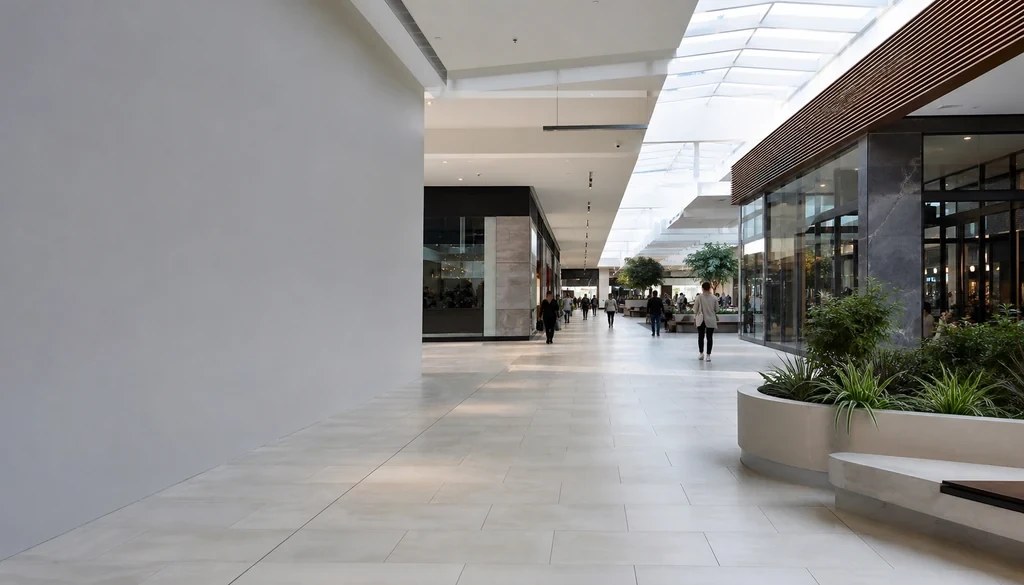
Distance is the variable people underestimate. This is the retail-specific problem. In a single-tenancy building, “we have a defibrillator” and “a defibrillator can reach the incident quickly” are close to the same statement. In a centre with two levels, a long mall run and a separate homemaker wing, they aren’t. Survival falls away sharply for every minute between collapse and the first shock. A device eight hundred metres and a travelator away from a collapse is, in practical terms, a device you don’t have.
So the real question in a centre isn’t do we have one. It’s how long does it take to get one to any point in the property, carried by someone who’s panicking. Walk it with a stopwatch. That number is your answer on how many you need and where they go.
Ambulance response is a Sydney metro number, and that’s fine. The delay trigger generally won’t be what carries a metro centre’s assessment. Be honest about that rather than inflating it — the footfall trigger is strong enough on its own, and a risk assessment that overstates one factor is easier to pick apart than one that doesn’t. Regional centres are a different conversation, because out there the delay trigger applies permanently rather than occasionally.
The bit that’s genuinely complicated: who’s responsible
Retail centres have overlapping duty holders and no NSW rule that sorts them out. South Australia solves this with a statutory “owner”. NSW doesn’t.
What you actually have is multiple PCBUs — the centre owner, the managing agent, and every tenant operating a business in the property — each holding a duty to the extent they have management or control. Common mall areas sit with whoever controls them, which is almost always centre management. Individual tenancies sit with the retailer.
In practice that means the sensible allocation is:
- Centre management covers the common areas. Concourses, food courts, entries, travelator landings, the areas nobody else controls. This is where the devices should live, because it’s where the people are and where access isn’t gated by a tenant’s trading hours.
- Large-format and anchor tenants make their own call for their internal floor area, particularly if they’re big enough that the mall devices are a long way from their back-of-house.
- Somebody owns maintenance in writing. The failure mode in shared arrangements isn’t a missing device, it’s a device nobody is checking because two parties each assumed the other was.
Get that written into the centre’s emergency response procedures rather than agreed verbally. Overlapping duties are only a problem when nobody has written down who does what.
Placement, specifically for a centre
- Spread them, don’t cluster them. Coverage across the property beats a good device in a great spot.
- Put them where the crowd is, not where the office is. Food courts, main concourse intersections, near the busiest entries. Not the centre management corridor behind a swipe card.
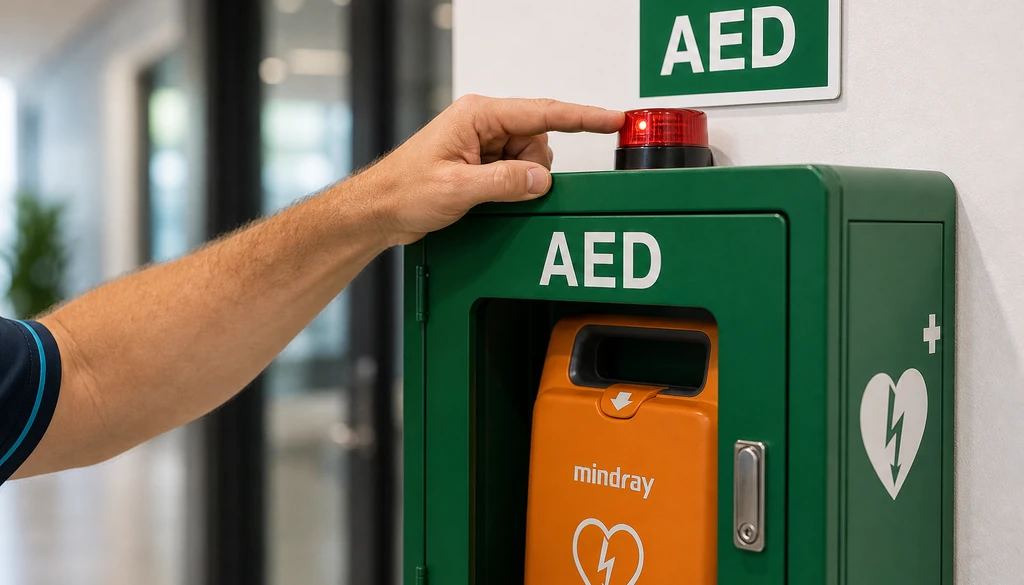
- Unlocked, always. Not in a cabinet needing a key or code. If theft is a real concern, use an alarmed cabinet under camera coverage rather than a locked one.
- Mount at 1.2 to 1.4 metres, with signage that reads from a distance down a long mall run.
- Brief the people who’ll actually be first there — centre security and cleaning staff, who are mobile and everywhere, are usually the most valuable group to train.
- Check trading hours. If the property has a 24-hour gym or late-trade tenancy in one wing, the nearest device to it needs to be reachable when the rest of the centre is shut.
On specification, NSW Health’s guidance for organisations is the sensible baseline: TGA approved, two sets of pads, shears and a razor in the cabinet, and IP55 or above for anything mounted outdoors or in a semi-exposed entry. Adult and paediatric compatibility is worth having in a centre, given who’s in the crowd.
Register it, and know what that gets you
NSW Ambulance runs the state AED registry through the GoodSAM platform. Registration is free, voluntary, and there’s no NSW law requiring it.
It’s still worth doing. Registered devices are visible to Triple Zero call-takers and to GoodSAM responders nearby, which means your device can be directed to an incident. For a centre with multiple units, register them all — you contact NSW Ambulance directly rather than doing them one by one through the app. Our GoodSAM registration walkthrough covers the process.
One honest caveat: registering makes the device findable, it doesn’t make it available. If your devices sit inside a property that locks at 6pm, that’s what the register will reflect. Fill in the accessibility hours accurately rather than optimistically.
Where this lands
No NSW centre has to install a defibrillator. But the Code names public numbers as a trigger, a retail centre is the clearest example of that trigger in the state, and the crowd you’re responsible for is the demographic most likely to need the device.
The decision worth making carefully isn’t whether. It’s how many and where, and that comes out of walking your own property with a stopwatch rather than a rule of thumb.
If you’d like help sizing that for a centre — coverage mapping, cabinet spec for public areas, and a maintenance routine that doesn’t fall between the owner and the agent — we install and maintain defibrillators for commercial property across New South Wales. Start at our New South Wales page.