Every argument for a defibrillator eventually comes down to one number: how long between someone collapsing and a shock being delivered. On land, that’s a question about ambulance response. On a boat off the Tasman Peninsula, it isn’t a response time at all. It’s a return leg.
That’s the sharpest version of the case anywhere in Tasmania, and it’s why marine tourism operators are worth treating as their own conversation rather than a footnote to the wilderness piece.
The legal position, briefly
Tasmania has no defibrillator law. There’s no equivalent to South Australia’s Act, and a check of the Bills introduced into the Tasmanian Parliament in 2026 turns up nothing mentioning defibrillators, AEDs or automated external anything. We re-checked before writing this. No mandate, no deadline, no penalty.
What applies is the Work Health and Safety Act 2012 (Tas) and the WHS Regulations 2022 — the standard first aid duty on every PCBU to provide equipment, make it accessible, provide facilities where appropriate, and have enough trained people.
The detail is in WorkSafe Tasmania’s First Aid in the Workplace Code of Practice, effective 27 May 2020, which follows the Safe Work Australia model wording:
“You should consider providing an AED if there is a risk to workers at your workplace from electrocution, if there would be a delay in ambulance services arriving at the workplace, or where there are large numbers of members of the public.”
Should consider. Not must install. Failing to provide one isn’t an offence in Tasmania. The foundation piece has the general position: do Tasmanian commercial buildings need an AED in 2026.
One thing to note before going further: this article is about the workplace safety duty, which is the framework we know. If you operate a domestic commercial vessel, you also sit under national marine safety requirements and your own safety management system, and what those require of your first aid equipment is a question for your survey requirements and AMSA directly. Don’t take a WHS article — this one included — as a statement of what your marine obligations are.
“Delay in ambulance services” means something different at sea
The Code’s second trigger was written with a road ambulance in mind. Apply it to a vessel and it changes character entirely.
When someone arrests on your boat, no ambulance is coming to you. The sequence is: recognise it, radio it, and start heading back — while doing CPR on a moving deck. The clock that matters isn’t dispatch to arrival. It’s the time to your berth or to a rendezvous, plus the time for the crew to get down to the vessel.
For a half-day dive charter off Eaglehawk Neck or a wildlife cruise out of Port Arthur, that’s rarely under thirty minutes and frequently a good deal more. For anything working the west coast, the Furneaux Group, or a full-day run, you’re well past the window in which a shock does much good.
Survival after cardiac arrest falls away sharply for every minute without defibrillation. CPR extends the window — it’s genuinely worth doing and it buys real time — but it doesn’t restore a rhythm. Only a shock does that. Which means that on a vessel, more than in any building in the state, the device either travels with you or it plays no part in the outcome.
That’s not a compliance argument. It’s just what the situation is. The Code names charter boats and dive operations among the settings where this trigger applies, and it’s hard to argue with.
The third trigger applies too, and the demographic is against you
Marine tourism also puts “large numbers of members of the public” on the deck, and the specific public matters.
Tasmania’s charter and cruise market skews heavily toward older domestic and international visitors — the demographic where cardiac risk is highest. They’ve often travelled to get there, sometimes slept badly, sometimes had a big day already. Some are on medication regimes that have been disrupted by travel. Dive operations add physical exertion and cold-water immersion for a customer base that frequently includes people well past their certification prime.
None of that makes an event likely on any given trip. It does mean the population on your vessel is not the same as the population in an office, and a risk assessment that treats twenty retirees on a four-hour cruise as equivalent to twenty office workers has got something wrong.
The wider tourism version of this argument is in our pieces on wilderness and tourism ambulance delay and accommodation, wineries and cellar doors. The marine setting is the same reasoning with the response time stretched.
Specification: the marine environment is the hard part
On land, IP rating is a footnote. On a working vessel it’s the whole specification conversation, and it’s where most of the practical decisions sit.
Salt is the problem, not water. Salt air corrodes, and it does it continuously, not just when something gets splashed. A device stored in an open wheelhouse on a boat that works six days a week is in a genuinely harsh environment.
What that means in practice:
- IP55 or above as the baseline for anything not in a fully enclosed dry space. Higher if it’s exposed.
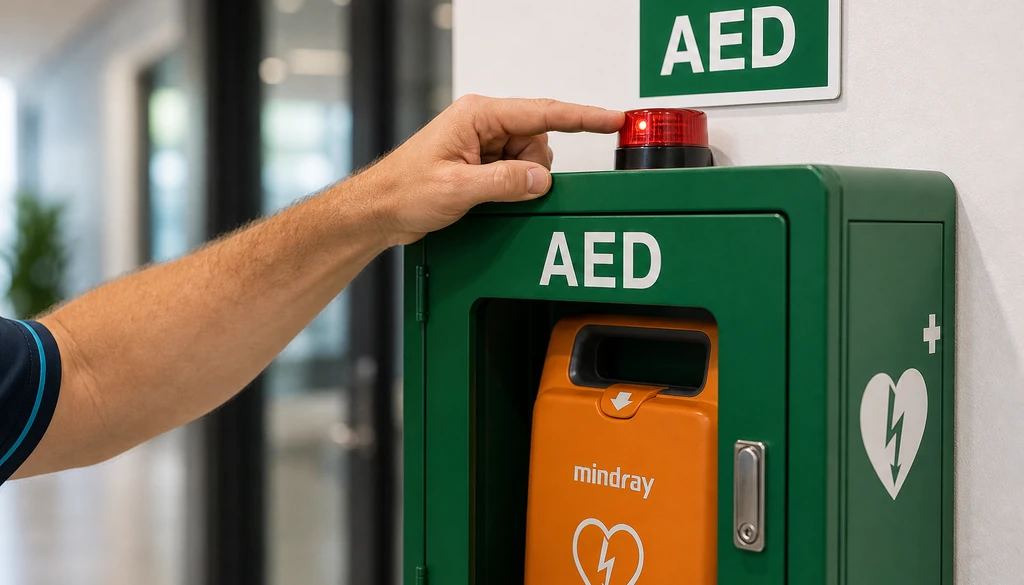
- A sealed, mounted case rather than a soft bag in a locker. It needs to be findable and secured against a rolling deck, not stowed under something.
- Somewhere dry and accessible, and those two often conflict. The wheelhouse usually wins. A device locked in a cabin nobody can reach quickly in a seaway is the wrong answer even if it stays drier there.
- Check it far more often than a shore-based site would. Corrosion on contacts and connectors is a marine-specific failure mode. Pads and battery still expire on their own schedule regardless.
- Confirm the manufacturer’s operating range and storage conditions suit the vessel, and keep the paperwork with the safety gear.
The generic advice about mounting height and unlocked cabinets is mostly written for buildings. On a boat, the useful version is: fixed, visible, reachable in seconds by whoever is nearest, and known to every crew member from day one.
Crew, not customers
On a building site or in a shopping centre, the theory is that anyone might grab the device. On a vessel, realistically it’s your crew, and often a crew of two or three.
Defibrillators are designed for untrained users and talk you through it — that’s true and it matters. But the marine setting has complications no voice prompt covers: doing effective CPR on a moving deck, deciding whether to turn back or continue to a rendezvous, and running the radio while managing a casualty and a boatload of frightened passengers.
That’s a drill, not a device. Worth running it as one, the same way you run your other emergency drills, so the first time someone thinks about where the device is isn’t the day it matters.
Registration, and its honest limits
Ambulance Tasmania runs AED registration in partnership with GoodSAM. It’s free and voluntary — no Tasmanian law requires it — and registered devices also appear on the public LISTmap layer. Tasmania has more than 1,300 publicly accessible registered AEDs, which is a strong footprint for the population.
Should a charter operator register? Yes, with a caveat.
The value of the registry is that a Triple Zero call-taker or nearby responder can find a device near an incident. That logic works for a fixed device at your office, your booking hut or your berth. A device that spends its working day moving around the water isn’t going to be findable that way, and the registry has availability and location fields you should fill in honestly rather than optimistically.
The genuinely useful version for a marine operator: if you have a shore base — a booking office, a dive shop, a jetty facility — consider a second device there, mounted externally and registered. That one serves the public and the map. The one on the boat serves the boat.
Funding, honestly
Tasmania’s community AED funding is real but it’s not aimed at you.
The Tasmanian Government’s Community AED Fund committed $500,000 to deliver 180 free devices over two years. Round 2 closed on 31 January 2026, the commitment is fully allocated, and no further round has been announced. St John Ambulance Tasmania’s Safe Community Grant runs separate rounds for community groups and charities, with a preference for externally mounted, publicly accessible devices, and its AED funding was fully committed at last check.
Both are community and not-for-profit programs. A commercial charter or dive business is unlikely to qualify for either. The general sport and recreation grants — Levelling the Playing Field, Ticket to Play, the junior travel programs — don’t fund defibrillators at all, whatever a supplier tells you. We went through the full picture in funding an AED for your Tasmanian sporting club.
For a commercial operator this is a business purchase. The realistic framing is that it’s a modest one-off against a vessel’s annual running costs, and it sits in the same category as your other safety equipment.
Where this lands
No Tasmanian charter boat or dive operator is required to carry a defibrillator under work health and safety law. But the Code’s delay trigger was written for exactly this kind of situation, and at sea it applies harder than anywhere on land, because the delay isn’t a response time you’re waiting out — it’s a distance you have to cover yourself.
Check what your vessel survey and safety management system require separately. Then make the WHS call on its own merits, which for most operators working any distance offshore isn’t a close one.
If you’d like help specifying a device and enclosure that will survive a Tasmanian working vessel, and setting up a check routine that catches corrosion as well as expiry dates, we supply and maintain defibrillators across Tasmania. Start at our Tasmania page.