Of the three things that are supposed to make you stop and think about a defibrillator, construction sites and electrical work tick the first one outright. Not as a stretch, not as a marketing angle — it’s the example the regulator leads with.
That still doesn’t make a defibrillator compulsory on a Western Australian site. Nothing does. But the gap between “not required” and “hard to justify not having” is narrower here than on almost any other job.
What WA actually requires
There’s no Western Australian defibrillator Act, and no Bill has been tabled. We re-checked before writing this. WA sits alongside every state except South Australia on that: no mandate, no deadline, no penalty for not having one.
What does apply is the Work Health and Safety Act 2020 (WA), which commenced on 31 March 2022 — WA was the last state in the country to adopt the model WHS framework, replacing the old Occupational Safety and Health Act 1984. If your safety documentation still reads like it was written for the 1984 Act, that’s worth a look for reasons well beyond defibrillators.
Under the WHS Act and the WHS (General) Regulations 2022, a PCBU has to provide first aid equipment and make sure workers can access it, provide facilities where appropriate, and make sure enough people are trained. The operational detail sits in WorkSafe WA’s First Aid in the Workplace Code of Practice, published 14 July 2022.
Failing to install a defibrillator isn’t an offence in WA. Failing to discharge the broader first aid duty could be — but that’s a fact-based argument about your own risk assessment, not a specific AED rule. The foundation piece covers the general position: do Western Australian commercial buildings need an AED in 2026.
The one WA document worth reading properly
WorkSafe WA has published something most regulators haven’t: a standalone bulletin on workplace defibrillators. Health and Safety Bulletin No. 11 — Provision and maintenance of automated external defibrillators at workplaces, published 18 September 2023 and last updated 19 November 2024. We re-verified it before writing this; it’s still current and hasn’t been re-issued.
It’s short, and it does two things.
First, it names the three circumstances where a defibrillator should be considered — the same three as the model Code:
- Risk of electrocution to workers
- Likely delay in ambulance arrival
- Large numbers of members of the public present
On a construction or electrical job, the first one is the whole point and the second one applies the moment you’re outside the metro area.
Second — and this is the part that makes the bulletin unusual — WorkSafe wrote it because devices weren’t working when people reached for them. Flat batteries, expired pads, units that weren’t visible or accessible. The bulletin puts it plainly:
“Defibrillation is the only way to restore a heart with a fatal heart rhythm back to normal. As a consequence, if an AED fails to operate when used on a person who is in cardiac arrest, first aid will not be effective or reduce the risk of fatality.”
— WorkSafe WA, Health and Safety Bulletin No. 11
That’s a regulator saying the quiet part out loud: a defibrillator that hasn’t been maintained is not a half-measure, it’s nothing. Which matters more on a construction site than anywhere else, and I’ll come back to it.
Why electrocution is the trigger that carries the argument
The chain is short and it’s the reason this trigger exists at all. Electric shock across the chest can throw the heart into ventricular fibrillation. In fibrillation the heart isn’t pumping, and the only thing that restores a normal rhythm is a shock. CPR buys time. It doesn’t fix the rhythm.
So on a site where workers are around live boards, temporary supply, testing and tagging, plant, or anything high voltage, the specific hazard you’re managing has a specific piece of first aid equipment attached to it. That’s a cleaner risk-assessment line than most safety spending gets to draw.
Worth being precise about scope, though. This is the clinical and risk logic that feeds the reasonably-practicable test — it’s why the trigger is in the Code. It isn’t WorkSafe WA telling you an electrical contractor must have a defibrillator. They haven’t said that, and neither should anyone quoting them.
The same reasoning runs through mining, where WA has more of it than anywhere: AEDs on WA mining sites covers that setting. Note that the Work Health and Safety (Mines) Regulations 2022 do not mandate defibrillators either — the WA First Aid Code of Practice explicitly applies to workplaces under both the General and the Mines Regulations, and the same risk-assessed approach applies to both.
The second trigger, and why WA is different
In Perth, ambulance response is a metro number and the electrocution trigger does most of the work in your assessment.
Get outside the metro area and the delay trigger stops being a footnote. WA is 2.5 million square kilometres served by St John WA, and a site in the Wheatbelt, the Pilbara or the Goldfields is working to a fundamentally different response window than one in Osborne Park. Cardiac arrest survival drops away with every minute. When the honest answer to “how long until a paramedic has hands on this person” is measured in the tens of minutes, the on-site device stops being a supplement to the ambulance and becomes the only thing that happens inside the window that matters.
Two triggers stacking is the situation the Code is describing. Most regional WA construction work is in it. For genuinely remote sites, the relevant training unit is HLTAID013 — Provide first aid in remote or isolated site, not the standard workplace unit, and we’ve written about the extended version of this problem in FIFO camps and remote work sites.
The site-specific problem: keeping it working
Come back to Bulletin No. 11’s actual concern, because a construction site is the hardest environment in the state to keep a defibrillator ready in.
A site box in Karratha in February is an oven. Devices have manufacturer temperature ranges and pad adhesive gel degrades with heat — the number that matters is the temperature inside the box on the site, not the forecast for the town. Add red dust that gets into everything, vibration, and a device that moves with the job rather than living on a wall.
What holds up in practice:
- Specify the enclosure for the site, not the office. IP55 or above for anything outdoors or semi-exposed, and shaded rather than on a north-facing wall. That’s best practice and manufacturer guidance, not a WA regulation.
- Check the manufacturer’s stated operating range against your actual conditions. Not all devices are equal on heat, and the spec sheet is the place to settle it.
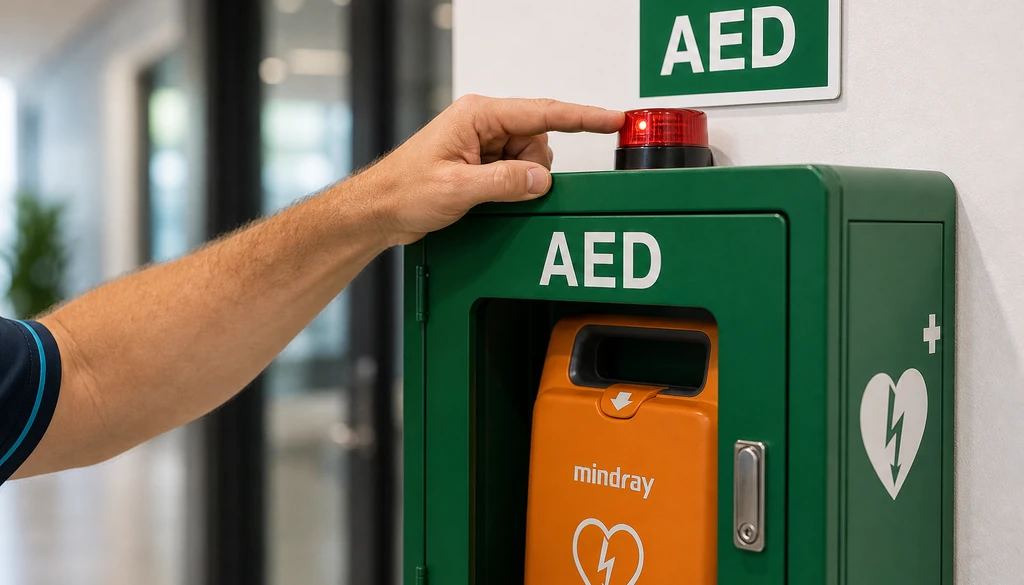
- Give the device a fixed home — the site office, the first aid point, the crib room — and mark it on the site plan and in the induction. A defibrillator whose location is tribal knowledge is a defibrillator nobody finds under pressure.
- Name a person, not a role in the abstract. Pads and batteries expire on a date, and on a site with rotating crews and a shifting supervisor, “someone checks it” means nobody does. This is precisely the failure WorkSafe wrote the bulletin about.
- Move it with the job and re-check it after each move. Handovers are where devices get left in a shed.
- Mount at 1.2 to 1.4 metres wherever it’s on a wall, unlocked. Never in a cabinet needing a key or code.
Register it with St John WA, not GoodSAM
This trips up eastern-states contractors working in WA constantly.
WA does not use GoodSAM. St John Ambulance WA is the contracted ambulance provider for the whole state — a non-government organisation delivering the service under contract to WA Health, not a government agency. It runs its own State Defib Network and the St John First Responder app, and that’s where WA devices get registered.
Registration is free and voluntary. No WA law requires it. When a Triple Zero call comes in, St John’s State Operations Centre can either alert a registered Community First Responder nearby or direct the caller to the closest registered device, using the State Defib Network data. Our walkthrough of St John WA registration has the process.
Honest note for a construction site: registration is worth more on a fixed commercial property than on a job that finishes in eight months. Your device is mostly there for your own people. Register it anyway — it costs nothing, and while the site is live it’s a device on the map in an area that may not have many — but update the record when the job moves and take it off when the site closes. A registry entry pointing at a device that isn’t there any more is worse than no entry.
Funding: there isn’t any, for you
Worth being direct. WA has no government AED grant for businesses.
The Lotterywest Heart Grant, delivered through St John WA, is the state’s significant AED funding story — around 1,001 devices subsidised to not-for-profit sporting and community groups at $249 a unit, with a condition that the device be publicly available 24/7. It’s a community program, commercial operators don’t qualify, and the application round was closed at last check.
The DLGSC sport and recreation programs — CSRFF, KidSport, Club Night Lights and the rest — don’t fund defibrillators and don’t list them as eligible items. WA has no equivalent to the NSW Office of Sport’s defibrillator grant.
For a construction business, this is a capital or consumables purchase, the same as any other piece of site safety equipment.
The short version
No WA construction site is required to have a defibrillator. But the regulator’s own bulletin names electrocution risk as the first reason to consider one, the trade is built around that hazard, and outside the metro area the ambulance-delay trigger stacks on top of it.
The bulletin’s real warning is worth taking more seriously than the installation question. A device on site that nobody has checked since the job started is a line item, not a control.
If you’d like help specifying an enclosure that survives a WA site, setting up a maintenance routine that survives crew turnover, and getting the device onto the St John network, that’s what we do. Start at our Western Australia page.