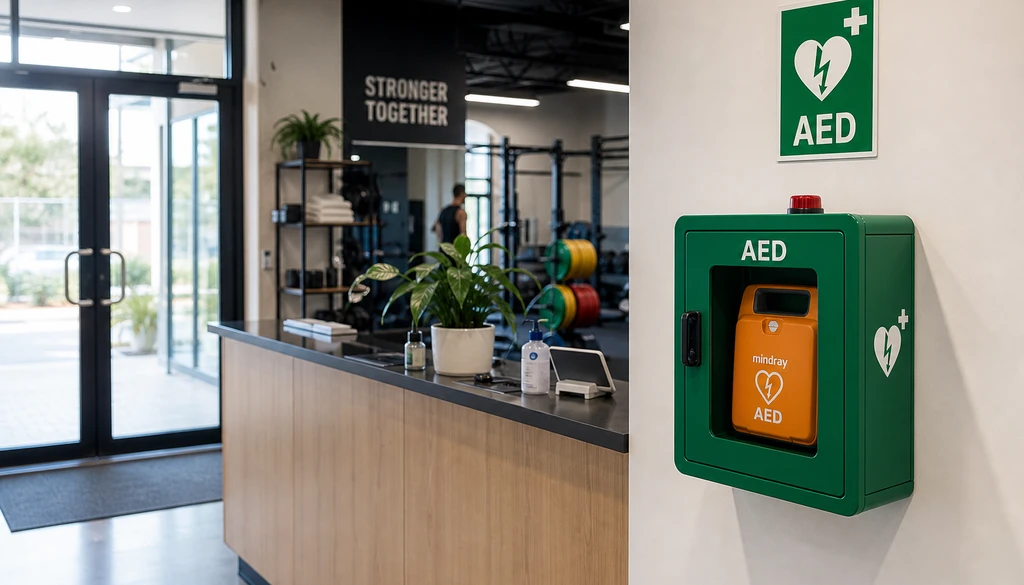
Queensland doesn’t require a defibrillator in a gym. There’s no Queensland AED Act, no Bill before Parliament, and failing to install one isn’t an offence in itself.
Cross the border into South Australia and the same business is legally required to have one. Gyms, yoga studios and Pilates studios are named as prescribed sporting facilities under the SA Act, so they need at least one device regardless of floor area.
Same equipment, same members, same risk. Different postcode, different answer. That’s worth knowing before someone tells you the law says you have to.
What Queensland has is a duty, and a code that tells you how to think about it.
What Queensland actually asks of you
The Work Health and Safety Act 2011 (Qld) puts the primary duty on the person conducting a business or undertaking: ensure, so far as is reasonably practicable, the health and safety of workers.
Regulation 42 of the WHS Regulation 2011 gives that duty its first aid shape. A PCBU has to provide first aid equipment and make sure each worker can get to it, provide first aid facilities where appropriate, and ensure an adequate number of workers are trained to administer first aid, or that workers have access to a sufficient number of trained people.
The First aid in the workplace Code of Practice 2021 is where defibrillators actually come up, and it treats them as a risk-based consideration rather than a required item. The Code points to three situations that should prompt you to consider one: where workers face a risk of electrocution, where there’d be a delay in ambulance services arriving, and where there are large numbers of members of the public present.
We re-checked the Bills register and the Code this month. Nothing has changed on either.
Which trigger actually applies to a gym
Be honest about this, because it shapes how you write the assessment.
Electrocution? No. Unless you’ve got an unusual plant room situation, this one isn’t yours.
Ambulance delay? Not in metro Brisbane, the Gold Coast or the Sunshine Coast. It’s a real factor for regional and remote Queensland clubs, and we’ve covered what ambulance distance does to the argument separately. For a suburban gym it isn’t the trigger.
Large numbers of members of the public? Yes. This is the one that carries it. A busy fitness centre moves hundreds of people through in a day and they’re members of the public, not your workers.
So the Code’s own trigger applies. What the Code doesn’t do is say anything about the specific thing that makes a gym different from a shopping centre with the same head count, and that’s the bit you put in your own risk assessment.
The bit you have to write yourself
Your risk assessment is where you record what’s particular about your site. For a gym, three things are worth writing down.
People are exerting themselves near their limit. That’s the entire point of the business. A cardiac event in a gym isn’t happening to someone sitting in a food court. It’s happening to someone who has deliberately pushed their heart rate up, often on a machine, often with headphones in and nobody watching.
Your membership isn’t uniformly young. Most centres have a strong over-fifties cohort, particularly in off-peak hours and in the rehab, group fitness and older-adult programs a lot of clubs run to fill the middle of the day.
People arrive with conditions you don’t know about. A health questionnaire at sign-up is a snapshot from the day they joined, not a live picture. You cannot risk-assess your way to knowing who in the room is at risk.
None of that is a legal requirement. All of it is exactly the sort of material the risk assessment route expects you to consider, and it’s why “we’re a gym so we have a defibrillator” is a defensible sentence even in a state that doesn’t demand it.
The 24-hour gym problem
If your site is staffed all opening hours, this section doesn’t apply to you. If it isn’t, it’s the most important part of the page.
A lot of Queensland fitness centres run staffed hours in the morning and evening and swipe-card access the rest of the time. That model creates a specific gap:
There is nobody to call for. Regulation 42’s first aid limb is built around workers having access to first aid equipment and to trained people. At 11pm in an unstaffed gym, “access to a trained first aider” means the other two members on the floor.
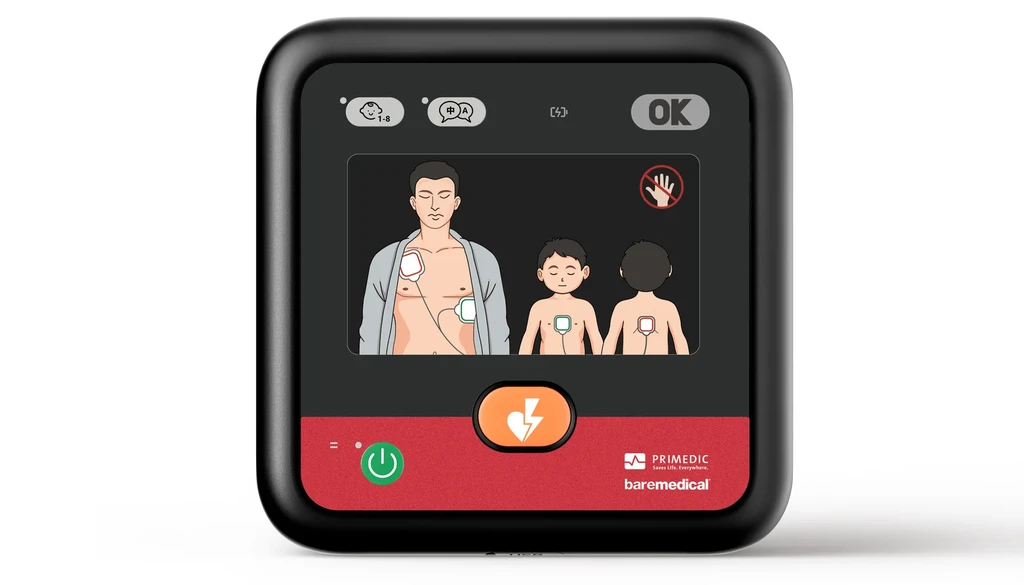
A device behind the counter is a device that doesn’t exist. If your defibrillator lives in the staff office and the staff office is locked at 8pm, you’ve bought a compliance ornament. On an unstaffed floor it has to be wall-mounted, in the open, visible from the training area.
Signage does more work than usual. A member who’s never noticed the device isn’t going to find it in the ninety seconds that matter. It needs to be somewhere people walk past every single visit, with a sign they’ve seen a hundred times without thinking about it.
This is the setting where a wall-mounted unit genuinely earns its place, because there’s no reception desk in the chain at all. It’s the member, the device, and the phone.
Registering with QAS, and why the fine print helps you here
Queensland Ambulance Service runs a voluntary AED register through the Queensland Government website. There’s no law requiring registration, and it isn’t linked to any compliance obligation.
QAS is upfront about the limit of what it does:
“Your AED location details will only notify the EMD if the suspected cardiac arrest occurs at your business or property. It will not generate an alert for calls from nearby businesses or properties.”
That’s a real difference from New South Wales and Victoria, which both run GoodSAM-integrated registries that alert nearby responders. Queensland’s register doesn’t do that, and we’ve written about why the QAS register behaves differently if you want the detail.
For a gym, though, that limitation barely costs you anything. The arrest you’re planning for is the one on your own floor, and that’s precisely the case QAS covers. Register the device with its real location and its real access hours. If the gym is 24-hour, say so.
Specifying for Queensland
Two practical notes that come up on every Queensland install.
Heat and humidity are a specification input, not a footnote. Devices and pads both have stated operating ranges. If a unit is going anywhere semi-outdoor — a covered functional training area, an outdoor rig, a poolside deck — check the manufacturer’s range against the conditions and use an enclosure rated for it. IP55 or above is sensible practice for outdoor and semi-outdoor placement. That’s industry practice, not a Queensland regulation, and it shouldn’t be presented as one.
Mount it where people already look. Between 1.2 and 1.4 metres off the floor, in the highest-traffic sightline closest to the highest-risk area. In most gyms that’s the wall between reception and the cardio floor, not the corridor to the toilets.
Funding, honestly
Queensland doesn’t have a dedicated government AED grant program. New South Wales has one for local sport and Victoria has an emergency sporting equipment stream. Queensland doesn’t.
What exists is more limited:
- Active Clubs grants of $2,500 to local and regional sport and active recreation organisations, with equipment as an eligible category. The guidelines don’t name defibrillators, so confirm eligibility with the department before you count on it.
- Alpha Sport’s Heart Starter grant ($500) subsidises an AED package, available to community sporting clubs including Queensland Rugby League clubs through a QRL partnership.
- Project Defib, a national program subsidising units for sports clubs.
All three are aimed at community clubs and not-for-profits. A commercial fitness business is unlikely to qualify for any of them, which is worth knowing before you spend a fortnight on an application. We’ve covered the club funding routes in full for the organisations that do qualify.
What to do with this
If you run a gym in Queensland, nothing here obliges you to buy anything. What it does is make the assessment straightforward.
Write down who uses your floor, when it’s unstaffed, how far the nearest ambulance realistically is, and what you decided. If the decision is to install, put the device where an unassisted member can find it, register it with QAS, and give it to a named person to check monthly so the pads don’t quietly expire.
If the decision is not to install, write down why. That’s the document that matters.
We install and maintain defibrillators for commercial sites across Queensland, including QAS registration and ongoing servicing. Start at our Queensland page, or read whether Queensland commercial buildings need an AED at all for the wider picture.